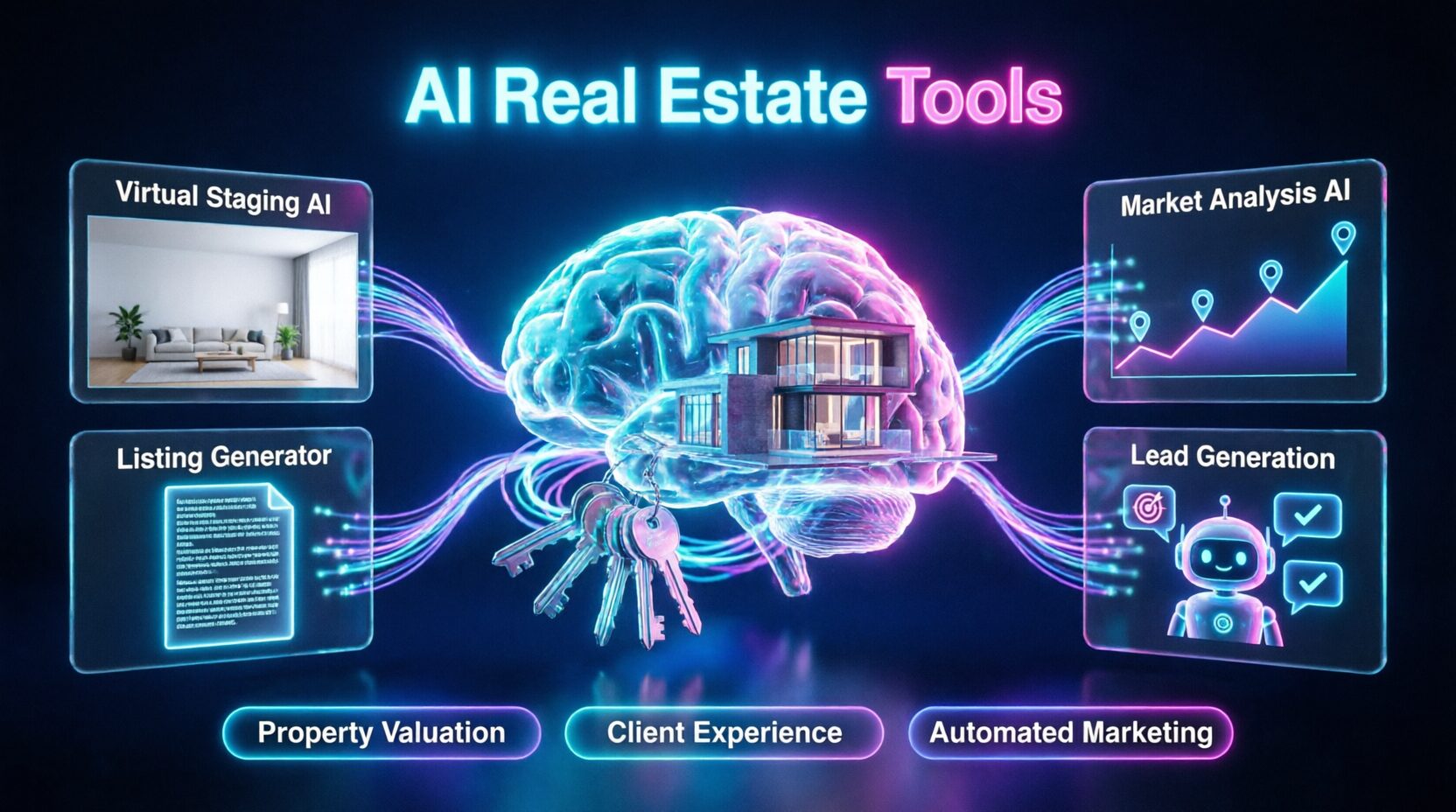
Mastering the deployment of AI real estate tools is the absolute best way to ensure your agency or independent practice navigates the highly competitive property market with unprecedented speed, precision, and client engagement. In an era where buyer expectations are higher than ever, and inventory turnover demands rapid response times, relying on manual listing creation, outdated comparative market analyses, and reactive lead follow-up is no longer a viable strategy for sustainable growth. Today, forward-thinking brokers, agents, and property managers are leveraging advanced AI real estate tools to automate tedious workflows, generate hyper-accurate valuations, and deliver personalized, 24/7 client experiences. However, navigating the rapidly expanding landscape of PropTech requires strategic foresight. If you are looking to understand exactly how to evaluate these platforms and select the right AI real estate tools to future-proof your business, you are in the right place.
This comprehensive guide demystifies the technological horizon of modern property sales and management. We will explore the core capabilities of an AI property listing generator, detail how AI virtual staging tools are transforming property marketing, and provide a strategic blueprint for integrating real estate market analysis AI. By the end of this article, you will have a clear, actionable framework for evaluating the best AI real estate tools, understanding the nuances of AI lead generation in real estate, and choosing the perfect technology stack that delivers maximum ROI and closed deals.
1. The Property Revolution: Why AI Real Estate Tools in 2026
Historically, the real estate industry has been characterized by heavy reliance on manual data entry, subjective property valuations, and time-intensive, in-person showings. As the volume of property data, digital marketing channels, and the demand for instant communication have grown exponentially, this traditional model has become economically unsustainable and prone to lost opportunities. The emergence of sophisticated Machine Learning (ML), Computer Vision, and Natural Language Processing (NLP) has introduced a paradigm shift.
Understanding how to leverage AI real estate tools is critical because the gap between AI-native brokerages and legacy agencies is widening rapidly. Professionals who fail to modernize their workflows risk severe inefficiencies, inaccurate pricing, and losing high-intent buyers to more responsive competitors. The shift from basic CRM automation to cognitive, context-aware AI real estate tools represents a monumental upgrade in capability. Modern systems do not just store client data; they comprehend buyer intent, predict market shifts, and proactively match properties to clients before they even hit the open market. According to a 2026 National Association of Realtors (NAR) Technology Survey, agencies that successfully integrate advanced AI real estate tools into their core operations report a 45% increase in lead conversion rates and a 30% reduction in time spent on administrative listing tasks.
2. Core Capabilities: What to Look for in AI Real Estate Tools
To make informed technology investments, you must first understand the primary drivers behind modern AI real estate tools. These solutions typically leverage a combination of predictive analytics, generative AI, and computer vision to transform raw property data into structured, highly compelling marketing and sales assets.
Predictive Analytics and Automated Valuation: Unlike legacy systems that rely on simple, backward-looking comparables, modern AI real estate tools analyze thousands of data points—including hyper-local market trends, school district ratings, and even neighborhood sentiment—to generate highly accurate, real-time AI property valuation outputs. This allows agents to price homes competitively and confidently from day one.
Generative AI for Marketing and Staging: Advanced AI real estate tools utilize generative models to instantly create high-quality, engaging content. From drafting compelling, SEO-optimized listing descriptions to digitally furnishing empty rooms with photorealistic AI virtual staging tools, these platforms drastically reduce the time and cost associated with traditional property marketing.
3. Top Contenders: Evaluating the Best AI Real Estate Tools for Agents
When searching for the best AI real estate tools, several platforms consistently rise to the top due to their balance of accuracy, ease of use, and deep industry-specific expertise.
Structurely is widely regarded as a pioneer in conversational AI for real estate. Its real estate chatbot software acts as an inside sales agent, engaging website visitors 24/7, qualifying leads, and seamlessly scheduling appointments directly into the agent’s calendar, making it one of the most effective AI lead generation real estate platforms available.
Restb.ai specializes in computer vision for real estate. Its AI virtual staging tools and automated photo tagging capabilities can instantly identify room types, architectural styles, and key features in property photos, while also allowing agents to virtually stage empty rooms in multiple design aesthetics with a single click.
Revaluate excels in predictive analytics. As a premier real estate market analysis AI platform, it scores and ranks a broker’s entire database of past clients and leads based on their likelihood to buy or sell in the next 6-12 months, allowing agents to focus their efforts on the highest-probability opportunities.
4. Streamlining Marketing: AI Property Listing Generators and Automated Listing Descriptions
The true value of AI real estate tools extends beyond high-level strategy; it is a game-changer for the daily operational efficiency of listing agents, directly combating burnout and accelerating time-to-market.
Frictionless Listing Creation: Gone are the days of staring at a blank screen trying to craft the perfect property description. An advanced AI property listing generator allows an agent to input a few basic details (e.g., “3 bed, 2 bath, modern kitchen, near downtown”). The tool instantly generates multiple variations of automated listing descriptions, tailored to different target demographics (e.g., young families, luxury buyers, or investors), complete with engaging emojis and SEO-friendly keywords.
Dynamic Virtual Staging: Traditional physical staging can cost thousands of dollars and take weeks. Modern AI virtual staging tools allow agents to upload photos of an empty property and instantly populate the rooms with high-end, photorealistic furniture. Some tools even offer “virtual renovation,” allowing agents to show buyers the potential of a dated property by digitally updating flooring, paint colors, and fixtures.
5. Enhancing Client Experience: Real Estate Chatbot Software and AI Home Search Tools
While operational efficiency is critical, the scope of AI real estate tools extends deeply into the client experience, making property discovery more personalized and responsive.
Intelligent 24/7 Lead Engagement: Advanced real estate chatbot software does more than just answer FAQs. It can engage visitors in natural, human-like conversations, ask qualifying questions about their budget, timeline, and must-haves, and instantly notify the listing agent via SMS when a high-intent lead is identified. This is the cornerstone of modern AI-led real estate generation.
Personalized Property Matching: Next-generation AI home search tools go beyond simple filter-based MLS searches. They learn from a buyer’s behavior—which homes they linger on, which features they click—and proactively push highly personalized property recommendations to their inbox or mobile app, often surfacing off-market or newly listed properties that perfectly match their implicit preferences.
6. Strategic Implementation: Best Practices for Adopting AI Real Estate Tools
Ultimately, adopting AI real estate tools is not a simple plug-and-play operation; it requires a strategic, phased approach to ensure high adoption rates among agents and measurable ROI, all while maintaining strict data compliance.
Seamless CRM and MLS Integration: To drive adoption, new AI real estate tools must integrate seamlessly with the software your team already uses. Look for solutions that offer robust, native API connections to major CRMs (e.g., Follow Up Boss, LionDesk) and local MLS systems to ensure a single source of truth and prevent workflow fragmentation.
Change Management and Agent Upskilling: The introduction of advanced AI can sometimes trigger anxiety among agents who may view it as a threat to their traditional role or a complex new hurdle. Successful implementation of AI real estate tools requires robust change management. Frame the technology as an “AI co-pilot” designed to eliminate tedious administrative tasks. Invest in upskilling your team to become “AI supervisors” who validate outputs, add the crucial human touch of empathy and negotiation, and focus on high-value client relationships.
Data Privacy and Compliance: When handling sensitive client financial and personal data, security is non-negotiable. Prioritize vendors that offer enterprise-grade security certifications and ensure the vendor’s terms explicitly state that your client data and proprietary listings will not be used to train their public, third-party models.
7. Comprehensive Query Coverage
What are the primary benefits of AI real estate tools? The primary benefits of AI real estate tools include a drastic reduction in administrative listing time, highly accurate and data-backed property valuations, 24/7 automated lead qualification, and the ability to generate stunning, cost-effective virtual staging and marketing materials instantly.
How does an AI property listing generator differ from a standard template? A standard template is static and generic. An AI property listing generator dynamically crafts unique, engaging, and SEO-optimized automated listing descriptions based on the specific features, location, and target demographic of the individual property, ensuring each listing stands out.
What should I look for in real estate market analysis AI? When evaluating real estate market analysis AI, look for platforms that offer hyper-local neighborhood insights, predictive pricing trends, automated comparative market analysis (CMA) generation, and seamless integration with your existing CRM or MLS data feeds.
Can real estate chatbot software replace human agents? No. Real estate chatbot software handles the repetitive, initial stages of lead capture, qualification, and appointment scheduling. However, human empathy, negotiation skills, and local market expertise remain essential for closing deals and guiding clients through complex transactions. The AI augments the agent; it does not replace them.
How do I ensure data security when using AI home search tools or lead generation platforms? To ensure data security with AI real estate tools, select vendors that offer end-to-end encryption, strict role-based access controls, and contractual guarantees that all client interactions and data are anonymized and will not be used for third-party model training.
Conclusion
Mastering AI real estate tools is no longer just a task for the tech-savvy early adopter; it is a strategic imperative for brokers, team leaders, and independent agents alike. By moving beyond manual processes and understanding the nuances of AI property listing generators, real estate market analysis AI, and AI virtual staging tools, you can ensure your practice operates with unprecedented speed, accuracy, and client-centricity.
Whether you are searching for real estate chatbot software to capture after-hours leads or aiming to automate your entire comparative market analysis pipeline with advanced AI property valuation tools, the key to success lies in aligning the vendor’s technological capabilities with your specific workflow and compliance requirements.
As artificial intelligence continues to evolve, the predictive and generative capabilities of these systems will only deepen, making sophisticated property intelligence accessible and indispensable for professionals of all sizes. Embrace the power of intelligent AI real estate tools today, and position your business at the absolute forefront of the modern PropTech revolution.