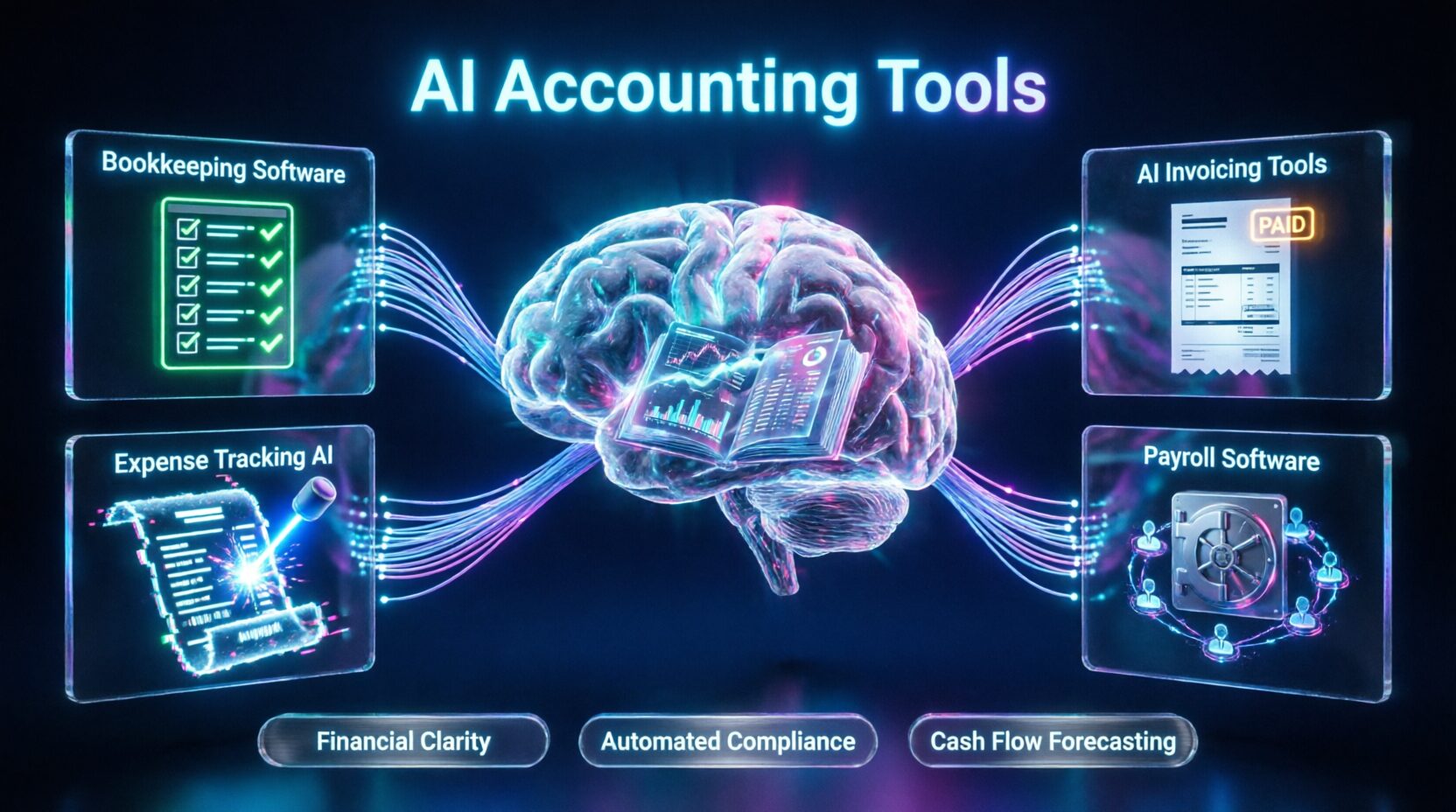
Mastering the deployment of AI accounting tools is the absolute best way to ensure your business navigates complex financial landscapes with unprecedented speed, accuracy, and strategic foresight. In an era where small businesses and enterprises alike are drowning in manual data entry, fragmented spreadsheets, and compliance headaches, relying on traditional, labor-intensive bookkeeping is no longer a viable strategy for sustainable growth. Today, forward-thinking CFOs, controllers, and small business owners are leveraging advanced AI accounting tools to automate tedious workflows, extract actionable financial insights, and mitigate audit risks at scale. However, navigating the rapidly expanding landscape of financial technology requires strategic foresight. If you are looking to understand exactly how to evaluate these platforms and select the right solutions to future-proof your financial operations, you are in the right place.
This comprehensive guide demystifies the technological horizon of modern finance. We will explore the core capabilities of AI bookkeeping software, detail how automated expense tracking AI is transforming daily operations, and provide a strategic blueprint for integrating AI financial reporting tools. By the end of this article, you will have a clear, actionable framework for evaluating the best AI accounting tools, understanding the nuances of AI tax preparation software, and choosing the perfect technology stack that delivers maximum ROI and financial clarity.
1. The Financial Revolution: Why AI Accounting Tools Matter in 2026
Historically, the accounting and bookkeeping function was defined by manual data entry, end-of-month crunches, and reactive financial analysis. As the volume of transactions, regulatory requirements, and the need for real-time financial visibility have grown exponentially, this traditional model has become economically unsustainable and prone to costly human error. The emergence of sophisticated Machine Learning (ML), Optical Character Recognition (OCR), and Natural Language Processing (NLP) has introduced a paradigm shift.
Understanding how to leverage AI accounting tools is critical because the gap between AI-native finance teams and legacy practices is widening rapidly. Organizations that fail to modernize their financial workflows risk severe inefficiencies, cash flow blind spots, and compliance penalties. The shift from basic rule-based automation to cognitive, context-aware AI accounting tools represents a monumental upgrade in capability. Modern systems do not just categorize transactions; they comprehend financial intent, predict cash flow shortages, and proactively flag anomalies. According to a 2026 Gartner Report on AI in Finance, organizations that successfully integrate advanced AI accounting tools into their core operations report a 60% reduction in manual bookkeeping hours and a 45% improvement in financial forecasting accuracy.
2. Core Capabilities: What to Look for in AI Bookkeeping Software
To make informed technology investments, you must first understand the primary drivers behind modern AI bookkeeping software. These solutions typically leverage a combination of machine learning, robotic process automation (RPA), and advanced analytics to transform unstructured financial data into structured, actionable insights.
Intelligent Transaction Categorization: Unlike legacy systems that rely on rigid, user-defined rules, modern AI bookkeeping software learns from historical data. It can accurately categorize a complex vendor payment (e.g., distinguishing between a software subscription and a capital equipment purchase) with over 95% accuracy, continuously improving its precision as it processes more data.
Predictive Cash Flow and Anomaly Detection Advanced AI accounting tools go beyond historical reporting to provide predictive insights. By analyzing thousands of historical transactions and market trends, these systems can forecast future cash flow scenarios and instantly flag unusual spending patterns, duplicate invoices, or potential fraud before a definitive financial loss occurs.
3. Top Contenders: Evaluating the Best AI Accounting Tools for Small Business
When searching for the best AI accounting tools, several platforms consistently rise to the top due to their balance of accuracy, ease of use, and deep financial domain expertise.
QuickBooks (with AI-powered features): QuickBooks remains a dominant force, heavily augmented by its new AI capabilities. Its small business accounting AI features include automated receipt capture, smart transaction categorization, and AI-driven cash flow forecasting, making it a comprehensive, all-in-one solution for growing enterprises.
Botkeeper is a pioneer in automated, AI-driven bookkeeping. It combines machine learning with human CPA oversight to provide a highly accurate, scalable AI bookkeeping software solution. It excels at handling high-volume transaction categorization and generating real-time financial dashboards for multiple entities.
Vic.ai focuses heavily on the accounts payable (AP) space. Its autonomous accounting platform uses deep learning to process invoices, match them to purchase orders, and route them for approval without human intervention, representing the pinnacle of AI invoice processing automation.
4. Streamlining Operations: Automated Expense Tracking AI and Receipt Scanning AI
The true value of AI accounting tools extends beyond high-level strategy; it is a game-changer for daily operational efficiency, particularly in managing employee expenses.
Frictionless Receipt Capture: Gone are the days of shoeboxes full of crumpled paper. Modern receipt scanning AI allows employees to simply snap a photo of a receipt via a mobile app. The AI instantly extracts the vendor, date, total amount, and tax, categorizing the expense and matching it to the correct corporate card transaction in seconds.
Proactive Policy Enforcement: Automated expense tracking AI doesn’t just record data; it enforces company policy. If an employee submits an expense that exceeds the per diem limit or falls outside of approved categories, the AI instantly flags it for manager review, preventing non-compliant spend before it hits the general ledger.
5. Beyond the Basics: AI Invoicing Tools and AI Payroll Software
While transaction management is a major use case, the scope of AI accounting tools extends deeply into revenue operations and human resources.
Dynamic AI Invoicing Tools Modern AI invoicing tools do more than just generate a PDF. They analyze customer payment histories to predict the likelihood of late payments. Based on this data, the AI can automatically trigger personalized, strategically timed payment reminders or even suggest dynamic early-payment discounts to improve Days Sales Outstanding (DSO).
Compliant AI Payroll Software: Navigating multi-state or international payroll is a compliance minefield. Advanced AI payroll software automatically updates tax tables, calculates complex withholdings, and flags potential misclassification risks (e.g., W-2 employee vs. 1099 contractor) before payroll is finalized, drastically reducing the risk of costly regulatory penalties.
6. Strategic Implementation: Best Practices for AI Financial Reporting Tools
Ultimately, adopting AI financial reporting tools is not a simple plug-and-play operation; it requires a strategic, phased approach to ensure high adoption rates among finance professionals and measurable ROI.
Data Hygiene and Chart of Accounts Standardization: AI models are only as good as the data they are fed. Before implementation, organizations must clean their historical financial data and standardize their Chart of Accounts. Clean, well-organized historical data is the fuel that powers accurate AI accounting tools.
Seamless Integration with Existing ERP: To drive adoption, the new AI accounting tools must integrate seamlessly with the software your team already uses. Look for solutions that offer robust, native API connections to your existing ERP (e.g., NetSuite, SAP, Microsoft Dynamics) and banking institutions to ensure a single source of truth.
Ironclad Security and Data Privacy: When handling highly sensitive financial data, security is non-negotiable. Prioritize vendors that offer enterprise-grade security certifications (SOC 1 Type II, SOC 2 Type II, ISO 27001) and provide options for encrypted data transmission and storage. Ensure the vendor’s terms explicitly state that your financial data will not be used to train their public models.
7. Comprehensive Query Coverage
What are the primary benefits of AI accounting tools? The primary benefits of AI accounting tools include a drastic reduction in manual data entry, improved accuracy in financial categorization, real-time cash flow visibility, automated compliance checks, and the ability to generate instant, predictive financial reports.
How does automated expense tracking AI differ from traditional expense software? Traditional software requires manual receipt entry and rule-based categorization. Automated expense tracking AI uses optical character recognition and machine learning to instantly read receipts, categorize expenses based on historical context, and proactively flag policy violations without human intervention.
What should I look for in AI tax preparation software? When evaluating AI tax preparation software, look for features like automated data aggregation from multiple financial institutions, real-time tax liability forecasting, continuous monitoring of changing tax codes, and robust audit trail generation to ensure defensibility during an IRS review.
Can AI bookkeeping software replace human accountants? No. AI bookkeeping software handles the repetitive, administrative tasks of data entry and reconciliation. However, human judgment remains essential for interpreting complex strategic implications, tax planning, and making nuanced business decisions. The AI augments the accountant; it does not replace them.
How do I ensure data security when using AI payroll software? To ensure data security, select vendors that offer role-based access controls, end-to-end encryption, multi-factor authentication, and contractual guarantees that your sensitive employee and payroll data will not be used for third-party model training.
Conclusion
Mastering AI accounting tools is no longer just a task for the IT department; it is a strategic imperative for CFOs, controllers, and small business owners alike. By moving beyond manual processes and understanding the nuances of AI bookkeeping software, automated expense tracking AI, and AI financial reporting tools, you can ensure your financial operations run with unprecedented speed, accuracy, and strategic foresight.
Whether you are searching for receipt scanning AI to eliminate expense report friction or aiming to automate your entire accounts payable pipeline with advanced AI invoicing tools, the key to success lies in aligning the vendor’s technological capabilities with your specific security requirements and operational workflows.
As artificial intelligence continues to evolve, the predictive and autonomous capabilities of these systems will only deepen, making sophisticated financial intelligence accessible and indispensable for businesses of all sizes. Embrace the power of intelligent financial technology today, and position your organization at the absolute forefront of the automated accounting revolution.