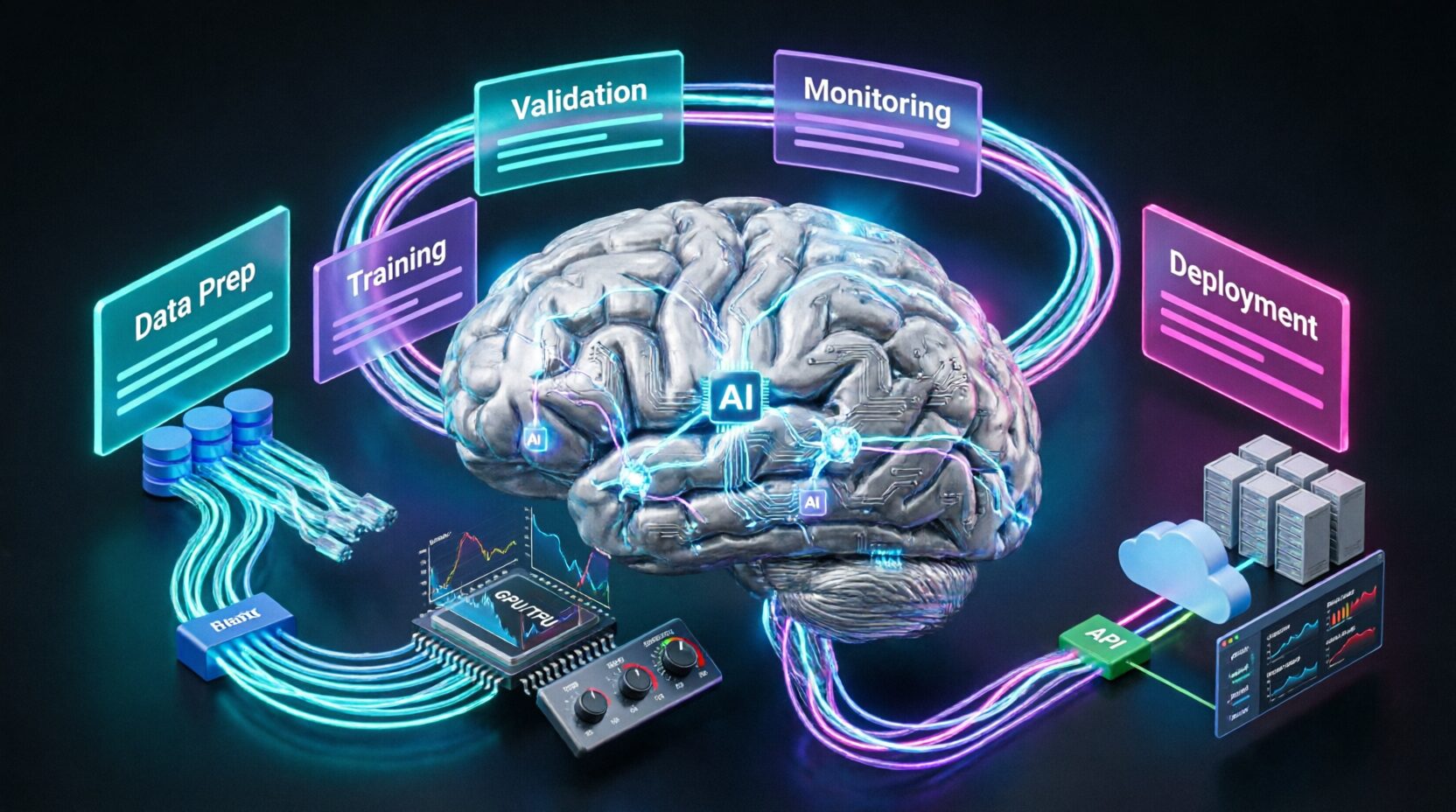
An AI model training guide is the most essential resource for data scientists, machine learning engineers, and technical leaders looking to build robust, scalable, and accurate artificial intelligence systems. In an era where the success of enterprise AI initiatives hinges on the quality and efficiency of the underlying models, relying on ad-hoc coding and manual workflows is no longer a viable strategy. Today, organizations are adopting rigorous MLOps practices, automated pipelines, and advanced optimization techniques to accelerate machine learning model development. If you are looking to understand the end-to-end lifecycle of building an AI system, from raw data to production deployment, you are in the right place.
This comprehensive guide demystifies the complex lifecycle of artificial intelligence. We will explore the critical steps of AI training data preparation, detail the mechanics of AI model hyperparameter tuning, and provide a strategic blueprint for executing seamless AI model deployment strategies. By the end of this article, you will have a clear, actionable framework for optimizing AI model training infrastructure, ensuring strict AI model versioning and governance, and driving measurable business value through intelligent automation.
1. The Foundation: Data Preparation and Security
The quality of any artificial intelligence system is fundamentally limited by the quality of the data it learns from. Proper AI training data preparation is the most critical step in the entire lifecycle. This involves data collection, cleaning, normalization, and feature engineering. Engineers must handle missing values, remove duplicates, and ensure the dataset is representative of the real-world scenarios the model will encounter. Without rigorous preparation, even the most advanced algorithms will suffer from the “garbage in, garbage out” phenomenon.
Equally important is AI model security in training. As models are trained on sensitive corporate or customer data, protecting this information from leakage, poisoning, or unauthorized access is paramount. Implementing strict access controls, encrypting data at rest and in transit, and utilizing secure enclaves during the training process ensures that your intellectual property and customer privacy remain intact.
2. Core Methodologies: Supervised Learning and Transfer Learning
Choosing the right learning paradigm dictates how your model will process information and make predictions.
Following supervised learning best practices is essential for tasks where labeled data is available, such as classification and regression. This involves carefully splitting data into training, validation, and test sets, selecting appropriate loss functions, and ensuring that the labels are accurate and consistent. High-quality labeled data is the fuel that drives accurate supervised models.
However, training a model from scratch is often computationally expensive and data-intensive. This is where transfer learning for business AI becomes a game-changer. By taking a pre-trained model that has already learned features from a massive dataset and fine-tuning it on your specific, smaller dataset, organizations can drastically reduce training time and computational costs while achieving state-of-the-art accuracy.
3. Optimizing Performance: Tuning, Validation, and Compression
Once the baseline model is built, the focus shifts to maximizing its accuracy and efficiency.
AI model hyperparameter tuning is the process of optimizing the configuration variables that govern the training process itself, such as learning rate, batch size, and network depth. Techniques like grid search, random search, and Bayesian optimization are used to find the optimal combination of parameters that yield the best performance without overfitting.
To ensure the model generalizes well to unseen data, robust AI model validation techniques must be employed. Cross-validation, holdout validation, and stress testing help identify overfitting and ensure the model performs reliably across different data distributions. Additionally, AI model performance benchmarking against industry standards and baseline models provides a clear metric of success.
For deployment on edge devices or in latency-sensitive environments, AI model compression techniques are vital. Methods like quantization, pruning, and knowledge distillation reduce the model’s size and computational requirements without significantly sacrificing accuracy, making it feasible to run complex AI on mobile phones or IoT devices.
4. Infrastructure and Economics: Scaling and Cost Optimization
Training large-scale models requires significant computational power, making the choice of hardware and cloud architecture critical.
Selecting the right AI model training infrastructure involves balancing CPU, GPU, and TPU resources based on the specific requirements of your neural networks. Distributed training across multiple nodes is often necessary for large language models or complex computer vision tasks. Cloud providers offer managed services that simplify this process, but on-premise clusters may be preferred for strict data sovereignty requirements.
However, compute costs can quickly spiral out of control. AI model training cost optimization requires strategic resource management. This includes utilizing spot instances for fault-tolerant training jobs, implementing early stopping to halt training when performance plateaus, and right-sizing compute instances to match the workload. FinOps practices should be integrated into the MLOps pipeline to track and allocate training costs accurately.
5. Ensuring Trust: Explainability, Bias, and Governance
As AI systems are increasingly used in high-stakes decision-making, transparency and fairness are non-negotiable.
AI model explainability methods allow stakeholders to understand how a model arrives at its predictions. Techniques like SHAP (SHapley Additive exPlanations) and LIME (Local Interpretable Model-agnostic Explanations) provide insights into feature importance, building trust with users and satisfying regulatory requirements.
Furthermore, AI model bias detection training is crucial to prevent discriminatory outcomes. Models trained on historical data often inherit societal biases. Implementing fairness metrics and actively auditing the training data and model outputs ensures that the AI treats all demographic groups equitably.
To manage these models at scale, strict AI model versioning and governance frameworks must be established. This involves tracking not just the code and model weights, but also the exact version of the training data, hyperparameters, and environment used to create each model. This ensures reproducibility and allows teams to roll back to previous versions if a new deployment fails.
6. Moving to Production: Deployment, Monitoring, and Retraining
A model is only valuable if it can be reliably served to end-users or integrated into business applications.
Effective AI model deployment strategies vary based on the use case. Options include batch inference for offline processing, real-time API endpoints for immediate predictions, and edge deployment for local processing. Containerization using Docker and orchestration with Kubernetes are standard practices for ensuring scalable and reliable deployments.
Once deployed, the work is not done. AI model monitoring in production is essential to detect data drift and concept drift. If the real-world data distribution shifts away from the training data, the model’s accuracy will degrade. Continuous monitoring alerts engineers to these shifts before they impact business outcomes.
When degradation is detected, AI model retraining automation kicks in. Automated pipelines can trigger retraining using newly collected data, validate the new model against the current production model, and seamlessly deploy the updated version if it performs better. This closed-loop system ensures the AI remains accurate and relevant over time.
7. Industry Applications and Future Trends
The principles of model training apply across all sectors, but specific nuances exist for different domains.
AI model training for specific industries requires domain-specific adaptations. In healthcare, models must be trained on highly regulated, anonymized patient data with a focus on extreme precision. In finance, models require high interpretability and must be trained to detect subtle anomalies in transaction data. In manufacturing, computer vision models are trained on synthetic data to detect microscopic defects on assembly lines.
Looking ahead, AI model training future trends point toward increased automation and efficiency. We are moving toward automated machine learning (AutoML) that handles the entire pipeline from data prep to deployment with minimal human intervention. Additionally, the rise of foundation models and multimodal AI will shift the focus from training models from scratch to efficiently fine-tuning and aligning massive, pre-existing architectures.
8. Comprehensive Query Coverage
What is the most important step in the AI model training guide? The most critical step is AI training data preparation. No matter how advanced the algorithm is, a model trained on poor, biased, or noisy data will produce unreliable results. High-quality, well-cleaned, and representative data is the foundation of all successful machine learning.
How does transfer learning benefit business AI? Transfer learning for business AI allows organizations to leverage pre-trained models that have already learned complex features from massive datasets. By fine-tuning these models on their own smaller, domain-specific datasets, businesses can achieve high accuracy with significantly less data, compute power, and training time.
Why is AI model explainability important in production? AI model explainability methods are crucial for building trust, meeting regulatory compliance, and debugging model errors. When stakeholders understand why a model made a specific prediction, they are more likely to adopt the technology, and engineers can more easily identify and fix underlying issues.
How can I optimize AI model training costs? AI model training cost optimization can be achieved by utilizing cloud spot instances for non-critical training jobs, implementing early stopping to prevent unnecessary compute usage, right-sizing your GPU/TPU instances, and leveraging transfer learning to reduce the overall training time required.
What is the role of MLOps in model deployment? MLOps bridges the gap between data science and IT operations. It provides the AI model versioning and governance, automated CI/CD pipelines, and AI model monitoring in production necessary to deploy models reliably, scale them efficiently, and ensure they continue to perform well over time.
Conclusion
Mastering the AI model training guide is the definitive requirement for any organization looking to build scalable, accurate, and trustworthy artificial intelligence systems. By understanding the end-to-end lifecycle from rigorous AI training data preparation and AI model security in training to advanced AI model hyperparameter tuning and seamless AI model deployment strategies technical teams can transform raw data into powerful business assets.
Whether you are leveraging transfer learning for business AI to accelerate development, implementing AI model bias detection training to ensure fairness, or setting up AI model retraining automation to maintain long-term accuracy, the key to success lies in a disciplined, MLOps-driven approach. By optimizing your AI model training infrastructure, tracking AI model training cost optimization metrics, and adhering to strict AI model versioning and governance, you can ensure your AI initiatives deliver sustained, measurable value.