What Is Airtable AI?

Defining the Concept
Airtable AI refers to the suite of artificial intelligence capabilities natively integrated into Airtable, the leading connected workspace platform that combines the flexibility of a database with the simplicity of a spreadsheet. Designed for teams across operations, marketing, product, and HR, Airtable AI uses large language models and machine learning to automate data entry, generate insights, draft content, and transform unstructured information into structured records without requiring technical expertise or custom code. Unlike generic AI writing tools that operate in isolation, Airtable AI works directly within bases, tables, and interfaces, understanding context, relationships, and field types to deliver intelligent, actionable outputs. By embedding AI into the fabric of collaborative work, Airtable AI turns static data into dynamic intelligence, enabling teams to build smarter workflows, reduce manual effort, and make faster decisions all within a single, unified workspace.
What Information Is Included?
Data Scope and Processing Capabilities
Airtable AI processes user-provided inputs and existing base data to generate structured, context-aware outputs, including:
- AI-generated records: Create full records from natural language prompts (for example, “Add a new project for Q3 website redesign with owner Sarah, due Aug 30”)
- Field enrichment: Auto-fill fields like descriptions, tags, summaries, or categories based on existing data (for example, summarize a long “Notes” field into a one-sentence “Summary”)
- Content drafting: Generate marketing copy, task descriptions, email templates, or meeting agendas using brand-aligned tone and context from linked records
- Data classification: Categorize unstructured text into predefined options (for example, label support tickets as “Billing,” “Bug,” or “Feature Request”)
- Formula and automation suggestions: Recommend Airtable formulas or automation triggers based on user goals (for example, “Notify Slack when status changes to ‘Blocked’”)
All AI processing occurs with strict privacy controls. User data is encrypted in transit (TLS 1.3 plus) and at rest (AES-256). Airtable does not use customer data to train public AI models unless explicitly opted into via the AI Model Training setting (disabled by default). Enterprise customers can enforce zero-retention policies and restrict AI processing to specific regions (U.S. or EU). Sensitive fields can be excluded from AI processing via field-level permissions.
Where Is Airtable AI Used?

Operational Workflows Across Teams
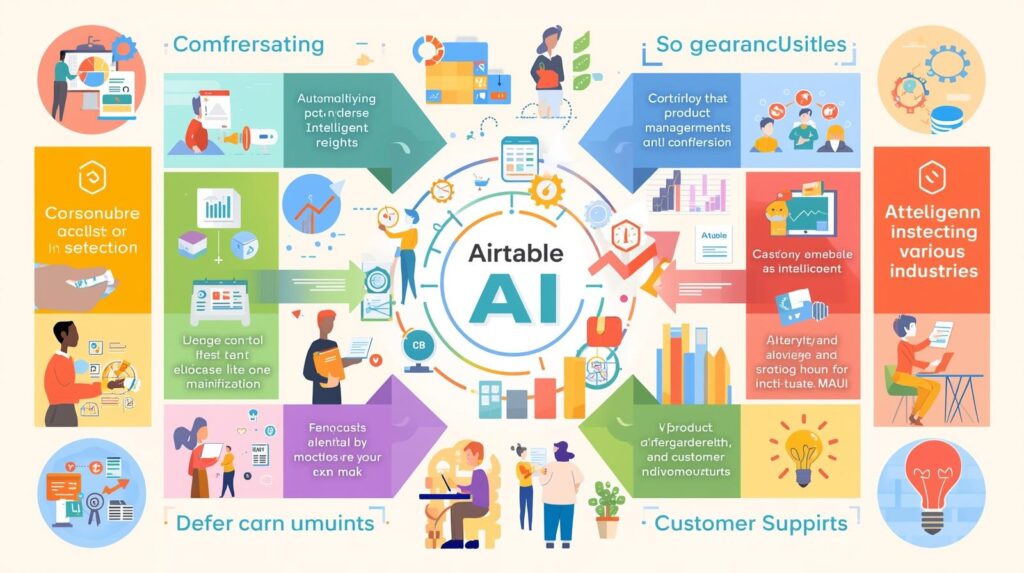
Airtable AI is deployed wherever teams manage complex, structured work with dynamic inputs:
- Marketing teams: Generate campaign briefs, social captions, and email copy from product specs; auto-tag leads by intent; summarize customer feedback from surveys
- Product and engineering: Draft user stories and bug reports from meeting notes; classify feature requests; generate release notes from sprint data
- Sales and customer success: Create personalized outreach from CRM data; summarize call notes into actionable next steps; enrich lead records with firmographic insights
- HR and recruiting: Draft job descriptions from role requirements; summarize interview feedback into structured evaluations; auto-categorize employee requests
- Operations and finance: Classify expenses, generate budget justifications, and draft status reports from project data
- Content and creative: Turn content calendars into social posts; summarize long-form drafts; tag assets by theme or campaign
Airtable AI supports both individual productivity and cross-functional collaboration, turning bases into intelligent, self-updating systems of record.
When Did Airtable AI Emerge?
From No-Code Flexibility to AI-Augmented Workspaces
Airtable, founded in 2012, pioneered the “spreadsheet-database hybrid” category. The company began experimenting with AI features in 2022 and officially launched Airtable AI in early 2023 as a premium add-on. Initial capabilities included text generation and summarization within fields. By late 2023 and 2024, Airtable expanded AI to include record creation from prompts, smart classification, and formula suggestions. In 2025, the platform introduced context-aware AI that understands table schemas, linked records, and interface views, enabling truly intelligent, workspace-native assistance. Today, Airtable AI is positioned as the cognitive layer that makes every base smarter, faster, and more adaptive.
Why Does Airtable AI Exist?

Solving the Manual Overhead of Structured Work
Airtable AI exists because structured work still requires unstructured effort. Teams spend hours copying data, writing repetitive descriptions, categorizing inputs, and translating ideas into records. Even in a flexible base, humans do the cognitive lifting. Traditional AI tools operate outside the workspace, forcing context switching. Airtable AI answers a critical need: How can teams capture, structure, and act on information without manual toil? Its purpose is to make data entry intuitive, content creation effortless, and insight generation automatic so users focus on outcomes, not formatting.
How Is Airtable AI Built?
Architecture and Core Components
Airtable AI is built as a native layer within the Airtable platform, with three integrated capabilities:
- Contextual Understanding Engine: Analyzes table schema, field types, linked records, and interface context to ground AI outputs in real workspace structure
- Generative AI Models: Leverages proprietary and third-party LLMs (with enterprise-grade security) fine-tuned for business tasks like summarization, classification, and drafting
- Actionable Output System: Delivers AI results directly into fields, records, or automations, never as external text, ensuring seamless integration
All AI features are accessible via the AI button in field editors, record menus, and the command bar. Processing occurs in secure cloud environments with SOC 2 Type II, ISO 27001, and GDPR compliance. Enterprise plans support private deployments and custom model fine-tuning.
Why Is Airtable AI Necessary?
The Hidden Tax of Manual Data Work
Airtable AI is necessary because unstructured effort slows down structured outcomes. It is essential because:
- Teams waste 10 to 15 hours per week on repetitive data entry and content drafting
- Inconsistent categorization reduces data reliability and reporting accuracy
- Great ideas get lost in unstructured notes instead of becoming actionable records
- Onboarding new team members is slow when bases lack clear, generated documentation
- Scaling operations requires more manual work, not less
Airtable AI ensures that every piece of information is captured, structured, and ready to act on, turning bases from passive repositories into active intelligence hubs.
Who Uses Airtable AI?
Target Users and Team Roles
Airtable AI serves a broad range of non-technical and technical users:
- Operations Managers: Automate status updates, generate reports, and classify incoming requests
- Marketers: Draft campaign assets at scale while maintaining brand voice
- Product Managers: Turn user feedback into prioritized feature records
- Recruiters: Summarize interviews and auto-score candidates against rubrics
- Project Coordinators: Create task descriptions and meeting notes from verbal updates
- Executives: Get AI-summarized dashboards of key initiatives without digging through tables
The platform’s low-code nature ensures adoption across roles with no training required.
Integration and Ecosystem
Connecting Airtable AI to Broader Workflows
Airtable AI enhances, rather than replaces, existing toolchains:
- Native Airtable Automations: Trigger AI actions as part of workflows (for example, “When form submitted, summarize notes and assign owner”)
- Interface Pages: Embed AI-generated content in dashboards, portals, and client-facing views
- Sync with External Tools: Push enriched records to Slack, Google Workspace, Salesforce, or Notion via integrations
- API Access: Developers can invoke AI actions programmatically using the Airtable API
Because AI lives inside Airtable, outputs flow naturally into connected systems with no copy-paste or manual export needed.
Pricing and Accessibility
Plans for Every Team Size
Airtable AI is available as an add-on to paid Airtable plans:
- Plus Plan: 20 dollars per user per month (billed annually) includes 500 AI actions per seat per month
- Pro Plan: 45 dollars per user per month includes 2,000 AI actions per seat per month
- Enterprise Plan: Custom pricing includes unlimited AI actions, private model options, and advanced governance
Free plan users do not have access to AI features. Actions reset monthly, and unused actions do not roll over. All plans include access to core AI capabilities with no feature gating by tier.
Future Roadmap
What’s Next for Airtable AI
Airtable is expanding AI to deepen workspace intelligence:
- Predictive Field Population: Suggest field values based on historical patterns (for example, “This bug is likely P1 based on similar past tickets”)
- AI-Powered Base Creation: Generate entire bases from a prompt like “Build a content calendar for a SaaS blog”
- Voice-to-Record: Speak updates that AI transcribes and structures into records
- Cross-Base Intelligence: Surface insights from related bases (for example, “This customer’s support tickets suggest a product issue”)
- Custom AI Agents: Train workspace-specific agents that learn team jargon, processes, and preferences
These innovations aim to make every Airtable base a proactive, intelligent collaborator.
Benefits of Airtable AI
Strategic and Operational Impact
Accelerated Workflows
Reduce time spent on data entry and drafting by 30 to 50 percent, speeding up project cycles.
Improved Data Quality
Ensure consistent categorization, summarization, and formatting across all records.
Enhanced Creativity
Overcome blank-page syndrome with AI-generated starting points for content and tasks.
Stronger Collaboration
Keep all team members aligned with clear, AI-summarized context in every record.
Scalable Operations
Handle 10 times more requests, leads, or projects without linear headcount growth.
Advantages and Disadvantages
Key Advantages
Airtable AI offers one of the most context-aware, workspace-native AI experiences available. Unlike generic tools, it understands your data structure, relationships, and business logic, delivering relevant, actionable outputs. The interface is seamless, requiring no switching between apps. Pricing is transparent and scales with usage. Most importantly, it turns Airtable from a passive tool into an active intelligence partner, amplifying human effort without replacing judgment.
Notable Disadvantages
Airtable AI is only available to paid Airtable users, with limited actions on lower tiers. Outputs require human review for accuracy, especially with technical or nuanced content. Complex logic still requires formulas or automations. AI cannot replace all custom workflows. Action limits may constrain high-volume teams unless on Enterprise. And because AI is tied to Airtable’s ecosystem, insights cannot be easily exported or used outside the platform.
Conclusion
The Intelligent Layer of Modern Work
Airtable AI may operate quietly within fields and records, but its impact is transformative. In every summarized note, every auto-categorized ticket, every drafted campaign, it frees teams from the friction of manual work. In an era where speed, clarity, and adaptability define competitive advantage, Airtable AI ensures that structured work stays human-centered, augmented, not automated.
It is not about replacing spreadsheets. It is about evolving them into living, intelligent systems that grow with your team. For organizations serious about operational excellence, Airtable AI is not just a feature. It is the foundation of a smarter, faster, and more connected way to work.