What Is Auto GPT?

Defining the Concept
Auto GPT refers to an open-source experimental application that demonstrates autonomous goal-directed behavior using large language models (LLMs). Unlike chatbots that respond to single prompts, Auto GPT chains together multiple LLM calls to plan, execute, and self-correct multi-step tasks such as researching a topic, writing a report, coding a tool, or managing a to-do list without continuous human input. It operates by accepting a high-level goal (e.g., “Write a market analysis of AI productivity tools in 2025”), breaking it into subtasks (e.g., “Search for recent reports,” “Summarize key trends,” “Draft executive summary”), using tools (web search, file read/write, code execution) to gather information and take action, and reflecting on results and adjusting its plan until the goal is achieved or halted. Auto GPT is not a product or commercial platform. It is a proof-of-concept implementation of agentic AI architecture illustrating how LLMs can be extended beyond passive response into active, iterative problem-solving.
Core Technical Architecture
Agentic Loop Design
Auto GPT implements a four-phase reasoning cycle inspired by the ReAct framework (Reason plus Act): Plan: Generate a list of prioritized next steps based on the goal and memory. Execute: Choose one action (e.g., Google search, read file, run code) and perform it. Observe: Capture the result (e.g., search snippets, file contents, stdout). Reflect: Assess progress, update memory, and replan if needed. This loop repeats autonomously enabling sustained effort toward complex objectives.
Tool Integration Framework
Auto GPT extends LLMs with real-world capabilities via a plugin system: Web Search: Uses SERP API or DuckDuckGo to fetch live information. File System Access: Reads/writes .txt, .md, .json, and code files for memory and output. Code Execution: Runs Python scripts in a sandboxed environment (with safety limits). Memory Management: Short-term (in-context) and long-term (vector DB via Chroma or Pinecone) storage. All tools are invoked via structured function calls, ensuring the LLM cannot execute arbitrary commands.
Memory and Context Handling
To overcome LLM context limits, Auto GPT uses: Contextual Compression: Summarizes past steps to fit within token limits. Vector Memory: Embeds key facts into a semantic database for retrieval-augmented generation (RAG). Priority-Based Forgetting: Drops low-value memories when near capacity. This enables sustained operation over hours or days not just single sessions.
Historical Context and Evolution
Origins in Open-Source Experimentation (2023)
Auto GPT was created in March 2023 by developer Toran Bruce Richards and released on GitHub as a side project. It gained viral attention for being one of the first publicly available implementations of autonomous LLM agents demonstrating that open models like GPT-3.5/4 could perform multi-hop reasoning without proprietary infrastructure.
Key Technical Influences
ReAct (2022): Combined reasoning and action for improved task performance. Chain-of-Thought Prompting: Enabled step-by-step problem decomposition. Toolformer (2023): Showed LLMs could learn to call APIs from text alone. BabyAGI (2023): Simpler task-driven agent that inspired Auto-GPT’s architecture. Unlike research prototypes, Auto-GPT prioritized accessibility written in Python, with clear documentation and Docker support—sparking a wave of community forks and improvements.
Community and Fork Ecosystem
The original Auto GPT (github.com/Significant-Gravitas/Auto GPT) has over 150,000 GitHub stars and 25,000 forks. Notable variants include: Auto GPT Next: Enhanced UI, plugin marketplace, and cloud deployment. GPT-Engineer: Specialized for software project generation. BabyAGI UI: Streamlined interface for task list automation. AgentGPT: Browser-based version for non-technical users. This ecosystem has made Auto-GPT a de facto reference implementation for agentic AI experimentation.
What Information Is Included?
Input and Goal Specification
User-Defined Goals
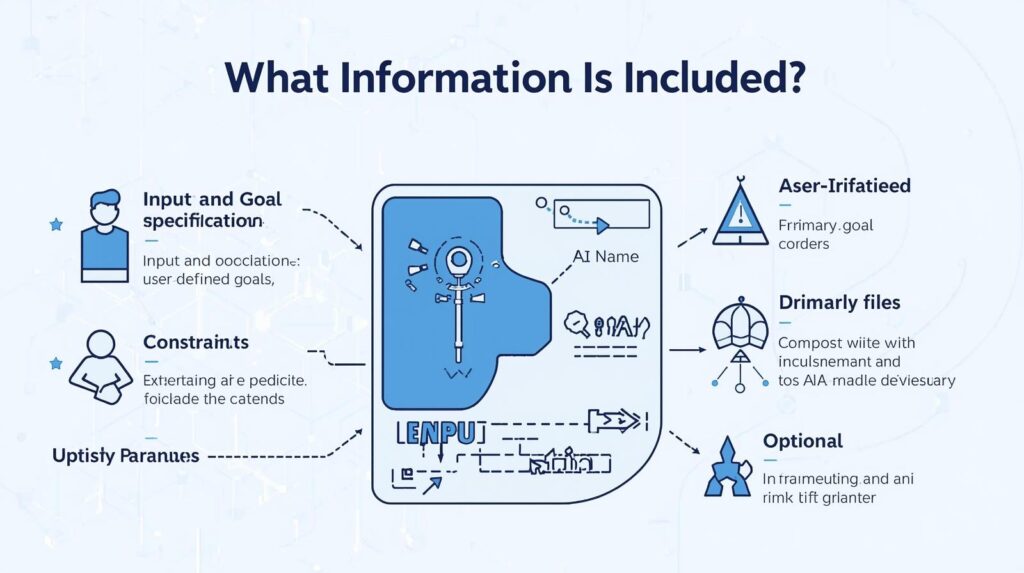
Auto GPT starts with two natural language inputs: AI Name: A persona (e.g., “MarketResearchPro”) to shape tone and expertise. Primary Goal: A high-level objective (e.g., “Create a 10-slide PowerPoint on renewable energy trends”). Optionally, users can provide: Constraints: Rules like “Use only .gov sources” or “Avoid technical jargon.” Initial Files: Seed documents for context (e.g., a brand style guide). API Keys: For search, embeddings, or advanced LLMs (e.g., GPT-4, Claude 3). The system converts these into a structured plan stored in ai_settings.yaml.
Data Processing and Tool Usage
Information Sources
Auto GPT gathers data from: Web Search: Queries Google/DuckDuckGo via API; extracts snippets and URLs. Local Files: Reads markdown, text, CSV, and code files in its workspace. LLM Knowledge: Leverages parametric knowledge for synthesis and reasoning. User Input: Pauses for human approval on critical actions (configurable).
Action Capabilities
By default, Auto GPT can: Write and edit files (reports, code, data). Execute Python scripts (with sandboxed subprocesses). Summarize and prioritize long documents. Generate follow-up tasks based on outcomes. With plugins, it gains additional skills: Email sending (via SMTP). Twitter posting (via API). Voice output (text-to-speech). Image generation (via DALL·E or Stable Diffusion APIs). All actions are logged in logs/ for audit and debugging.
Output and Deliverables
Generated Artifacts
Auto GPT produces tangible outputs in its workspace folder: final_report.md: Completed deliverable (e.g., research summary, code project). tasks.json: Current task list with priorities and statuses. memories/: Vector database snapshots for long-term recall. logs/: Timestamped records of every action, observation, and decision. Users can download, edit, or feed these back into new runs enabling iterative refinement.
Safety and Limitations
Built-In Safeguards
Command Allowlist: Only pre-approved shell commands (e.g., ls, cat) permitted. Code Sandboxing: Python runs in restricted subprocesses; no network access by default. Human-in-the-Loop: Optional approval step before file writes or web requests. Cost Monitoring: Tracks token/LLM usage to avoid surprise bills.
Known Constraints
Hallucination Risk: May invent sources or misinterpret search results. Token Limits: Long tasks require aggressive summarization, losing nuance. Tool Reliability: Web search APIs can throttle or return noisy data. No True Understanding: Behavior is statistical, not cognitive fails on novel logic. Auto-GPT is designed for exploration, not production deployment.
Where Is Auto GPT Used?

Developer and Research Applications
AI Experimentation and Education
Students and hobbyists learn agentic AI concepts by modifying the codebase. Researchers use it as a baseline for testing new memory, planning, or tool-use methods. Workshops and bootcamps teach LLM capabilities through hands-on agent building.
Prototyping and Ideation
Startups rapidly mock up autonomous assistants for customer service or research. Product teams simulate agent behavior before investing in custom development. Open-source contributors build plugins for niche tools (e.g., Notion, Airtable, Zapier). Auto-GPT lowers the barrier to testing agentic workflows—without enterprise licensing.
Practical Use Cases (With Human Oversight)
Research and Content Creation
Market analysis: “Compare pricing of top 5 AI SEO tools and summarize in a table.” Technical documentation: “Read this GitHub repo and write a beginner’s guide.” Academic literature review: “Find 10 papers on RAG since 2023 and extract key findings.”
Software Development Assistance
Bug triage: “Read error logs, hypothesize causes, and suggest fixes.” Code generation: “Build a Flask app that scrapes news headlines and emails summaries.” Test automation: “Write pytest cases for this function.”
Personal Productivity
Email drafting: “Write a polite follow-up to a vendor who missed a deadline.” Learning assistant: “Explain transformer architecture like I’m a software engineer.” Task automation: “Check my calendar for free slots tomorrow and draft a meeting invite.” All require human review—Auto-GPT suggests; users decide.
When Did Auto GPT Emerge?
Timeline of Development
March 2023: Public Launch
Toran Bruce Richards released Auto-GPT v0.1 on GitHub, combining GPT-4 with web search and file I/O. Within days, it trended on Hacker News and GitHub—garnering 50,000 stars in 2 weeks.
April to June 2023: Community Explosion
Forks added critical features: Persistent memory (using Chroma DB). Plugin system for extensibility. Streamlit UI for non-CLI users. Cost tracking and token optimization. The Auto GPT-Plugins repo became a hub for community contributions.
July 2023 to 2024: Maturation and Specialization
Auto-GPT Next emerged as the leading maintained fork. Integration with vector DBs (Pinecone, Weaviate) improved long-context handling. Support for open models (Llama 3, Mistral) reduced reliance on OpenAI. Docker and cloud deployment guides enabled wider adoption.
2025: Legacy and Influence
While no longer the state of the art, Auto GPT’s architecture lives on in: Commercial agents (e.g., Agent Verse, Microsoft AutoGen). Frameworks like LangChain’s Plan-and-Execute. Academic benchmarks (e.g., WebArena, AgentBoard). It remains the most accessible entry point to agentic AI.
Why Does Auto GPT Exist?
Solving the Single-Turn Limitation of LLMs
Auto-GPT exists because standard LLM interactions are passive and fragmented. Users must: Break complex tasks into tiny steps. Manually feed outputs back as new prompts. Remember context across sessions. Switch between tools (search, code, docs) manually. This “human-in-the-loop” model is slow and error-prone. Auto GPT answers a critical question: Can an LLM manage its own workflow planning, acting, learning like a human intern? Its purpose is to demonstrate that autonomy is achievable with current technology not just theoretical.
Democratizing Agentic AI Research
Before Auto-GPT, agentic systems were confined to labs with massive compute budgets. Auto-GPT proved that: A single developer could build a functional agent in days. Open models and APIs were sufficient for impressive demos. The community could collaborate to push boundaries rapidly. It shifted agentic AI from closed research to open innovation—inspiring thousands to experiment.
How Is Auto GPT Built?
Core Components and Workflow
Agent Loop Implementation
The main autogpt.py script runs a continuous cycle: Load memory: Retrieve past actions and context. Generate plan: LLM proposes next steps given goal and history. Select action: Choose highest-priority task (e.g., “search,” “write_file”). Execute tool: Call the relevant plugin (e.g., google_search.py). Store result: Save output to memory and log. Evaluate progress: LLM assesses if goal is near completion. Repeat or exit. This loop runs until the goal is met, the user stops it, or a safety limit is hit.
Memory System Architecture
Short-Term: Last 5 to 10 steps kept in prompt context (via contextual_compression.py). Long-Term: Key facts embedded via all-MiniLM-L6-v2 and stored in Chroma DB. Recall: Before acting, the agent queries memory for relevant past information. This hybrid approach balances speed and scalability.
Plugin System Design
Plugins are Python classes inheriting CommandPlugin:
class GoogleSearchPlugin(CommandPlugin):
def command_name(self): return “google”
def run(self, query: str) -> str:
return serp_api.search(query)
The agent discovers plugins at startup and includes their usage instructions in its system prompt—enabling zero-shot tool use.
Deployment and Requirements
Local Setup
OS: Linux, macOS, or Windows (WSL2 recommended). Python: 3.10 plus with pip install -r requirements.txt. API Keys: OpenAI (required), SERP API (optional), embedding model (optional). Hardware: 8GB RAM minimum; GPU not required (runs on CPU).
Cloud and Container Options
Docker: Official image for isolated, reproducible runs. Gitpod: One-click browser-based development environment. Hugging Face Spaces: Deploy UI demos with free compute. No enterprise infrastructure is needed making it ideal for learning and prototyping.
Why Is Auto-GPT Necessary?
Bridging Theory and Practice in AI

Auto-GPT is necessary because it makes agentic AI tangible. Papers describe autonomous agents, but most developers have never seen one operate. Auto-GPT lets users: Watch an LLM debug its own code. See how memory failure leads to looping. Experience the trade-offs between speed, cost, and accuracy. This hands-on understanding is critical for responsible AI development.
Accelerating Real-World Agent Development
Teams building production agents use Auto-GPT to: Validate tool designs before custom engineering. Benchmark performance against a known baseline. Train new hires on agent patterns and pitfalls. It serves as a “training wheels” layer—reducing the risk of building bespoke systems from scratch.
Who Uses Auto GPT?
Primary User Groups
AI Researchers and Students
Use it to test theories about planning, memory, and tool use without writing infrastructure code. Common in university NLP courses and self-directed study.
Developers and Engineers
Experiment with agentic patterns for internal tools: Automating repetitive dev tasks (e.g., ticket triage). Building custom research assistants. Prototyping agent-based features for products.
Technical Product Managers
Evaluate agentic AI feasibility for roadmaps—running demos to assess realism vs. hype.
Open-Source Contributors
Extend functionality via plugins: 200 plus community plugins for Slack, Notion, Excel, etc. Localization for 15 plus languages. Accessibility improvements (screen reader support).
Limitations for Non-Technical Users
While browser-based forks (e.g., AgentGPT) lower the barrier, the core Auto-GPT requires: Command-line familiarity. Understanding of API keys and tokens. Patience with LLM quirks (e.g., infinite loops, hallucinated files). It is a developer tool—not an end-user product.
Integration and Ecosystem
Native Tool Support
Core Plugins (Built-In)
File System: read_file, write_to_file, append_to_file. Web: google, browse_website (with scraping). Code: execute_python_file, improve_code. Memory: add_to_memory, query_memory.
Popular Community Plugins
Email: Send via SMTP or Gmail API. Twitter: Post threads with tweet_chapter. Notion: Create pages and databases. Zapier: Trigger external automations. Voice: Text-to-speech via ElevenLabs. Plugins are drop-in no core code changes needed.
Development and Experimentation Tools
Debugging and Monitoring
Verbose Mode: See full prompts and LLM outputs. Log Inspection: logs/ contains timestamped action histories. Memory Viewer: CLI tool to query vector DB contents.
Customization Points
Prompt Engineering: Edit prompts/ for persona and behavior tuning. Tool Limits: Configure max tokens, retries, and safety rules. Model Swapping: Use OpenRouter to try Claude, Mistral, or open models. This flexibility makes Auto-GPT a living lab for agent design.
Pricing and Accessibility
Open-Source and Free
Core Platform
License: MIT (permissive open source). Cost: 0 dollars to download, modify, and deploy. Hosting: Run on your laptop, cloud VM, or Docker. All code, docs, and issue tracking are public on GitHub.
Operational Costs
LLM API: ~0.02 to 2.00 dollars per run (GPT-3.5 vs. GPT-4). Search APIs: ~0.01 per query (SERP API free tier available). Embeddings: Free with Hugging Face models; 0.10 dollars/1K calls with OpenAI. Users control costs via configuration (e.g., max_tokens, max_cost).
Commercial Alternatives
While Auto-GPT itself is free, managed alternatives exist: AgentVerse Cloud: Hosted Auto-GPT with UI and monitoring (29 dollars/month). SuperAGI: Enterprise agent platform with Auto-GPT compatibility (99 dollars/month plus). LangChain Templates: Pre-built Auto GPT workflows in cloud notebooks. None replace the educational value of running the open-source version.
Future Roadmap
Community-Driven Enhancements
Near-Term (2025)
Multimodal Support: Image and audio input/output via plugins. Better Memory Compression: Hierarchical summarization to retain nuance. Cost Optimization: Smart token budgeting and model fallback (GPT-4 → Claude 3 Haiku).
Long-Term Vision
Collaborative Agents: Multiple Auto-GPT instances working on shared goals. Self-Improvement: Agents that rewrite their own prompts or plugins. Hardware Integration: Raspberry Pi deployments for edge agent tasks. These are community-led no central roadmap.
Relationship to Production Systems
Auto GPT will likely remain a research/learning tool, while its ideas flow into: Enterprise agents (e.g., Microsoft Copilot Studio agents). Framework abstractions (e.g., LangGraph’s stateful agents). Standardized benchmarks (e.g., AgentBoard for eval). Its legacy is not in scaling but in inspiration.
Benefits of Auto GPT
Technical and Educational Value
Hands-On AI Literacy
Learn how agents plan, act, and reflect in real time. Understand trade-offs in memory, tool use, and safety. Debug failure modes (e.g., goal drift, infinite loops).
Rapid Prototyping
Test agent ideas in hours, not months. Share reproducible configs via GitHub. Iterate with community feedback.
Cost Efficiency
0 dollars software cost vs. 10K dollars plus commercial platforms. Run on modest hardware (no GPU required). Pay only for LLM tokens used.
Practical Impact
Accelerated Research
Generate literature reviews 10x faster. Automate data collection for experiments. Draft code for baseline models.
Developer Productivity
Reduce boilerplate (e.g., docstrings, tests). Explore API integrations safely in sandbox. Offload repetitive tasks (e.g., log analysis).
Advantages and Disadvantages

Key Advantages
Unmatched Accessibility
Fully open source, well-documented, and runnable on a laptop no vendor account or credit card required. Lowers barrier to agentic AI experimentation more than any other project.
Transparent and Modifiable
Every line of code is inspectable. Users can: See exactly how prompts are constructed. Add logging to trace decision paths. Swap components (e.g., memory DB, LLM provider). This transparency builds trust and understanding.
Active, Helpful Community
25,000 plus forks and 100 plus Discord channels provide support, plugins, and tutorials. Issues are triaged quickly; PRs often merged in days.
Proven Influence
Shaped the design of commercial agents and research frameworks validating its architectural choices.
Notable Disadvantages
Not Production-Ready
Lacks enterprise features: No user management or RBAC. No audit trails or compliance certifications. No SLA or support contracts. Use only for development and testing.
Unreliable for Critical Tasks
Prone to: Hallucinated sources or code. Infinite loops without human intervention. Cost overruns from unbounded tool use. Always validate outputs.
Steep Learning Curve
Requires: Python and CLI familiarity. Understanding of tokens, APIs, and sandboxing. Patience with LLM limitations. Beginners may prefer AgentGPT or Flowise UIs.
Conclusion
The Gateway to Autonomous AI
Auto GPT is not a product it is a movement. In an era of AI hype, it provides a rare window into how autonomous agents actually work: messy, iterative, and full of trade-offs. By making agentic AI tangible, open, and modifiable, it has educated thousands of developers, inspired commercial systems, and proven that goal-directed AI is not science fiction.
It is not about building the perfect agent. It is about understanding the principles so when the next breakthrough arrives, we’re ready to build responsibly. For anyone serious about the future of AI, Auto GPT is not just a tool. It is the essential first step into the age of autonomous intelligence.