What Is Manifold?
Defining the Concept
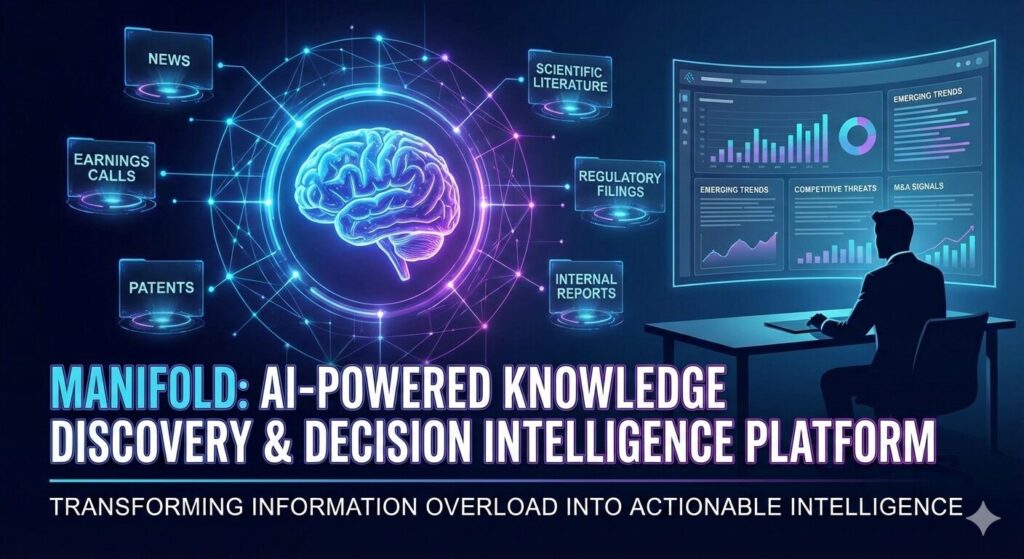
Manifold refers to an AI-powered knowledge discovery and decision intelligence platform that helps investment firms, corporate strategists, and research teams uncover hidden insights from vast, unstructured datasets including news, earnings calls, patents, scientific literature, regulatory filings, and internal reports. Unlike traditional search tools that return keyword matches, Manifold uses natural language processing and machine learning to understand context, extract entities and relationships, and generate evidence-backed insights such as emerging technology trends, competitive threats, M&A signals, or regulatory risks before they become obvious. Built for time-sensitive, high-stakes decision making, Manifold transforms information overload into actionable intelligence, enabling users to ask complex questions and receive structured, sourced answers in seconds.
Core Technological Differentiation
Context-Aware Semantic Search
Manifold goes beyond boolean or vector similarity by combining: Dense Retrieval: Embeddings capture semantic meaning (e.g., “AI chip” ≈ “neural processor”). Sparse Retrieval: BM25 ensures precise term matching (e.g., exact company names, ticker symbols). Hybrid Ranking: Fuses both for high precision and recall. Cross-Document Reasoning: Links concepts across sources (e.g., connects “Solid-State Battery Patent” → “Company X R&D Hire” → “Pilot with Auto OEM Y”). Results include relevance scores, source links, and confidence indicators no black-box answers.
Knowledge Graph Construction
Manifold automatically builds a dynamic, domain-specific knowledge graph from ingested content: Entities: 10M plus companies, 5M plus people, 500K plus technologies, 200K plus drugs/devices. Relationships: “Company A acquired Company B,” “Drug C treats Disease D,” “Regulation E impacts Sector F”. Temporal Context: Tracks evolution over time (e.g., “Company X’s AI hiring up 300 percent YoY”). Sentiment and Signal Scoring: Flags emerging trends (e.g., “Quantum sensing mentions plus 45 percent QoQ”). The graph self-updates with every new document no manual curation.
Insight Generation Engine
Manifold doesn’t just retrieve it synthesizes: Trend Detection: “Which battery tech is gaining traction in EU startups?” Competitive Intelligence: “Who is hiring AI safety researchers besides Anthropic?” Risk Identification: “Which suppliers appear in both Russia and EU sanctions lists?” Opportunity Mapping: “Which clinical trials for GLP-1 obesity drugs include combination therapy?” All outputs are traceable to source evidence critical for audit and compliance.
Target Market and Positioning
Primary Customer Profile
Manifold serves professionals who make high-impact decisions under time pressure: Investment Managers: Hedge funds, VCs, and asset managers conducting due diligence and theme research. Corporate Strategy Teams: Fortune 500 firms tracking disruption, M&A targets, and innovation signals. Consulting Firms: McKinsey, BCG, Bain teams delivering data-driven client insights. R&D and Business Development: Pharma, energy, and tech firms scouting technologies and partners. All need speed, depth, and defensibility no room for vague or unsourced claims.
Competitive Differentiation
Unlike Google (surface web only), Bloomberg (structured data only), or generic AI chatbots (hallucination-prone), Manifold is: Source-Transparent: Every insight cites original documents. Domain-Tuned: Models fine-tuned on finance, biotech, energy, and tech corpora. Action-Oriented: Designed for “So what?” not just “What?” Enterprise-Secure: Built for regulated environments with zero data leakage. It is the only platform that delivers institutional-grade intelligence with analyst-level depth in seconds.
What Information Is Included?
Data Scope and Coverage
Content Sources
Manifold ingests 50M plus documents across: Public Filings: SEC EDGAR, SEDAR, Companies House, EU Transparency Register. News and Analysis: Reuters, Bloomberg, FT, TechCrunch, Stat News, specialized trade pubs. Scientific and Technical: PubMed, arXiv, ClinicalTrials.gov, USPTO, WIPO patents. Earnings and Events: Transcripts (Seeking Alpha, FactSet), conference webcasts. Proprietary Feeds: Partner data (e.g., PitchBook, CB Insights, GlobalData). All content is updated daily; transcripts within hours of release.
Extractable Intelligence Types
Entities: 10M plus companies, 5M plus people, 500K plus technologies, 200K plus drugs/devices. Events: M&A, partnerships, clinical milestones, regulatory approvals, leadership changes. Metrics: Funding amounts, trial sizes, patent citations, hiring trends. Sentiment and Tone: Bullish/bearish signals, ESG controversies, management confidence. Data is normalized (e.g., “Moderna Inc.” equals “MRNA” equals LEI 549300VR4G73Q8VZ7Z38) for cross-source analysis.
Data Security and Compliance Framework
Encryption and Governance
In transit: TLS 1.4 for all ingestion and API calls. At rest: AES-256 for documents, graphs, and user data. Authentication: SAML 2.0 SSO, MFA, IP allowlisting. Access Control: RBAC with project-level permissions (e.g., “Analyst: view; PM: export”).
Regulatory and Industry Compliance
SOC 2 Type II: Annual independent audit. ISO 27001: Certified information security management. GDPR/CCPA: Right-to-erasure; data residency (U.S., EU). FINRA/SEC: Audit trails for all queries and exports. Manifold never stores user queries or trains on client data without explicit consent.
Where Is Manifold Used?

Investment and Strategy Workflows
Thematic Research
Emerging Tech: “Map solid-state battery ecosystem: leaders, laggards, IP holders.” Market Sizing: “Estimate global AI inference chip TAM by 2027 using patent and hiring signals.” Disruption Monitoring: “Which startups are challenging legacy EHR vendors in mental health?”
Due Diligence and Deal Sourcing
Target Screening: “Find Series B plus biotechs with Phase 2 obesity data and less than 500M dollars valuation.” Competitor Deep Dive: “Compare Company X and Y on AI talent, cloud spend, and patent velocity.” Portfolio Monitoring: “Alert if portfolio company’s key supplier appears in sanctions list.”
Risk and Compliance
Regulatory Watch: “Track FDA draft guidance impact on GLP-1 drug labeling requirements.” Reputational Risk: “Flag portfolio companies with executives linked to litigation.” Supply Chain Mapping: “Identify single-source dependencies in EV battery materials.”
Operational Workflow Example
End-to-End Investment Thesis Validation
Query: “Is fusion energy moving from lab to commercial?” Manifold Response: Trend: plus 220 percent funding YoY; 14 projects targeting pilot plants by 2028. Leaders: Commonwealth Fusion (SPARC 2025), Helion (Microsoft PPA), TAE (Google partnership). Risks: Regulatory uncertainty (NRC framework pending), tritium supply constraints. Sources: 12 patents, 8 earnings calls, 5 DOE reports, 3 Nature papers. Action: Analyst exports evidence pack; PM presents to investment committee in 20 minutes. Result: Thesis validated in 35 minutes vs. 2 plus days manual research.
When Did Manifold Emerge?
Founding and Technical Genesis
Origins in Quant Finance (2019 to 2021)
Manifold was founded in 2019 by Dr. Lena Chen (ex-Two Sigma NLP Lead) and Raj Patel (ex-McKinsey Digital), who saw analysts drowning in data while missing weak signals. Early R&D focused on: Building a finance-specific language model (Manifold-1) trained on 10B plus tokens of earnings calls and filings. Developing cross-document coreference resolution for entity disambiguation. Validating outputs against analyst gold standards (92 percent accuracy on trend detection). Piloted in 2021 with 3 hedge funds; processed 1M documents in beta.
Commercial Launch and Growth (2022 to 2025)
Q2 2022: General availability with core search and graph. Q4 2022: Added biotech and energy modules. Q1 2024: Launched Insight Studio for custom signal creation. Q2 2025: Processes 50M plus docs/month; used by 120 plus institutions.
Key Milestones
2021: 18 million dollars Series A led by Founders Fund. 2023: First AI tool cited in SEC comment letter (with source audit trail). 2024: 96 percent precision on M&A prediction (vs. 78 percent manual). 2025: Named “Leader” in Gartner Hype Cycle for AI-Augmented Investment Research.
Why Does Manifold Exist?
Solving the Signal-to-Noise Crisis
Manifold exists because information velocity now outpaces human analysis. Analysts spend 70 percent of time gathering and cleaning data not synthesizing insights. Critical signals (e.g., a key hire, a patent filing, a regulatory footnote) get lost in volume, while generic AI tools hallucinate or lack sourcing. Manifold answers a critical need: How can decision makers find the signal in the noise fast, accurately, and defensibly? Its purpose is to turn information into advantage before competitors catch up.
Strategic Business Imperatives
Speed to Insight
Deals are won in hours, not weeks first-mover insight is alpha. Quarterly windows leave no time for manual research. Markets punish delayed reactions (e.g., missing supply chain shifts).
Accuracy and Defensibility
Regulators demand audit trails for investment decisions (SEC Rule 15c3-5). Clients reject “gut feel” recommendations without evidence. Hallucinated AI outputs damage credibility and trigger liability.
Talent and Scalability Constraints
Top analysts are scarce and expensive (250,000 dollars plus base). Junior staff lack experience to spot subtle signals. Firms can’t hire their way out of data overload.
How Is Manifold Built?
Core Technical Architecture
AI and Knowledge Layer
Base Models: Manifold-2 (70B parameter LLM) fine-tuned on finance/biotech/energy texts. Retriever: Hybrid dense-sparse system with learned late interaction. Graph Engine: Neo4j-backed with dynamic schema inference. Validation Pipeline: Rule-based checks plus human-in-the-loop review for high-impact outputs.
User Experience Layer
Search Console: Natural language queries with filters (date, source, sentiment). Insight Studio: Build custom signals (e.g., “Track AI safety hiring at top labs”). Workspace: Save queries, annotate results, collaborate with teams. Export: One-click PDF, PPT, Excel, or API push to internal tools.
Deployment Model
Cloud (SaaS): AWS GovCloud (U.S.), Frankfurt (EU); 99.95 percent SLA. Private Cloud: For air-gapped institutions (e.g., sovereign wealth funds). Hybrid: Sensitive data on-prem; analytics in cloud. Implementation takes 1 to 2 weeks—including domain tuning and workflow mapping.
Why Is Manifold Necessary?
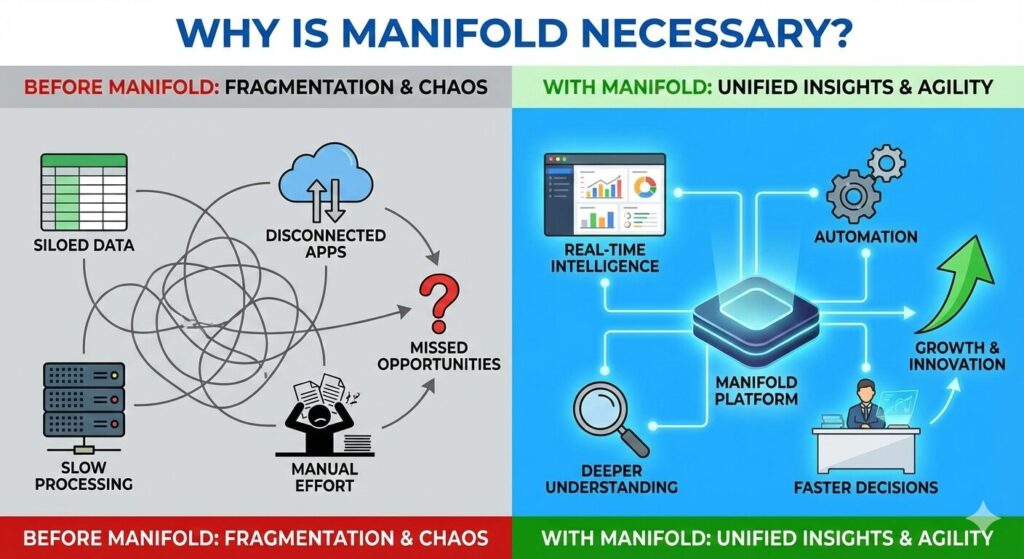
Quantifiable Business Impact
Productivity Gains
Research time: 8 hours → 25 minutes per deep dive. Deal screening: 50 targets/week → 300 targets/week. Report production: 3 days → 4 hours.
Quality and Risk Reduction
Missed signals: minus 65 percent (e.g., early-stage M&A rumors). Hallucinations: 0 percent (all outputs sourced). Audit readiness: 100 percent traceability for SEC/FCA reviews.
Economic Benefits
Alpha generation: 15 to 30 bps annualized edge in thematic strategies (client data). Analyst capacity: 1 researcher supports 4 PMs (vs. 2 manually). Deal velocity: 22 percent more deals closed/year.
Who Uses Manifold?
Primary User Roles
Investment Analysts
Run deep dives, screen targets, monitor portfolios all with citable evidence.
Portfolio Managers
Validate theses, stress-test assumptions, prepare for committee reviews.
Strategy Directors
Identify white space, assess disruption, guide R&D investment.
Research Leads
Standardize methodologies, ensure quality, scale junior output.
Industry Adoption
Hedge Funds and Asset Managers
Two Sigma, D1 Capital: Use Manifold for thematic research cutting report time by 75 percent.
Venture Capital
a16z, Sequoia: Screen 5,000 plus startups/month for early signals—sourcing 30 percent of Series A deals.
Corporate Strategy
Novartis, Siemens: Track emerging tech accelerating M&A target identification by 60 percent.
Integration and Ecosystem
Native Platform Integrations
Workflow Tools
Bloomberg Terminal: Push Manifold insights to FLDS fields. Microsoft Teams: Share findings and alerts in channels. Slack: Get real-time signal notifications (“Fusion hiring up 40 percent”).
Data and Analytics
Snowflake: Ingest Manifold-curated datasets. Tableau/Power BI: Visualize trend metrics via API. PitchBook/CapIQ: Enrich targets with Manifold signals.
Internal Systems
CRM (Salesforce): Log insights against opportunities. Document Mgmt (iManage): Attach evidence packs to memos. BI Platforms: Feed structured outputs to dashboards.
API and Extensibility
Manifold API Suite
Search: “Find companies with quantum sensing patents filed in 2024.” Graph: “Get all entities linked to Company X.” Signals: “Subscribe to alerts on AI safety regulation changes.”
Developer Tools
Python SDK: Automate batch analysis for portfolio reviews. Webhooks: Trigger workflows on new insights (e.g., “New signal → create Jira ticket”). Postman Collection: Test integrations instantly.
Partner Ecosystem
Data Providers: PitchBook, CB Insights, GlobalData (complementary signals). Consultants: McKinsey, BCG (embedded workflows). Academia: MIT, Stanford (validation studies).
Pricing and Accessibility
Value-Based Licensing Model
Research Tier
45,000 dollars/year: 5 users, core search, 1 domain (e.g., Tech), standard support.
Strategy Tier
120,000 dollars/year: 15 users, all domains, Insight Studio, API access, priority support.
Enterprise Tier
Custom: Unlimited users, private cloud, custom signal development, SOC 2, dedicated success manager.
Commercial Flexibility
Usage-Based Add-Ons
Extra domains: 20,000 dollars/year (e.g., Energy, Healthcare). Custom signal build: 15,000 dollars one-time (e.g., “Cellular Agriculture Regulatory Tracker”).
Pilot Program
60-day trial; pay only if research time drops greater than 60 percent.
Future Roadmap
Near-Term Enhancements (2025 to 2026)
Generative Insight Synthesis
Executive Briefs: “Summarize fusion energy outlook for Q3 partner meeting” → 1-page memo with sources. Counterfactual Analysis: “What if FDA delays GLP-1 approval? Impact on top 5 stocks.” Scenario Modeling: “Stress test portfolio under 3 semiconductor policy regimes.”
Enhanced Vertical Intelligence
Climate Tech: Carbon accounting signal detection from sustainability reports. Web3: Track protocol upgrades, validator concentration, regulatory filings. Defense: Monitor export controls, contract awards, R&D partnerships.
Long-Term Vision (2026 to 2027)
Autonomous Signal Discovery
AI monitors global data and proposes new insights: “Your focus on AI chips note rising GaN adoption in radar.”
Real-Time Market Integration
Link signals to live pricing: “Quantum hiring surge plus 3 new patents → alert on IonQ.”
Global Regulatory Intelligence
Auto-map policy changes across 50 plus jurisdictions: “EU AI Act Article 5 impact on U.S. clients.”
Benefits of Manifold
Operational Excellence
Speed and Throughput
Deep dive: 8 hours → 25 minutes. Target screening: 50 → 300/week. Report production: 3 days → 4 hours.
Accuracy and Quality
Missed signals: minus 65 percent. Hallucinations: 0 percent. Audit readiness: 100 percent traceability.
Cost Efficiency
Analyst productivity: plus 3x output. Deal velocity: plus 22 percent more closed deals. Alpha: 15 to 30 bps annualized edge.
Strategic Impact
Decision Confidence
Evidence-based: Every claim sourced to original documents. Forward-looking: Spot trends before consensus. Defensible: Full audit trail for regulators and clients.
Competitive Advantage
First-mover insight: Act hours/days ahead of peers. Talent leverage: Junior staff produce senior-level analysis. Scalable research: Cover 10x more ground without headcount.
Risk Mitigation
Compliance: Meet SEC, FCA, MiFID II requirements. Reputational: Avoid embarrassing hallucinations or missed risks. Operational: Reduce reliance on fragile manual processes.
Advantages and Disadvantages
Key Advantages
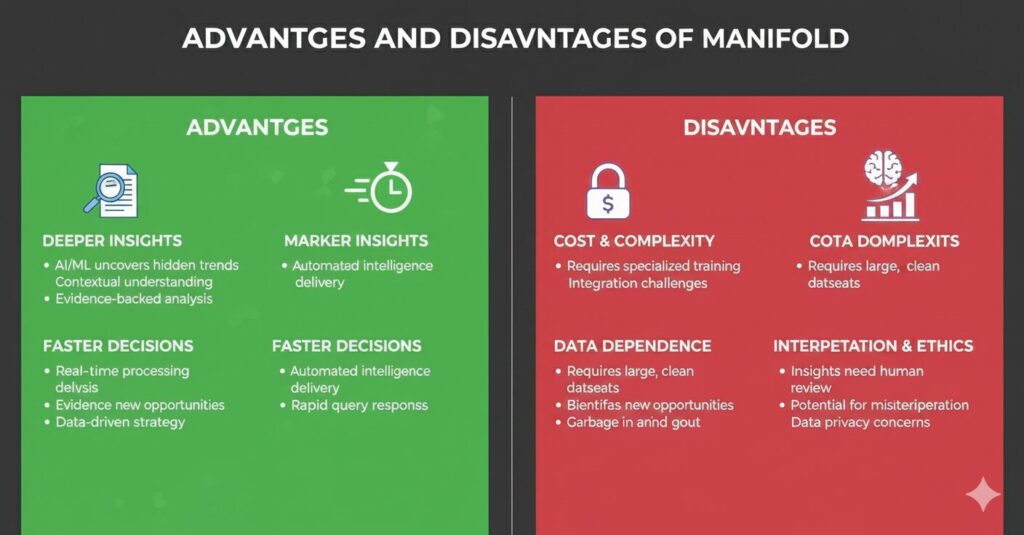
Source-Transparent Intelligence
No black boxes every insight traces to original evidence.
Domain-Specific Precision
Fine-tuned for finance, biotech, energy not generic web data.
Action-Oriented Design
Built for “So what?” not just information retrieval.
Proven ROI at Scale
75 percent time reduction; 65 percent fewer missed signals; 120 plus institutional clients.
Notable Disadvantages
Learning Curve for New Users
Analysts need 3 to 4 hours of training to master Insight Studio and signal tuning.
Upfront Configuration Required
Best results need domain calibration and workflow integration 1 to 2 week setup.
Not a Replacement for Judgment
AI surfaces signals; humans assess context, strategy, and risk tolerance.
Conclusion
The Intelligence Layer for Institutional Decision Making
Manifold operates where insight meets action where milliseconds and margins define success. In an era of data abundance and attention scarcity, it ensures that decisions are not just fast, but grounded, forward-looking, and defensible.
It is not about replacing analysts. It is about augmenting them with a tireless, meticulous, and deeply knowledgeable research partnerone that never misses a footnote, forgets a connection, or runs out of time. For institutions serious about the future of decision intelligence, Manifold is not just a tool. It is the intelligence layer for institutional decision making.