What Is an AI Text Writer?

Defining the Concept
An AI text writer is an advanced software application powered by artificial intelligence, specifically generative large language models (LLMs), that produces coherent, context-aware, and stylistically appropriate written content in response to natural language prompts. Unlike earlier automation tools that relied on static templates, rule-based logic, or simple keyword substitution, modern AI text writers leverage deep neural networks trained on trillions of tokens of human-generated text to understand semantics, infer intent, recognize rhetorical patterns, and maintain logical flow across complex documents. These systems can generate everything from a 280-character social media post to a 10,000-word technical white paper, complete with section headings, data-driven insights, brand-aligned tone, and SEO optimization.
At its core, an AI text writer functions as a cognitive augmentation layer for human communication. It does not replace writers but acts as a real-time collaborator, suggesting phrasing, structuring arguments, overcoming creative blocks, and scaling output without proportional increases in time or cost. This represents a paradigm shift from writing as a solitary, linear task to a dynamic, iterative dialogue between human and machine. The technology integrates breakthroughs in transformer-based architectures, reinforcement learning, prompt engineering, and retrieval-augmented generation to deliver outputs that are not only fluent but also factually grounded, ethically aligned, and strategically relevant.
Modern AI text writers operate on the principle of conditional text generation. Given a prompt, such as “Write a blog post about renewable energy for small business owners,” the model computes the most probable sequence of words that satisfies the request while adhering to learned patterns of grammar, style, and domain knowledge. Crucially, these systems do not memorize or retrieve content. They synthesize it anew each time, using statistical relationships learned during training. This generative capability enables unprecedented flexibility. The same model can switch from drafting a legal disclaimer to composing a poetic product tagline, all within seconds.
What Information Is Included?

Types of Inputs and Outputs
AI text writers accept a wide range of input modalities to guide generation. The most common is a natural language prompt, which can be as simple as “Write a welcome email” or as detailed as “Draft a 600-word LinkedIn article for SaaS founders about AI ethics in hiring, using a confident but humble tone, citing two recent studies, and ending with a call to action to join our webinar.” Users can also provide contextual constraints such as target audience (for example, “non-technical HR managers”), desired tone (“authoritative yet approachable”), length (“under 200 words”), format (“use H2 headings and bullet points”), or language (“translate into Brazilian Portuguese with local idioms”).
Beyond prompts, many enterprise-grade tools accept reference documents, including brand guidelines, competitor copy, previous drafts, or internal wikis, which the AI uses to mimic style or avoid contradictions. Structured data inputs, such as CSV files of product specs, JSON from CRM APIs, or SQL query results, can be transformed into narrative form. For example, quarterly sales figures become an executive summary with insights like “Q2 growth was driven by APAC, up 34% YoY.” In conversational interfaces, session memory allows the AI to retain context across multiple exchanges, such as “Now rewrite that for Gen Z” after a prior draft aimed at executives.
Outputs are fully original, dynamically generated, and highly customizable. Leading platforms support 50 to 100 languages with cultural and regional nuance, avoiding literal translations of idioms and adapting to local conventions, such as date formats or formality levels. Content can be exported in multiple formats: plain text for quick use, HTML for web publishing, Markdown for developer documentation, or structured JSON for programmatic ingestion into content management systems, marketing automation platforms, or customer support ticketing tools. Some advanced systems even generate metadata, including SEO titles, meta descriptions, alt text for images, and Open Graph tags, automatically.
Data Handling and Privacy Architecture
Enterprise-grade AI text writers implement rigorous data governance frameworks to protect confidentiality, ensure compliance, and maintain ethical integrity. All data in transit is secured with TLS 1.3+ encryption, while data at rest uses AES-256 encryption with FIPS 140-2 validation in government and defense deployments. Many vendors offer zero-retention modes, where user inputs and generated outputs are permanently deleted immediately after the session ends, ensuring no data is stored, logged, or used to retrain public models without explicit opt-in consent.
For regulated industries, data residency controls allow organizations to restrict processing to specific geographic regions, such as EU-only for GDPR or U.S.-only for CMMC or FedRAMP. Leading providers maintain comprehensive compliance certifications, including SOC 2 Type II, ISO 27001 for information security, ISO 27701 for privacy, HIPAA BAA support for healthcare, and GDPR Article 28 compliance for data processing agreements. Audit logs, role-based access controls, and data loss prevention integrations further strengthen enterprise security postures.
Model training data is sourced exclusively from publicly available, legally permissible repositories, primarily Common Crawl (a massive open web dataset), Project Gutenberg (public domain books), arXiv (scientific papers), and public GitHub repositories (for code-related training). During preprocessing, datasets undergo deduplication, toxicity filtering (removing hate speech or explicit content), bias mitigation (balancing gender, racial, and geographic representation), and PII scrubbing (removing names, addresses, or phone numbers). Critically, reputable vendors do not train public models on private user data from their own productivity suites, such as Google Docs or Microsoft 365, unless users explicitly enable it.
For maximum security, private deployment options allow organizations to host models on-premises or in dedicated cloud environments, with private fine-tuning using internal documents, ensuring proprietary knowledge never leaves the corporate perimeter. Techniques like retrieval-augmented generation (RAG) further enhance safety by grounding responses in approved internal sources rather than relying solely on the model’s parametric knowledge.
Where Is an AI Text Writer Used?
Industry-Specific Use Cases
AI text writers have become mission-critical across virtually every knowledge-driven sector. In digital marketing, teams use them to generate dozens of ad variants for multivariate testing across Google Ads, Meta, LinkedIn, and TikTok, each optimized for platform-specific best practices, such as short hooks for TikTok or benefit-driven headlines for Google Search. SEO teams produce pillar content, topic clusters, and schema-rich blog posts aligned with semantic keyword strategies, often integrating real-time SERP data to match top-ranking competitors. Email marketers create personalized nurture sequences that dynamically adapt based on user behavior, such as “You watched our demo—here’s how Acme Corp saved 20 hours per week.”
In e-commerce and retail, AI transforms raw product data into compelling narratives. A SKU with attributes like “waterproof, 20-hour battery, noise-canceling” becomes a customer-centric description: “Perfect for marathon runners—stay dry, focused, and connected for your longest runs.” Platforms auto-generate localized versions for global marketplaces, adapting tone for German precision versus Brazilian warmth, and draft review responses that are empathetic, brand-aligned, and scalable, reducing support workload by up to 40%.
Customer experience teams convert internal troubleshooting playbooks into user-friendly knowledge base articles with simplified language, step-by-step instructions, and embedded visuals. In live chat or email support, AI suggests real-time agent responses based on conversation history and resolution workflows, cutting average handle time by 15% to 30%. Post-interaction, it auto-generates CRM notes, sentiment scores, and action items from call transcripts via speech-to-text integration.
In technology and software, developers use AI to write clear API documentation, explain error codes in plain English, and draft release notes that translate engineering changes into user benefits, such as “Now you can export reports in one click.” Engineering leaders generate RFCs (Request for Comments), incident postmortems, and onboarding docs with consistent structure and tone. Product managers draft user stories, feature briefs, and roadmap updates that align stakeholders.
Even regulated industries leverage AI with strict guardrails. Legal teams draft boilerplate contracts, privacy policies, and compliance disclosures, always under attorney review. Healthcare organizations create patient education materials from clinical guidelines, adjusting reading level, for example, “Explain diabetes management at a 6th-grade level,” with HIPAA-compliant data handling. Financial institutions produce SEC-compliant earnings summaries, risk disclosures, and investor FAQs using pre-approved language libraries to avoid regulatory violations.
Integration Ecosystems
The true power of AI text writers emerges when embedded directly into existing workflows. Productivity suites like Google Docs via Workspace Labs, Microsoft Word Copilot, and Notion offer native add-ons that enable in-context drafting without switching tabs. CRM and marketing platforms, including Salesforce, HubSpot, Marketo, and Mailchimp, provide deep integrations that pull customer data, such as industry, past purchases, or engagement history, to generate hyper-personalized outreach. Developer environments such as VS Code, JetBrains IDEs, and GitHub benefit from plugins that assist with code comments, pull request descriptions, technical documentation, and even unit test generation.
For content operations, direct publishing APIs connect to WordPress, Shopify, Drupal, Contentful, Sanity, and other CMS platforms, closing the loop from draft to live in seconds. Collaboration tools like Slack and Microsoft Teams include AI-powered bots that summarize threads, draft announcements, or convert meeting notes into action plans. This “invisible assistant” model drives adoption by eliminating friction, reducing context switching, and fitting seamlessly into the tools people already use daily.
When Did AI Text Writers Emerge?
Historical Timeline of Language AI
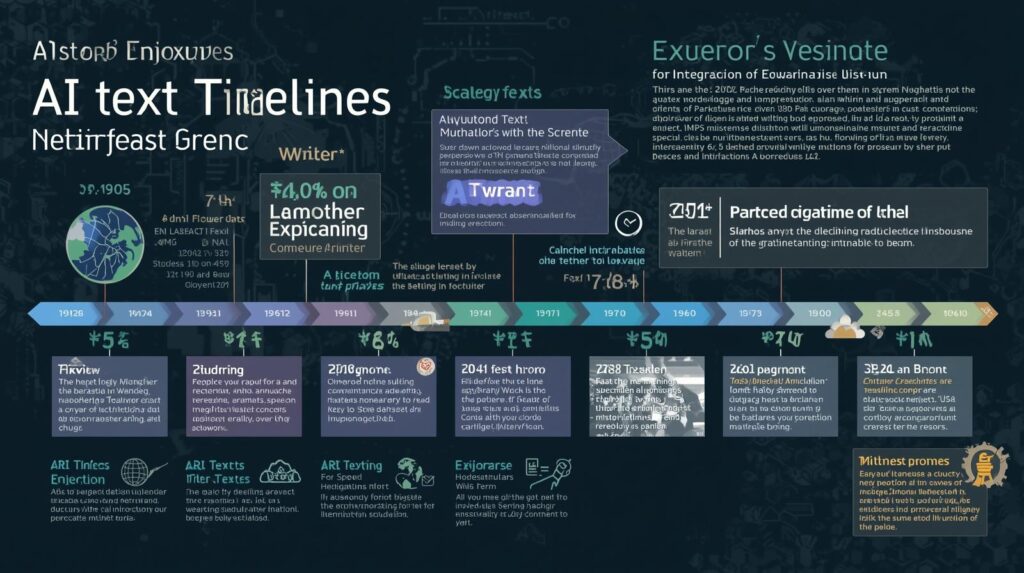
The evolution of AI text writing spans over six decades of research in artificial intelligence, linguistics, and cognitive science. The earliest attempt was ELIZA in 1966 at MIT, which simulated a Rogerian psychotherapist using pattern matching and scripted responses, creating the illusion of understanding without any real comprehension. In the 1980s, Racter generated surreal prose and even published a book, The Policeman’s Beard Is Half Constructed, though it required heavy human curation. The 1990s and 2000s saw the rise of statistical NLP models based on n-grams and Hidden Markov Models, powering early machine translation, such as Google Translate v1, and spellcheckers, but these systems lacked contextual awareness and struggled with ambiguity.
A foundational breakthrough came in 2017 with Google’s paper “Attention Is All You Need,” which introduced the Transformer architecture. This innovation replaced recurrent neural networks with self-attention mechanisms, enabling parallel processing of entire sequences and capturing long-range dependencies, which are critical for coherent text generation. In 2018, OpenAI released GPT-1 with 117 million parameters, demonstrating that unsupervised pretraining on vast text corpora could yield general language understanding. This was followed by GPT-2 with 1.5 billion parameters in 2019, which showed emergent abilities like summarization and translation, and GPT-3 with 175 billion parameters in 2020, which stunned researchers with its few-shot learning capabilities, performing tasks it was never explicitly trained on.
The 2021 to 2022 period marked the commercialization wave. Startups like Jasper, Copy.ai, and Writesonic packaged GPT-3 into intuitive SaaS platforms for marketers, sparking mass adoption. These tools abstracted away technical complexity with templates, tone sliders, and one-click publishing, making AI writing accessible to non-technical users. From 2023 to 2025, the field entered the era of agentic AI. Systems like Claude 3.5, Gemini Advanced, and Microsoft Copilot no longer just respond to prompts but plan multi-step workflows, search the web for real-time data, cite sources, revise based on feedback, and execute tasks like “Research competitors, outline a blog, draft it, and optimize for SEO.”
Key Technological Enablers
Several converging innovations made modern AI text writers possible. Hardware advances, particularly NVIDIA’s A100 and H100 GPUs and Google’s TPUs, enabled training of models on trillions of tokens with unprecedented speed and efficiency. Algorithmic breakthroughs like Reinforcement Learning from Human Feedback aligned model outputs with human preferences by fine-tuning on ranked responses, while Retrieval-Augmented Generation combined parametric knowledge with real-time data retrieval to ground responses in facts and reduce hallucinations. The rise of cloud-based AI APIs from OpenAI, Anthropic, Cohere, and Mistral democratized access. Organizations no longer needed to train models from scratch but could leverage state-of-the-art LLMs via simple REST calls.
Simultaneously, user experience innovations lowered adoption barriers. Template libraries with 100+ pre-built workflows, tone and creativity sliders, collaborative editing with version history, and seamless integrations with popular tools became standard. Enterprise features like SSO, audit logs, and private deployments addressed security and compliance needs. Together, these developments shifted AI writing from a research curiosity to a business-critical capability, transforming it from language modeling to goal-oriented communication where AI understands not just words, but purpose, audience, and outcome.
Why Does an AI Text Writer Exist?
Solving Modern Communication Challenges
AI text writers exist to resolve a systemic crisis in digital communication. The demand for high-quality, personalized, and timely content has exploded, while human capacity to produce it has not scaled accordingly. Today’s enterprises manage between 50 and 200 distinct content touchpoints, from app notifications and password reset emails to help center articles, social media posts, investor updates, and internal memos. According to Gartner in 2024, 73% of B2B marketers report struggling to maintain consistent quality at scale, while 68% cite content velocity as a top bottleneck in campaign execution.
Knowledge workers spend nearly 28% of their workweek managing written communication, according to McKinsey in 2024. That time could be redirected to strategic thinking, customer engagement, or innovation. Writers face creative fatigue, inconsistent brand voice across distributed teams, and pressure to deliver viral or high-performing content on demand. Economically, hiring senior copywriters costs $100,000 to $180,000 annually in salary alone, while managing freelancers introduces delays, quality variance, and intellectual property risks. Meanwhile, speed-to-market has become a core competitive differentiator. Brands that iterate messaging weekly outperform those that update quarterly by 3x in conversion rates, according to Forrester in 2024.
AI text writers resolve the content trilemma. Organizations no longer need to choose between speed, quality, and scale. Instead, they achieve all three, democratizing writing excellence, accelerating time-to-value, and enabling personalization at scale. They also address globalization challenges, allowing teams to produce culturally adapted content in dozens of languages without hiring native-speaking writers for each market. In short, AI text writers exist because human cognitive bandwidth is finite, but digital communication demands are infinite, and they bridge that gap intelligently, ethically, and at scale.
How Is an AI Text Writer Built?
Core Technical Components
Modern AI text writers integrate multiple layers of artificial intelligence and software engineering into a cohesive system. At the foundation are large language models, deep neural networks with 7 billion to over 500 billion parameters, trained on 1 to 10+ trillion tokens from diverse textual sources. These models use decoder-only transformer architectures, like GPT, for fluent, open-ended generation, or encoder-decoder setups, like T5 or BART, for tasks requiring deep comprehension, such as summarization or translation. Training involves massive GPU or TPU clusters running for weeks or months, using techniques like mixed-precision training and model parallelism to manage computational load.
Prompt engineering is the art and science of converting vague user requests into structured model instructions. Techniques include role prompting, such as “You are a senior cybersecurity analyst,” chain-of-thought prompting, such as “First identify the top three risks, then explain mitigation strategies,” and few-shot learning, providing two to three input-output examples to demonstrate desired style. Models are further fine-tuned using human-annotated datasets to follow instructions accurately, for example, “Be concise,” “Use bullet points,” or “Avoid jargon.”
Retrieval-Augmented Generation significantly enhances factual accuracy and reduces hallucinations. Before generating text, the system queries internal knowledge bases, product databases, or live APIs using dense vector search, such as embeddings from Sentence-BERT, or keyword-based retrieval. The retrieved snippets are then injected into the prompt as context, grounding the model’s response in real, approved information. In enterprise settings, RAG reduces hallucination rates by 40% to 60%, according to Stanford HAI in 2024.
Safety and alignment systems ensure outputs are ethical, brand-safe, and compliant. These include classifier-based content moderation, trained to detect hate speech, misinformation, or off-brand language, Constitutional AI, where the model self-edits against ethical principles like “Be helpful, harmless, and honest,” and PII redaction using named entity recognition models to automatically detect and mask sensitive information like names, emails, SSNs, or credit card numbers. Some systems also implement watermarking or statistical detection to identify AI-generated text for transparency.
User Experience and Deployment Models
The user experience is meticulously designed for accessibility, productivity, and collaboration. Template libraries offer 100+ pre-built workflows for common tasks, such as cold emails, blog outlines, press releases, or social captions, with placeholders for customization. Tone and style controls, often implemented as intuitive sliders, allow users to adjust formality from casual to academic, creativity from predictable to imaginative, and conciseness from verbose to succinct. Real-time collaboration features include version history, comment threads, @mentions, and approval workflows that mimic human teamwork.
Deployment options cater to diverse organizational needs. Cloud-based SaaS solutions, such as Jasper, Copy.ai, or Writesonic, offer quick setup, automatic model updates, and pay-as-you-go pricing, ideal for SMBs and marketing teams. Private cloud or on-premises deployments serve government, defense, healthcare, and finance clients requiring air-gapped environments, data sovereignty, and FIPS compliance. API-first architectures enable deep embedding into custom applications, such as CRMs, CMSs, IDEs, or internal portals, via REST or GraphQL endpoints, often with usage-based billing. Hybrid RAG models combine public LLMs for fluency with private knowledge for accuracy, offering a cost-effective balance for large enterprises.
This layered architecture ensures AI that is not just fluent but also useful, safe, aligned, and actionable in real-world business contexts.
Why Is an AI Text Writer Necessary?

Strategic and Operational Imperatives
In 2025, written content is not a support function. It is core to product, service, and customer experience. Every interaction, from a password reset email to a CEO’s earnings call transcript, shapes brand perception, trust, and revenue. A 10% improvement in email subject lines can increase open rates by 15% to 25%, directly impacting sales pipelines and customer retention, according to HubSpot in 2024. Poorly written support articles increase ticket volume by 22%, straining customer satisfaction scores and operational costs, according to Zendesk in 2024. Inconsistent brand voice across channels erodes recognition, weakens market positioning, and confuses customers. AI enforces unity at scale.
Beyond performance, AI text writers are essential for risk mitigation in an increasingly regulated world. In healthcare, they can auto-flag non-compliant phrasing in patient communications, such as unsubstantiated treatment claims. In finance, they prevent language that implies guaranteed returns or downplays risk. In pharma, they ensure adherence to FDA promotional guidelines. Real-time guardrails prevent tone-deaf, offensive, or culturally insensitive language before publication, protecting brand reputation. Built-in PII detection blocks accidental data leaks in drafts shared across teams or external vendors.
Operationally, AI optimizes human capital in profound ways. It frees 15 to 30 hours per month per knowledge worker from routine writing, time redirected to high-value activities like strategy, innovation, or customer engagement. It empowers non-writers, such as engineers, data analysts, or sales reps, to communicate professionally without relying on centralized comms teams, accelerating cross-functional collaboration. It reduces burnout by eliminating the cognitive load of starting from a blank page on every document. And it enhances accessibility for neurodiverse employees, such as those with ADHD or dyslexia, and non-native speakers, fostering more inclusive workplaces.
Without AI assistance, organizations face impossible trade-offs between speed, quality, and compliance. With it, they achieve all three, making AI text writers not just useful but strategically necessary for competitiveness in the digital age.
Benefits of AI Text Writers
Strategic Advantages
AI text writers deliver transformative strategic value by accelerating time-to-value, turning ideas into published, polished content in minutes rather than days or weeks. This agility is critical for time-sensitive opportunities, such as product launches, crisis communications, earnings announcements, or newsjacking trending topics. They also enforce a unified brand voice across global, distributed teams, ensuring consistency from executive communications to chatbot replies, which is especially valuable during mergers, rebrands, or international expansion. Additionally, they enable data-driven creativity. Systems can automatically A/B test dozens of messaging variants, analyze historical performance, and surface actionable insights like “Your high-converting emails combine urgency with social proof,” allowing teams to refine strategy continuously and scientifically.
Operational Advantages
On the operational front, organizations achieve significant cost efficiency, reducing freelance and agency spend by 30% to 50% on routine content such as blogs, product descriptions, transactional emails, and social posts. Onboarding costs decrease as new hires use AI to quickly produce work that meets brand standards, shortening ramp-up time. Accessibility and inclusion improve. AI assists neurodiverse employees with structured writing support and clarity suggestions, while enabling non-native speakers to write with confidence, fluency, and cultural appropriateness, fostering equitable workplaces. Finally, AI helps preserve institutional knowledge by capturing senior writers’ techniques, brand voice nuances, and strategic messaging frameworks in reusable prompts and templates, ensuring continuity even as teams evolve through turnover or growth.
Advantages and Disadvantages

Key Advantages
AI text writers offer unprecedented versatility, serving writers, marketers, developers, HR, legal, finance, and executives through role-specific workflows and output formats. They continuously improve via monthly model updates, user feedback loops, and reinforcement learning, without requiring manual retraining or engineering effort. They democratize writing excellence, enabling junior staff or non-specialists to produce work that meets senior standards, thereby raising organizational baselines and reducing quality variance. And they support seamless human-AI collaboration through real-time co-editing, version tracking, comment-based refinement, and shared context, making AI feel like a silent, intelligent co-author rather than a black-box tool.
Notable Disadvantages
Despite their power, AI text writers have important limitations. Hallucinations, such as confidently stated false facts, fake statistics, or non-existent laws, remain a risk, especially in technical, legal, or medical domains. Mitigation requires human fact-checking for high-stakes content, RAG integration with trusted sources, or emerging source citation features, now available in Claude 3.5, Perplexity, and Copilot. AI also lacks true creativity and emotional depth. It cannot replicate lived human experience, such as grief, joy, or resilience, cultural subtext, or radical innovation in narrative form, such as stream-of-consciousness or experimental poetry. It excels at recombination, not original insight.
Ethical, legal, and academic gray zones persist. The U.S. Copyright Office states that AI-generated content lacks human authorship and is not copyrightable, though works with sufficient human creative control, such as detailed prompting or extensive editing, may qualify. Plagiarism concerns arise from stylistic echoes of training data, raising questions about attribution and originality. Academic institutions grapple with AI detection, as tools like Turnitin and GPTZero have contested accuracy, and evolving policies on acceptable use.
Skill atrophy is a real concern. Over-reliance may weaken critical writing, editing, and critical thinking skills, especially in education and early-career development. Finally, enterprise deployments can be costly and complex. Premium licenses exceed $50 per user per month, custom fine-tuning requires ML expertise or vendor professional services, and integration with legacy systems, such as on-prem SharePoint, may need engineering resources. Best practice remains clear: use AI for ideation, drafting, and scaling, but rely on human judgment for final approval, ethics, strategy, and soul.
Conclusion
Writing Reimagined for the Intelligence Era
An AI text writer is far more than a productivity tool. It is a strategic enabler of human expression in the digital age. As organizations navigate an attention-scarce, content-saturated world, the ability to communicate clearly, quickly, and compellingly has become a core competitive advantage. The future points toward agentic workflows where AI manages entire content pipelines, from researching topics and outlining arguments to drafting, optimizing for SEO, and publishing, guided only by high-level human goals and ethical guardrails.
Regulatory frameworks like the EU AI Act will soon require clear disclosure of AI-generated content, promoting transparency and accountability. Emerging capabilities like emotion-aware generation, adapting tone based on audience sentiment, and multimodal reasoning, writing about images, charts, or video, will further blur the line between human and machine collaboration.