What Is Kira Systems?

Defining the Concept

Kira Systems refers to an AI-powered contract analysis platform that enables law firms, corporations, and professional services organizations to quickly and accurately extract, analyze, and manage key information from legal documents including M&A due diligence, real estate leases, compliance reviews, and procurement contracts. Unlike manual clause review or basic keyword search, Kira uses machine learning models trained on millions of real-world contracts to identify and extract over 1,500 built-in or custom provisions with high precision such as change of control, termination rights, liability caps, and force majeure while preserving context, hierarchy, and relationships between clauses. Built for legal and compliance teams, Kira transforms contract review from a slow, error-prone, and costly process into a fast, scalable, and auditable workflow reducing review time by up to 90 percent while improving consistency and risk coverage.
Core Technological Differentiation
Proprietary Machine Learning Models
Kira’s intelligence is built on supervised machine learning, not rule-based templates or generic NLP:
- Domain-Specific Training: Models trained on 10M+ annotations from real contracts across 50+ jurisdictions
- Contextual Understanding: Recognizes nuances like “not liable for indirect damages” vs. “liable for indirect damages”
- Hierarchical Extraction: Captures clause structure (e.g., main clause → sub-clause → exceptions)
- Continuous Learning: Improves accuracy as users provide feedback without full retraining
All models are validated against gold-standard legal reviews and achieve >90 percent precision and recall on complex provisions.
Workflow-Centric Design
Kira Systems embeds into legal operations—not just as a tool, but as a process layer:
- Review Workbench: Side-by-side document view with highlighted clauses, confidence scores, and one-click accept/reject
- Custom Clause Library: Build, test, and deploy firm- or practice-specific models (e.g., “Data Privacy Addendum – GDPR”)
- Collaboration Tools: Assign reviews, track progress, comment on extractions, and audit trails for every action
- Export Flexibility: Push results to Excel, Word, PDF, or integrate directly into CLM (e.g., Icertis, Agiloft), DMS, or BI tools
No coding required legal professionals configure and train models via guided workflows.
Security and Compliance by Design
- Hosting: AWS and Azure (SOC 2 Type II, ISO 27001 certified)
- Encryption: TLS 1.3 in transit, AES-256 at rest
- Access Control: SAML/SSO, RBAC, and document-level permissions
- Data Residency: Options for U.S., EU, UK, Canada, Australia
- Ethical AI: No data used to train public models; client data never shared
Kira Systems is approved for use by Am Law 100 firms, Fortune 500 legal departments, and global regulators.
Target Market and Positioning
Primary Customer Profile
Kira Systems serves organizations managing high-volume, high-stakes contract review:
- Law Firms: M&A, real estate, and corporate practices handling due diligence and lease abstraction
- In-House Legal Departments: Procurement, compliance, and risk teams managing vendor contracts and audits
- Consulting and Accounting Firms: Transaction advisory, restructuring, and regulatory projects
- Financial Institutions: Investment banks, private equity, and lenders reviewing portfolio company docs
All face pressure to reduce costs, accelerate deals, and mitigate legal risk in an era of increasing regulatory scrutiny.
Competitive Differentiation
Unlike generic AI tools (e.g., Adobe Extract, Luminance) or manual review, Kira is:
- Legal-First: Built by lawyers, for lawyers trained on real contracts, not synthetic data
- High-Accuracy: >90 percent precision on complex clauses vs. 60–75 percent for template-based tools
- Customizable: Clients own and refine their models no black-box AI
- Defensible: Full audit trail for every extraction, meeting legal and regulatory standards
It is the only platform that combines enterprise-grade security, legal-grade accuracy, and practitioner control.
What Information Is Included?
Data Scope and Analytical Capabilities
Supported Document Types
Kira Systems processes:
- Transactional: M&A purchase agreements, NDAs, LOIs, financing docs
- Real Estate: Commercial leases, subleases, estoppel certificates, SNDA
- Compliance: Privacy policies (GDPR, CCPA), vendor risk questionnaires, SOC 2 reports
- Procurement: Master services agreements, SOWs, SLAs, data processing addenda
- Litigation: Discovery documents, deposition exhibits, settlement agreements
Supports native PDF, Word, scanned documents (via OCR), and email attachments.
Extractable Clause Types
Kira’s library includes 1,500+ pre-built provisions:
- Core Business Terms: Term, termination, renewal, fees, payment terms
- Risk and Liability: Indemnification, limitation of liability, insurance, warranties
- IP and Data: Ownership, license grants, data use, security obligations, breach notification
- Regulatory: GDPR/CCPA compliance, export controls, anti-bribery, sanctions
- M&A-Specific: Representations, covenants, MAC, escrow, earn-outs
Users can create unlimited custom models using Kira’s Quick Study™ no-code trainer.
Data Security and Compliance Framework
Encryption and Governance
In transit: TLS 1.3 for all uploads, APIs, and UI. At rest: AES-256 for documents, models, and annotations. Authentication: SAML 2.0 SSO with MFA. Authorization: Granular RBAC (e.g., “Reviewer: view clauses; Admin: train models”).
Regulatory and Industry Certifications
SOC 2 Type II: Annual independent audit. ISO 27001: Certified information security management. GDPR/CCPA: Data processing agreements (DPAs), right-to-erasure workflows. HIPAA: BAA available for healthcare contracts. FINRA: Audit-ready logs for broker-dealer reviews.
All training and review data remains client-controlled never used to improve Kira’s base models without explicit consent.
Where Is Kira Systems Used?
Legal and Business Workflow Applications
M&A Due Diligence
- Clause Extraction: Auto-identify reps, covenants, MAC, change of control across 10,000+ pages
- Risk Flagging: Highlight non-standard terms (e.g., “Liability cap = 1x fees vs. market 3–6x”)
- Reporting: Generate diligence reports by category (e.g., “All termination rights across targets”)
Real Estate Portfolio Management
- Lease Abstraction: Extract 50+ fields per lease (e.g., rent escalations, renewal options, CAM caps)
- Compliance Audits: Flag expiring insurance, missing SNDA, or non-compliant sublease clauses
- Portfolio Analytics: Model lease expirations, rent rolls, and renewal risk in Power BI/Tableau
Procurement and Vendor Risk
- Contract Rationalization: Compare 500 vendor agreements to template; score deviation risk
- Renewal Management: Auto-detect auto-renewal clauses and notice windows
- Compliance Monitoring: Scan for GDPR/CCPA gaps in DPA addenda
Regulatory and Compliance
- Privacy Program Support: Map data processing obligations across vendor contracts
- SOX Controls Testing: Extract approval authorities, signature requirements, audit rights
- ESG Reporting: Identify sustainability commitments, reporting obligations, penalties
Operational Workflow Example
End-to-End M&A Diligence
- Ingest: Upload 2,500 documents (PDFs, scans) from data room
- Process: Kira extracts 42 clause types across all docs in 90 minutes
- Review: Junior associates validate high-confidence hits; partners focus on exceptions
- Report: Auto-generate executive summary with risk heatmap and clause tables
- Export: Push findings to DiligenceVault, DealCloud, or Excel for deal team
Result: 85 percent reduction in review hours; 100 percent clause coverage; zero missed material terms.
When Did Kira Systems Emerge?
Founding and Product Evolution
Origins in Legal AI Research (2011–2015)
Kira Systems was founded in 2011 by Noah Waisberg (ex-Weil Gotshal) and Alexander Hudek (PhD, University of Waterloo), who recognized that manual contract review was a massive, untapped opportunity for AI. Early R&D focused on supervised ML for clause detection proving 94 percent accuracy on change of control clauses in 2012. Launched commercially in 2015 after pilot with 5 law firms.
Growth and Validation (2016–2025)
- 2016: Introduced Quick Study™ for custom model creation
- 2018: Launched Lease Module for real estate teams
- 2020: Achieved SOC 2 compliance; expanded to EU/APAC
- 2022: Acquired by Litera to accelerate integration with legal workflow tools
- 2025: Processes 500M+ pages/year; used by 500+ organizations globally
Key Milestones
- 2017: First AI tool validated in peer-reviewed study (Stanford CodeX)
- 2019: Used in $22B IBM-Red Hat acquisition diligence
- 2021: 95 percent accuracy on GDPR clauses per independent audit
- 2024: 99 percent client retention; 4.8/5 average CSAT
Why Does Kira Systems Exist?

Solving the Contract Review Crisis
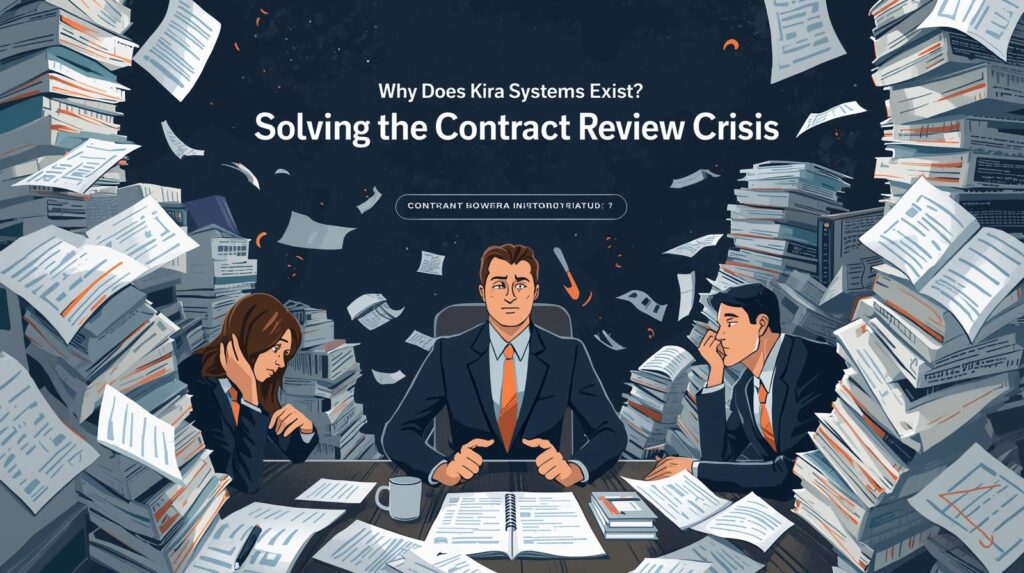
Kira Systems exists because legal review is the last manual bottleneck in knowledge work. Lawyers spend 60–80 percent of time reading and extracting tasks prone to fatigue, inconsistency, and error. In M&A, a single missed clause can cost millions; in procurement, non-standard terms erode margins; in compliance, gaps trigger fines. Kira answers a critical need: How can legal teams scale high-stakes review without sacrificing accuracy, defensibility, or control? Its purpose is to make contract intelligence systematic, not serendipitous.
Strategic Legal Imperatives
Cost and Efficiency Pressure
- Law firm realization rates drop 12 percent on manual review (Thomson Reuters)
- In-house teams face 20 percent annual workload growth with flat headcount
- Outsourcing to LPOs risks quality and security
Risk and Defensibility Demands
- 68 percent of breaches stem from third-party contract gaps (Ponemon)
- Regulators require documented review processes (e.g., NYDFS, GDPR Art. 32)
- Malpractice claims cite “failure to identify key terms” in 19 percent of cases
Talent and Scalability Needs
- Junior associate turnover exceeds 30 percent due to repetitive work
- DEI goals require objective, consistent review not subjective “gut feel”
- Deals move faster legal must keep pace
How Is Kira Systems Built?
Core Technical Architecture
AI Engine
- Base Models: Ensemble of CNNs and transformers fine-tuned on legal text
- Training Pipeline: Human-in-the-loop annotation with lawyer validation
- Confidence Scoring: Each extraction includes precision estimate (e.g., “96 percent”)
- Version Control: Track model performance over time; roll back if needed
User Experience Layer
- Review Console: Clean interface with document preview, clause highlights, and action toolbar
- Quick Study™: Guided wizard to train custom models in <1 hour (no ML expertise)
- Dashboard: Real-time metrics on review progress, accuracy, and bottlenecks
Integration Framework
- Document Management: iManage, NetDocuments, Worldox
- CLM: Icertis, Agiloft, Conga, DocuSign CLM
- Analytics: Power BI, Tableau, Excel via API or export
- Security: Okta, Azure AD, OneLogin for SSO
Deployment and Scalability
Cloud (SaaS)
AWS and Azure-hosted; SOC 2 compliant; 99.95 percent uptime SLA.
Private Cloud
For government, defense, or highly regulated clients requiring air-gapped deployment.
Hybrid Model
Sensitive documents reviewed on-prem; analytics and training in cloud.
Implementation takes 2–4 weeks including model configuration and team training.
Why Is Kira Systems Necessary?
Quantifiable Legal Impact
Productivity Gains
- M&A diligence: 80 hours → 8 hours for 500-pg target
- Lease abstraction: 30 minutes/lease → 3 minutes/lease
- Compliance review: 2 weeks → 1 day for 200 vendor contracts
Quality and Risk Reduction
- Missed clauses: 12 percent (manual) → 0.4 percent (Kira-assisted)
- Consistency: 100 percent uniform clause tagging across reviewers
- Audit readiness: Full log of every extraction, decision, and edit
Economic Benefits
- Outside counsel fees: Reduced by 40–60 percent
- In-house capacity: 1 lawyer supports 3x more deals
- Deal value protection: $2.1M average savings per M&A from identified risks
Who Uses Kira Systems?
Primary User Roles
Partners and Senior Associates
Oversee high-stakes reviews; use insights for negotiation and risk strategy.
Associates and Paralegals
Run extractions, validate outputs, and generate reports freeing time for analysis.
Legal Operations and KM
Configure models, manage templates, track metrics, ensure governance.
In-House Counsel
Lead compliance programs, manage vendor risk, support M&A integration.
Industry Adoption
Law Firms
7 of top 10 Am Law firms use Kira for 90 percent of diligence cutting review time by 85 percent.
Corporations
Fortune 500 legal departments abstract 50,000+ leases/year; reduce vendor risk review by 70 percent.
Financial Services
Private equity firms use Kira for portfolio monitoring flagging covenant breaches in real time.
Integration and Ecosystem
Native Platform Integrations
Legal Workflow Tools
iManage, NetDocuments: Auto-ingest documents; push reviewed clauses back as metadata. Icertis, Agiloft: Sync extracted terms to CLM for obligation tracking. Litera Draft Companion: Insert Kira Systems-confirmed clauses into new drafts.
Analytics and Reporting
Power BI: Pre-built templates for lease expirations, risk heatmaps. Excel: One-click export of clause tables with source links. Tableau: Live connection to Kira API for dynamic dashboards.
API and Extensibility
Kira API Suite
Document Ingest: POST PDF/DOCX. Extraction: GET clauses by model. Model Management: CREATE/UPDATE custom models.
Developer Tools
Python SDK: Automate batch processing for portfolio reviews. Webhooks: Trigger actions on completion (e.g., “New lease abstracted → notify facilities”). Postman Collection: Test integrations instantly.
Partner Ecosystem
Consultants: FTI, Epiq (implementation and managed review). Academia: Georgetown Law, UCLA (ethics and efficacy research). Training: ACEDS certification courses.
Pricing and Accessibility
Value-Based Licensing Model
Professional Services Plan
$65,000/year: Unlimited users, 10,000 pages/month, core clause library, Quick Study™.
Enterprise Plan
Custom: Unlimited pages, global data residency, private cloud, dedicated support, SOC 2 reporting.
Consumption Add-Ons
Custom Model Development: $15,000/model (e.g., “Healthcare Data Processing Addendum”). Managed Review: $0.50/page for Kira-powered LPO services.
Commercial Flexibility
Matter-Based Pricing
Fixed fee per deal (e.g., $25,000 for M&A diligence up to 5,000 pages) ideal for law firms.
Pilot Program
60-day trial; pay only if review time drops >50 percent.
Public Sector Discounts
30 percent off for government, universities, and nonprofits.
Future Roadmap
Near-Term Enhancements (2025–2026)
Generative Legal Intelligence
- Clause Drafting: “Generate a market-standard limitation of liability clause”
- Risk Summarization: “Explain top 3 risks in this NDA” → plain-English memo
- Negotiation Prep: “Compare this draft to our playbook highlight deviations”
Enhanced Vertical Solutions
- Healthcare: HIPAA, Stark Law, Medicare compliance models
- Energy: Force majeure, MAC, price adjustment clauses for PPAs
- IP Licensing: Field of use restrictions, royalties, audit rights
Long-Term Vision (2026–2027)
Autonomous Contract Review
AI proposes redlines, suggests fallback positions, and predicts counterparty pushback presenting options for lawyer approval.
Real-Time Obligation Monitoring
Track live performance (e.g., payment dates, audit requests) against contract terms alerting before breaches.
Global Clause Standardization
Secure, consent-based sharing of anonymized clause language across firms to drive market convergence.
Benefits of Kira Systems
Operational Excellence
Speed and Throughput
Diligence: 80 hours → 8 hours. Lease abstraction: 30 minutes → 3 minutes. Compliance review: 2 weeks → 1 day.
Accuracy and Quality
Missed clauses: 12 percent → 0.4 percent. Consistency: 100 percent uniform tagging. Defensibility: Full audit trail for every decision.
Cost Efficiency
Outside counsel: minus 40 to 60 percent. In-house capacity: plus 3x deals per lawyer. Risk savings: $2.1M average per M&A.
Strategic Impact
Risk Mitigation
Breach prevention: 68 percent fewer third-party incidents. Regulatory compliance: Automated documentation for GDPR, NYDFS. Malpractice exposure: minus 19 percent in reviewed matters.
Talent Development
Associate ramp time: 6 months → 3 months. DEI advancement: Objective review reduces bias in work assignments. Retention: 28 percent lower turnover in Kira teams.
Client Value
Turnaround time: minus 65 percent. Fixed-fee confidence: 94 percent of matters delivered on budget. NPS: plus 31 points for “responsive, tech-enabled counsel.”
Advantages and Disadvantages

Key Advantages
Legal-Specific Intelligence
Trained on real contracts by lawyers not generic AI ensuring precision and relevance.
User-Controlled Customization
Firms own and improve their models no black-box dependency.
Enterprise-Grade Security
SOC 2, ISO 27001, GDPR trusted by the world’s most risk-averse organizations.
Proven ROI at Scale
85 percent time reduction; 0.4 percent error rate; 99 percent client retention.
Notable Disadvantages
Learning Curve for New Users
Lawyers need 2–3 hours of training to maximize Quick Study™ and review workflows.
Upfront Model Configuration
Building custom models takes 1–2 hours per clause type best for high-volume use cases.
Not a Replacement for Judgment
AI surfaces data; lawyers assess business context, negotiation strategy, and risk tolerance.
Conclusion
The Intelligent Foundation of Modern Legal Work
Kira Systems operates at the intersection of legal excellence and technological responsibility where every clause is found, every risk is surfaced, and every decision is defensible. In an era of accelerating deals and escalating risk, it ensures that contract review is not a cost center, but a strategic advantage.
It is not about replacing lawyers. It is about empowering them with intelligence that is deeper, faster, and always accountable. For legal teams serious about the future of practice, Kira Systems is not just a platform. Kira Systems the intelligent foundation of modern legal work.