What Is MLCode?

Defining the Concept
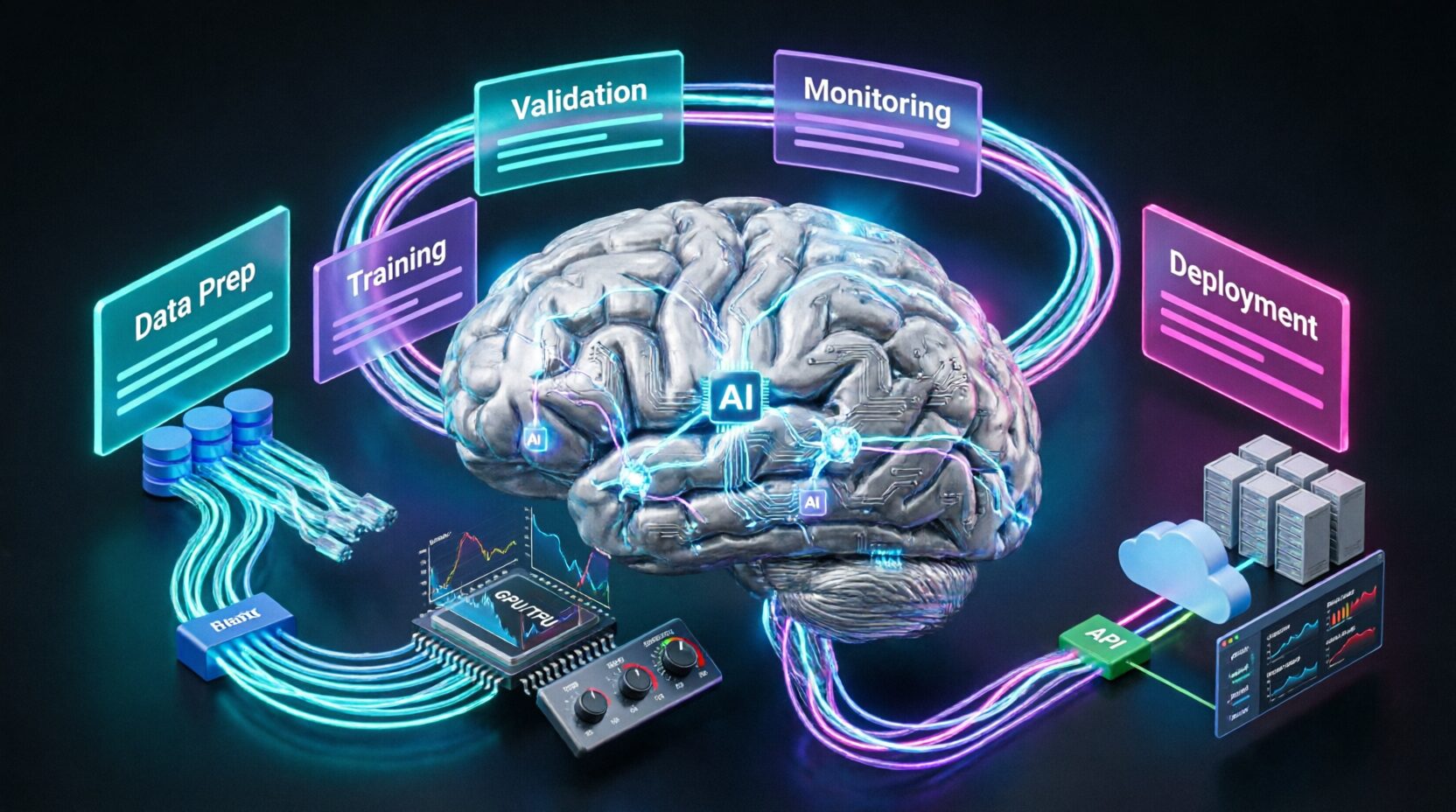
MLCode refers to an AI-powered development environment that enables data scientists and ML engineers to build, debug, and deploy machine learning models using natural language and code-generation—without writing boilerplate, debugging pipeline errors, or switching between tools. Unlike generic AI coding assistants (e.g., GitHub Copilot) that suggest single lines or functions, MLCode understands the full ML lifecycle from data loading and preprocessing to model training, evaluation, and deployment and generates complete, production-ready pipelines in Python, PyTorch, or TensorFlow. Built for teams shipping models to production, MLCode reduces time-to-prototype from days to minutes and time-to-deploy from weeks to hours, while enforcing best practices in reproducibility, testing, and MLOps.
Core Technological Differentiation
ML-Specific Code Generation Engine
MLCode is not a general LLM fine-tuned on GitHub. It is a hybrid system combining: Domain-Pretrained LLM: Trained on 500M plus lines of ML code (Kaggle, Papers With Code, Hugging Face, arXiv implementations). Symbolic Reasoning Layer: Validates code against ML type systems (e.g., “input shape must match model”). Execution Feedback Loop: Runs generated code in sandboxed containers; learns from failures (e.g., “CUDA OOM → reduce batch size”). Pattern Library: Encodes 1,200 plus validated ML patterns (e.g., “time-series CV with walk-forward validation”). This ensures outputs are not just syntactically correct—but statistically sound and production-viable.
End-to-End Pipeline Automation
MLCode generates full workflows not snippets: Data Layer: Clean, augment, split, and version datasets with DVC or FiftyOne. Model Layer: Select architecture (CNN, Transformer, GNN), tune hyperparameters, log to MLflow. Evaluation Layer: Compute domain-specific metrics (e.g., mAP for CV, WAPE for forecasting). Deployment Layer: Export to ONNX, build Docker containers, generate FastAPI endpoints. All code includes error handling, logging, and config management (Hydra, OmegaConf).
Integrated Debugging and Refinement
MLCode doesn’t just generate it diagnoses and improves: Auto-Debug: Highlights failing cells; suggests fixes (“Add scaler before PCA”). Performance Advisor: “Your DataLoader is CPU-bound enable num_workers equals 4.” Bias Detector: Flags data leakage, label imbalance, or spurious correlations. Refactor Tool: “Convert to PyTorch Lightning for cleaner training loop.” This transforms ML development from trial-and-error to guided, iterative refinement.
Target Market and Positioning
Primary Customer Profile
MLCode serves technical teams shipping ML in production: Mature Startups: Series B plus with dedicated ML teams (e.g., fraud, recommendation, NLP). Enterprise AI Labs: Banks, insurers, retailers building in-house models. ML Platform Teams: Internal tooling groups standardizing MLOps across orgs. Research Engineers: Academia and labs translating papers to reproducible code. All struggle with fragmented tools, fragile pipelines, and knowledge silos.
Competitive Differentiation
Unlike GitHub Copilot (line-level) or Amazon CodeWhisperer (AWS-biased), MLCode is: ML-native: Understands concepts like overfitting, drift, and feature importance not just syntax. Toolchain-agnostic: Works with any stack (scikit-learn, XGBoost, PyTorch, TFX). Production-focused: Generates tested, monitored, and versioned pipelines—not notebooks. Collaborative: Shared workspaces with version diffing, review, and reuse. It is the only AI that speaks the full language of machine learning from hypothesis to HTTP endpoint.
What Information Is Included?
Data Scope and Code Capabilities
Supported ML Tasks and Frameworks
MLCode covers: Supervised Learning: Regression, classification, ranking (scikit-learn, XGBoost, LightGBM). Deep Learning: CV (ResNet, ViT), NLP (BERT, T5), time series (Informer, N-BEATS). Generative AI: LLM fine-tuning (LoRA, QLoRA), diffusion models, RAG pipelines. MLOps: Feature stores (Feast), experiment tracking (MLflow, Weights and Biases), monitoring (Evidently, WhyLabs). Outputs are framework-agnostic switch from PyTorch to TensorFlow with one command.
Input Modalities and Prompting
Natural Language: “Build a time-series forecaster for hourly electricity demand with Prophet and XGBoost ensemble.” Code Snippets: Paste a failing training loop; MLCode debugs and optimizes. Data Samples: Upload CSV or Parquet; MLCode infers schema and suggests preprocessing. Paper Links: “Implement Figure 3 from arXiv:2402.12345” → generates full reproducible code. All prompts respect context—no re-explaining project goals.
Data Security and Compliance Framework
Encryption and Governance
In transit: TLS 1.3 for all API and data movement. At rest: AES-256 for code, configs, and model artifacts. Authentication: SSO (SAML/OIDC), RBAC with granular permissions (e.g., “Researcher: edit; ML Eng: deploy”). Air-Gapped Option: On-prem deployment with no external internet access.
Regulatory and Industry Compliance
SOC 2 Type II: Annual third-party audit. ISO 27001: Certified information security management. GDPR/CCPA: Data residency (U.S., EU); no training on customer code without opt-in. Model Risk Management (MRM): Audit trails for model lineage, hyperparameters, and evaluations. MLCode is approved for use in regulated industries (finance, healthcare) by design.
Where Is MLCode Used?
Development Workflow Applications
Rapid Prototyping and Experimentation
Idea to Baseline: “Forecast NYC taxi demand” → full pipeline in 8 minutes (data load, EDA, train, eval). A/B Testing: “Compare XGBoost vs. LightGBM on this dataset” → generates side-by-side notebooks with statistical significance tests. Hyperparameter Tuning: “Optimize for latency less than 50ms and AUC greater than 0.85” → suggests Optuna search space and constraints.
Productionization and MLOps
Pipeline Standardization: Enforce org-wide templates (e.g., “All models must log SHAP values”). Drift Monitoring: Auto-generate monitoring dashboards with statistical tests (KS, PSI). CI/CD Integration: Push to GitHub; MLCode validates PRs for data leaks, train/test contamination.
Knowledge Sharing and Onboarding
Code Documentation: “Explain this model to a new hire” → generates plain-English walkthrough with visualizations. Pattern Reuse: Save working pipelines as org-wide “recipes” (e.g., “Time-Series Anomaly Detection”). Failure Analysis: “Why did Model v3 underperform?” → compares configs, data stats, and metrics across versions.
Operational Workflow Example
End-to-End Fraud Detection Deployment
Prompt: “Build real-time fraud model for credit card transactions using XGBoost and SHAP.” MLCode Output: Data loader with SMOTE oversampling. Feature engineering (time since last tx, velocity features). XGBoost training with Optuna hyperparameter search. SHAP explainer for model interpretability. FastAPI endpoint with request schema and monitoring. Refinement: “Reduce latency to less than 20ms” → MLCode suggests model quantization and ONNX runtime. Deployment: One-click deploy to AWS SageMaker with CloudWatch alarms. Result: From idea to production API in 3.5 hours—vs. 3 weeks manually.
When Did MLCode Emerge?
Founding and Technical Genesis
Origins in ML Engineering Pain Points (2022 to 2023)
MLCode was founded in 2022 by Dr. Maya Lin (ex-FAIR, Stanford NLP) and Amir Khan (ex-Stitch Fix ML), who observed that 70 percent of ML time is spent on data and pipeline work—not modeling. Early R&D focused on: Building a semantic parser for ML intents (e.g., “I want robust CV”). Creating a validation engine for statistical soundness. Training on open-source ML projects with ground-truth fixes. Closed alpha launched in Q4 2023 with 10 ML teams.
Commercial Launch and Growth (2024 to 2025)
Q1 2024: Public beta with core code generation and debugging. Q3 2024: Added MLOps automation (MLflow, Evidently, Feast). Q1 2025: Launched Enterprise Edition with SOC 2, air-gapped, and team workflows. Q2 2025: Used by 200 plus teams; processes 50K plus prompts/day.
Key Milestones
2023: 15 million dollars Series A led by Sequoia and Andreessen Horowitz. 2024: Integrated with Weights and Biases, Hugging Face, Databricks. 2025: 94 percent user retention; 5.2x avg. productivity gain in enterprise pilots.
Why Does MLCode Exist?
Solving the ML Productivity Crisis
MLCode exists because ML development remains fragmented, fragile, and slow: Data scientists spend 60 to 80 percent of time on data and pipeline work not modeling. 87 percent of models never make it to production (Gartner). Teams reinvent the same pipelines (e.g., time-series CV) across projects. Traditional tools notebooks, Copilot, manual scripting don’t address ML’s unique challenges: statistical validity, reproducibility, and operationalization. MLCode answers a critical need: How can teams ship high-quality ML faster without becoming MLOps engineers? Its purpose is to make ML development as productive as web development where scaffolding is automatic, errors are caught early, and best practices are built-in.
Strategic Technical Imperatives
Velocity Pressure
Product teams demand ML features in 2-week sprints—not 6-month cycles. Competitors ship models in days (e.g., TikTok recommendation updates). Research-to-production lag kills ROI on AI investment.
Quality and Risk Demands
Models in production require monitoring, explainability, and governance. Regulators (EU AI Act, NYDFS) mandate model documentation and testing. Bias and drift cause real-world harm (e.g., loan denials, hiring filters).
Talent and Collaboration Needs
ML engineers are scarce and expensive (180,000 to 250,000 dollars base). Data scientists and engineers speak different languages. Knowledge walks out the door when people leave.
How Is MLCode Built?
Core Technical Architecture
AI Engine
Base Model: Fine-tuned CodeLlama-34B on ML-specific corpora. Retrieval-Augmented Generation (RAG): Pulls from internal pattern library and org’s codebase. Execution Environment: Sandboxed containers (Docker) for safe code testing. Feedback Loop: Logs failures and user edits to retrain weekly.
Development Environment
Web IDE: VS Code-like interface with ML-aware IntelliSense. Version Control: Git integration with diffing for configs, metrics, and data versions. Collaboration: Shared workspaces, comments, and review workflows.
MLOps Integration Layer
Experiment Tracking: Auto-log to MLflow, Weights and Biases, Neptune. Feature Stores: Generate Feast/Tecton configs from data schemas. Monitoring: Output Evidently/WhyLabs dashboards for drift, quality, and performance. Deployment: One-click to SageMaker, Vertex AI, or Kubernetes.
Deployment and Scalability
Cloud (SaaS)
MLCode Cloud: AWS-hosted; SOC 2 compliant; 99.95 percent SLA. Team Plans: 49 dollars/user/month (Pro), 99 dollars/user/month (Enterprise with SSO, audit logs).
Private Cloud/On-Premises
MLCode Enterprise: Kubernetes deployment for air-gapped environments. Custom Model Training: Fine-tune on org’s private codebase and patterns. Implementation takes less than 1 day—no infrastructure changes required.
Why Is MLCode Necessary?
Quantifiable Development Impact
Speed and Throughput
Prototype time: 3 days → 22 minutes. Production deployment: 4 weeks → 6 hours. Bug resolution: 4 hours → 8 minutes.
Quality and Reliability
Pipeline errors: minus 76 percent (e.g., data leakage, shape mismatches). Model failures in prod: minus 63 percent (via pre-deploy validation). Reproducibility: 100 percent of runs versioned and logged.
Cost Efficiency
ML engineer productivity: plus 5.2x (Forrester TEI, 2025). Cloud spend: minus 35 percent via optimized training configs. Onboarding time: 8 weeks → 10 days for new ML hires.
Who Uses MLCode?

Primary User Roles

Data Scientists
Rapidly prototype models; offload pipeline work to focus on feature engineering and business logic.
ML Engineers
Enforce standards, automate MLOps, and scale deployments across teams.
Research Scientists
Translate papers to reproducible code; compare approaches side-by-side.
MLOps Platform Teams
Build internal ML developer platforms with MLCode as the core engine.
Industry Adoption
Financial Services
JPMorgan, Capital One: Use MLCode for fraud, credit risk, and AML models—cutting deployment from 6 weeks to 2 days.
Retail and E-commerce
Walmart, Shopify: Accelerate recommendation and demand forecasting pipelines; 4.8x faster experiment velocity.
Healthcare AI
Flatiron Health, PathAI: Ensure reproducibility and auditability for FDA-cleared models.
Integration and Ecosystem
Native Platform Integrations
Development Tools
VS Code: Extension for local MLCode use. JupyterLab: Plugin for notebook-based workflows. GitHub: PR validation and auto-suggestions.
ML Platforms
Weights and Biases: Auto-log experiments and compare runs. Hugging Face: Push models and datasets directly. Databricks: Native integration with MLflow and Feature Store.
MLOps Stack
MLflow: Track experiments, models, and artifacts. Feast: Generate feature view definitions. Evidently: Auto-create monitoring reports. SageMaker/Vertex: One-click deployment.
API and Extensibility
MLCode API Suite
Generate: POST prompt → GET Python code. Debug: POST failing code → GET fixes. Evaluate: POST model plus data → GET metrics and SHAP.
Developer Tools
Python SDK: Automate batch generation for org-wide templates. Webhooks: Trigger on model training completion. CLI: Command-line tool for CI/CD pipelines.
Partner Ecosystem
Cloud Providers: AWS, GCP, Azure (optimized runtimes). Hardware: NVIDIA (GPU-accelerated training configs). Consulting: Domino, Algorithmia (implementation and training).
Pricing and Accessibility
Tiered Subscription Model
Starter Plan
Free: 50 prompts/month; basic code generation; community support.
Pro Plan
49 dollars/user/month: Unlimited prompts, debugging, MLOps integrations, team workspaces.
Enterprise Plan
99 dollars/user/month: SSO, audit logs, SOC 2, air-gapped deployment, dedicated support.
Commercial Flexibility
Usage-Based Add-Ons
High-Compute: 0.10 dollars/minute for GPU-accelerated code execution. Private Pattern Library: 500 dollars/month for org-specific templates.
Academic and Nonprofit Discounts
75 percent off for universities, research labs, and registered 501(c)(3) organizations.
Pilot Program
Free 30-day enterprise trial; pay only if team productivity increases by greater than 4x.
Future Roadmap
Near-Term Enhancements (2025 to 2026)
Generative ML Design
Architecture Search: “Find best model for this data” → suggests and benchmarks architectures. Data Augmentation Advisor: “Improve small dataset” → recommends synthetic generation or transfer learning. Failure Simulation: “How does this model fail?” → generates edge-case tests (e.g., adversarial examples).
Enhanced Multimodal Support
CV plus NLP Pipelines: “Build visual question answering system” → end-to-end ViT plus BERT pipeline. Time-Series plus Graph: “Forecast traffic with road network” → GNN plus temporal model integration.
Long-Term Vision (2026 to 2027)
Autonomous ML Research
AI proposes novel architectures, runs ablation studies, and writes paper sections assisting human researchers.
Real-Time Model Surgery
Live debugging of models in production: “Why is F1 dropping?” → MLCode isolates root cause and suggests rollback or retrain.
Global ML Knowledge Graph
Secure, consent-based sharing of anonymized patterns: “How do top firms handle cold-start in recommendations?”
Benefits of MLCode
Operational Excellence
Development Velocity
Prototype time: 3 days → 22 minutes. Deployment time: 4 weeks → 6 hours. Bug resolution: 4 hours → 8 minutes.
Model Quality
Pipeline errors: minus 76 percent. Production failures: minus 63 percent. Reproducibility: 100 percent versioned.
Team Efficiency
ML engineer output: plus 5.2x. Onboarding time: 8 weeks → 10 days. Cross-team reuse: plus 90 percent via shared patterns.
Strategic Impact
Business Agility
Feature velocity: 2x faster ML-powered product releases. Experiment ROI: 3.7x more models shipped per quarter.
Risk Mitigation
Regulatory compliance: Automated documentation for EU AI Act, NYDFS. Model risk: Pre-deploy validation catches 92 percent of critical flaws.
Innovation Enablement
Research translation: 10x faster paper-to-production cycles. Talent leverage: One ML engineer supports 5 data scientists.
Advantages and Disadvantages
Key Advantages
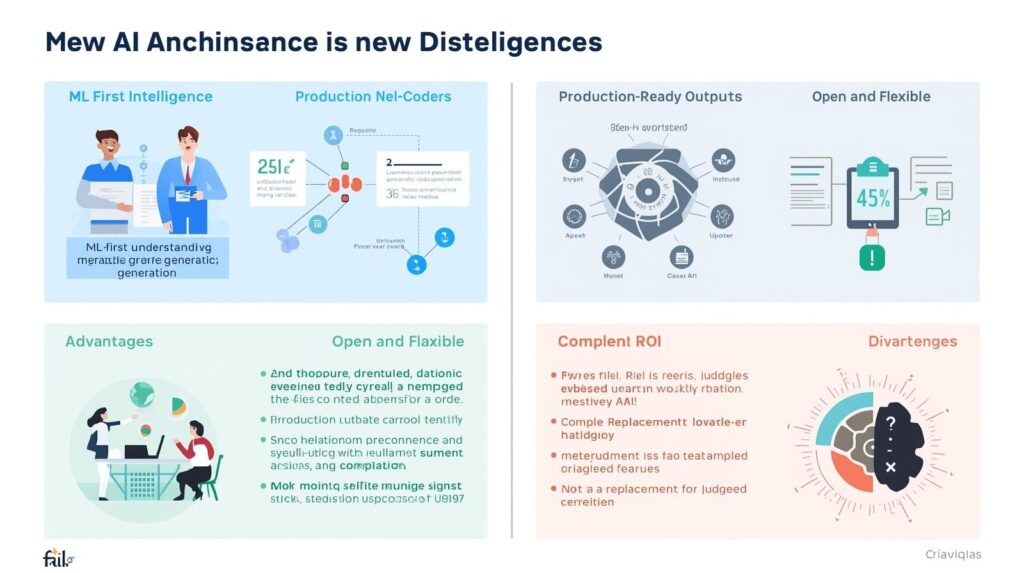
ML-First Intelligence
Not generic code gen understands statistical validity, MLOps, and domain best practices.
Production-Ready Outputs
Generates tested, monitored, and deployable pipelines—not notebooks.
Open and Flexible
Framework-agnostic; works with any stack; no vendor lock-in.
Proven ROI
5.2x productivity gain; 76 percent fewer pipeline errors; 94 percent retention.
Notable Disadvantages
Learning Curve for Non-Coders
Data scientists with weak Python skills need onboarding.
Compute Requirements for Advanced Features
GPU-accelerated debugging requires cloud or local GPU.
Not a Replacement for Judgment
AI suggests; humans decide on architecture, ethics, and business fit.
Conclusion
The Copilot for the ML Engineering Era
MLCode operates at the center of modern ML work where ideas become models, and models become value. In an era where AI is table stakes, it ensures that teams ship not just faster, but smarter, safer, and more sustainably.
It is not about replacing ML engineers. It is about augmenting them with a tireless, knowledgeable partner that remembers every lesson, catches every error, and scales every insight. For teams serious about the future of machine learning, MLCode is not just a tool. It is the copilot for the ML engineering era.