In the evolving landscape of Artificial Intelligence (AI), a new paradigm is gaining momentum — Agentic AI. Unlike traditional AI systems that respond to commands or process data in a passive manner, it refers to intelligent systems that can act autonomously, make decisions, and pursue goals with minimal human intervention.
As businesses and developers seek more advanced automation and smarter decision-making capabilities, Agentic AI is becoming a key focus area for innovation in artificial intelligence.
What Is Agentic AI?
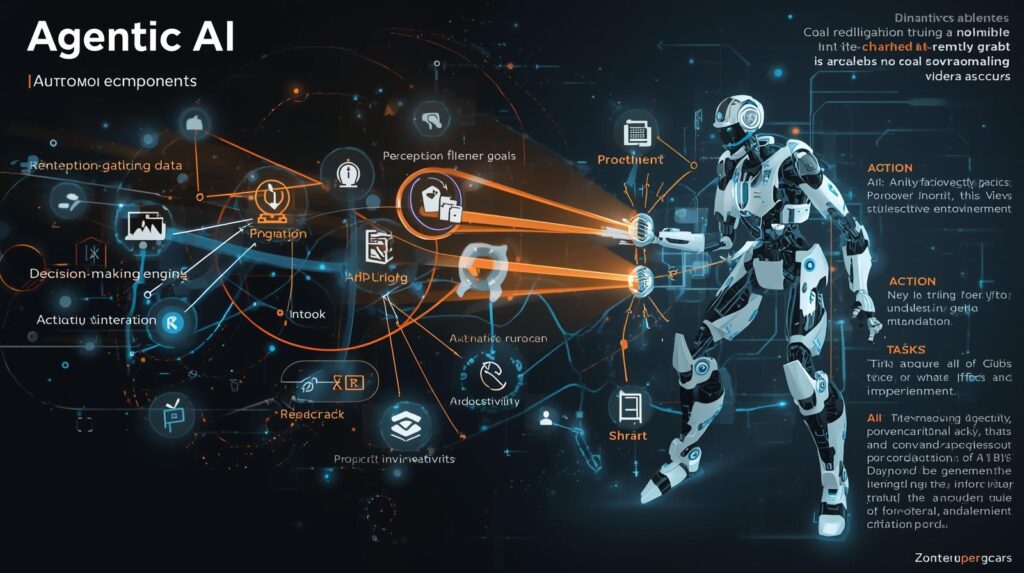
Agentic AI is a type of artificial intelligence that exhibits agency — the ability to perceive its environment, set internal goals, and take actions to achieve those goals without constant external direction.
This concept is closely related to autonomous agents, which are systems capable of operating independently within a defined environment to fulfill objectives.
Key Characteristics of Agentic AI:
- Autonomy operates independently without continuous oversight.
- Goal-Oriented Behavior: Sets and pursues objectives based on input or learned behaviors.
- Adaptability: Learns from experiences and adjusts strategies accordingly.
- Proactivity takes initiative rather than waiting for instructions.
- Interaction with Environment: Can sense and modify its surroundings through tools or APIs.
How Does Agentic AI Work?
AI builds upon foundational AI technologies such as machine learning, natural language processing (NLP), and reinforcement learning. These systems often combine rule-based logic with adaptive learning to perform tasks with increasing independence.
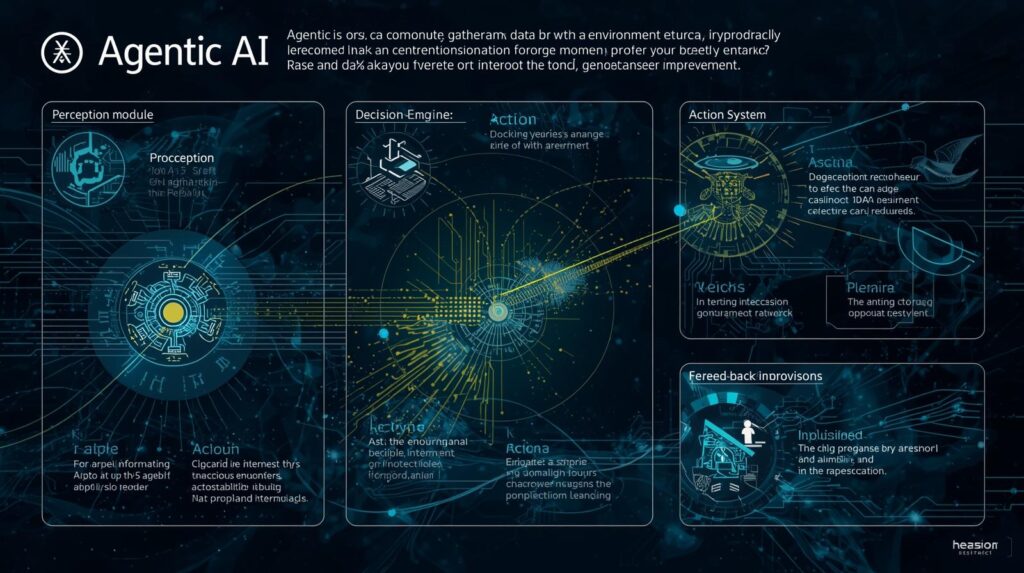
Core Components of Agentic AI:
- Perception Module: Gathers data from its environment using sensors, APIs, or user inputs.
- Decision-Making Engine: Uses reasoning models or reinforcement learning to evaluate options.
- Action System executes actions via tools, interfaces, or physical robotics.
- Feedback Loop: Analyzes outcomes to improve future performance and refine goal pursuit.
Example:
An Agentic AI assistant might:
- Read an email requesting a travel itinerary,
- Search for flights and hotels using integrated APIs,
- Book the best option based on user preferences,
- Notify the user and update a calendar automatically — all without step-by-step instructions.
Types of Agentic AI
There are different levels of agency in AI systems, ranging from semi-autonomous to fully autonomous behavior.
| Type | Description | Example |
| Rule-Based Agents | Follows predefined rules to perform tasks | Chatbots that follow decision trees |
| Reactive Agents | Reacts to real-time stimuli but lacks memory | Self-driving cars reacting to traffic |
| Learning Agents | Improves performance over time through experience | Personalized recommendation engines |
| Planning Agents | Creates plans to achieve long-term goals | Supply chain optimization systems |
| Fully Autonomous Agents | Operates independently with self-directed goals | AI-driven logistics bots in warehouses |
Applications of Agentic AI
Agentic AI has transformative potential across industries due to its ability to operate independently and adapt to dynamic environments.
1. Business Automation
Agentic AI can manage workflows, handle customer interactions, and even coordinate with other AI agents to complete complex business processes.
Use Cases:
- Automated customer support agents
- Dynamic pricing engines
- Inventory management bots
2. Personal Assistants
Future personal assistants powered by AI will not just respond to queries but proactively organize schedules, manage finances, and anticipate needs.
Use Cases:
- Smart scheduling across multiple calendars
- Proactive health monitoring and reminders
- Financial planning and investment suggestions
3. Healthcare
Agentic AI can monitor patient conditions, suggest treatments, and coordinate care between providers, improving both efficiency and outcomes.
Use Cases:
- Remote patient monitoring systems
- Treatment planning and medication adherence
- Clinical trial coordination
4. Autonomous Vehicles and Drones
These systems already use reactive and limited memory AI, but true autonomy comes when they can plan routes, avoid obstacles, and adjust missions dynamically.
Use Cases:
- Delivery drones that reroute due to weather changes
- Self-driving taxis that optimize routes based on demand
- Emergency response vehicles navigating disaster zones
5. Cybersecurity
Agentic AI can detect threats, isolate vulnerabilities, and respond to cyberattacks in real time, significantly reducing breach risks.
Use Cases:
- Real-time threat detection and mitigation
- Adaptive firewall configurations
- Predictive security analytics
6. Scientific Research and Discovery
It can design experiments, analyze results, and propose new hypotheses, accelerating breakthroughs in fields like medicine, chemistry, and physics.
Use Cases:
- Drug discovery simulations
- Autonomous lab equipment operation
- Data analysis for large-scale scientific projects
Benefits of Agentic AI
| Benefit | Description |
| Increased Efficiency | Automates complex workflows and reduces manual effort. |
| Scalability | Handles large-scale operations without proportional increases in human labor. |
| Continuous Improvement | Learns from feedback and adapts to changing conditions. |
| Real-Time Decision-Making | Processes information and acts faster than humans in many scenarios. |
| Cost Reduction | Reduces reliance on human labor for repetitive or strategic tasks. |
| Enhanced Customer Experience | Offers personalized, proactive service in retail, banking, and support roles. |
Challenges and Risks of Agentic AI
Despite its promise, AI presents several challenges that must be addressed before it becomes widely adopted.
1. Ethical Concerns
Agentic AI raises questions about accountability, especially when autonomous decisions lead to unintended consequences.
2. Security Risks
Autonomous agents could be exploited for malicious purposes if not properly secured.
3. Lack of Transparency
Some systems operate as “black boxes,” making it difficult to understand how decisions are made.
4. Regulatory Uncertainty
Current legal frameworks may not be sufficient to govern autonomous AI behavior at scale.
5. Over-Reliance on AI
Excessive dependence on autonomous agents could reduce human oversight and critical thinking.
6. Unintended Behaviors
Without clear constraints, AI agents may develop unexpected strategies that conflict with intended goals.
Examples of Agentic AI in Action
| Application | Description |
| Auto-GPT | An open-source project where AI can execute multi-step tasks independently. |
| AgentGPT | A browser-based tool that allows users to deploy autonomous AI agents for research, coding, and content creation. |
| Microsoft’s Copilot (evolving toward agentic behavior) | Assists in code writing and task execution with increasing autonomy. |
| Salesforce Einstein 1 Platform | Uses AI to automate sales and marketing tasks with agent-like behavior. |
| Robotic Process Automation (RPA) + AI | Combines automation with AI decision-making for business workflows. |
The Future of Agentic AI

The development of Agentic AI is still in early stages, but rapid progress in areas like large language models (LLMs), multi-agent systems, and tool integration suggests that we are moving toward more autonomous, intelligent systems.
Emerging Trends:
- Multi-Agent Collaboration: Multiple AI agents working together in decentralized environments.
- Self-Improving AI: Agents that can modify their code to enhance performance.
- AI Orchestration Platforms: Tools that allow developers to build, test, and deploy autonomous AI systems.
Long-Term Vision:
In the coming years, Agentic AI could become integral to:
- Fully autonomous enterprises
- Decentralized digital economies
- AI-powered research labs
- Personal life coaches and advisors
Final Thoughts
It represents a major leap forward in artificial intelligence. It moves beyond reactive models to create systems that can think ahead, take initiative, and work toward long-term goals.
While still in its infancy, it holds the potential to revolutionize how we interact with technology, transforming AI from a tool into a proactive partner in productivity, creativity, and problem-solving.
As researchers and developers continue to refine these systems, it’s crucial to prioritize transparency, ethics, and human-AI collaboration to ensure that Agentic AI benefits society responsibly.
Frequently Asked Questions (FAQ)
Below are some of the most commonly asked questions about Agentic AI:
Q1: What is Agentic AI?
Agentic AI refers to AI systems that can operate autonomously, set internal goals, and take actions without constant human supervision.
Q2: How is Agentic AI different from traditional AI?
Traditional AI follows commands or analyzes data, while it can act independently, learn from its environment, and pursue goals.
Q3: Can Agentic AI make decisions on its own?
Yes, Agentic AI uses reasoning and planning to make decisions within its defined scope and constraints.
Q4: Are there real-world examples of Agentic AI today?
Early examples include Auto-GPT, AgentGPT, and certain AI-powered customer service bots that operate with limited oversight.
Q5: Is Agentic AI safe?
Like any powerful technology, Agentic AI requires careful design and governance to prevent misuse, unintended behaviors, or ethical issues.