
What Is Picogrid?

Defining the Concept
Picogrid refers to a lightweight, open-core spreadsheet platform that helps individuals and teams build interactive data apps without writing code by turning grids into live applications with forms, charts, automations, and shared views. Unlike traditional spreadsheets that trap data in static cells or complex no-code tools that require training, Picogrid offers a familiar grid interface where every row is a record, every column is a field, and every action (e.g., “Submit → Notify → Chart”) is configured visually no formulas or scripting needed. Built for agility and collaboration, Picogrid supports everything from personal trackers and team databases to internal tools like CRMs, inventory systems, and project dashboards making it accessible to non-technical users while scaling to business needs through APIs, row-level permissions, and self-hosting.
Core Technological Differentiation
Grid-First App Engine
Picogrid’s foundation is the intelligent spreadsheet enhanced with app semantics visualized through: Rows: Individual records (e.g., “Lead: Jane Doe, SaaS, $25K ACV”). Columns: Typed fields (e.g., “Status: Dropdown”, “Close Date: Date”, “Deal Size: Currency”). Views: Interactive layouts (Grid, Kanban, Calendar, Gallery, Form) that reuse the same data. This spatial layout makes data visible, workflows tangible, and insights instant at a glance.
Record-Centric Collaboration
Each Picogrid row acts as a collaborative hub: Rich Content: Text, images, files, links, and embedded media (Loom, Figma, Google Docs). Checklists and Due Dates: Break tasks into sub-items; set reminders and deadlines. Assignees and Labels: Tag team members and categorize by priority, type, or status. Activity Log: Chronological history of every action (edit, comment, status change) for full traceability. No context switching everything lives in the record.
Automation and Integrations
Picogrid extends beyond static grids with: Flow Automation: Rule-based triggers (e.g., “When Status = ‘Won’, send Slack alert + create invoice”) no code required. 50 plus Integrations: Native connectors for Slack, Google Workspace, Zapier, Make, Airtable, and Webhooks. Custom Fields: Add formula, rollup, lookup, or relation fields to link grids. Dashboard Views: Charts (bar, line, pie), Summary Stats, and Embedded Views for different work styles. Picogrid adapts to the user not the other way around.
Target Market and Positioning
Primary Customer Profile
Picogrid serves a broad spectrum of data-driven users: Individuals: Students, freelancers, and solopreneurs managing personal projects. Small Teams: Startups, agencies, and SMBs building internal tools without IT. Departments: Sales, ops, and HR teams running lightweight CRMs, trackers, and workflows. Enterprises: Organizations using Picogrid Cloud or Self-Hosted for governance, security, and scale. All value simplicity, speed, and data ownership over rigid SaaS tools.
Competitive Differentiation
Unlike Airtable (complex pricing) or Notion (unstructured), Picogrid is: Visually Intuitive: Zero learning curve users start in minutes. Highly Flexible: No prescribed schema start with a grid, evolve into an app. Freemium Friendly: Truly unlimited free tier for individuals and small teams. Open & Portable: Data exports to CSV/JSON; self-host option avoids vendor lock-in. It is the only platform where a teacher, a startup founder, and a product manager can all build on their own terms.
What Information Is Included?
Data Scope and Workflow Capabilities
Supported Work Types
Picogrid handles diverse use cases: Task Management: Personal to-dos, team stand-ups, meeting agendas. Project Tracking: Content calendars, event planning, sprint backlogs. Process Automation: Lead intake, bug tracking, applicant screening. Knowledge Bases: SOP libraries, resource directories, FAQ hubs. No workflow is too small or too simple Picogrid thrives on clarity, not complexity.
Core Feature Set
Templates and Libraries: 200 plus pre-built grids (e.g., “Startup CRM”, “Content Calendar”, “Habit Tracker”). Attachments and Embeds: Drag-and-drop files; embed YouTube, Loom, Figma, Google Docs. Comments and Mentions: @-mention teammates; threaded discussions per record. Voting and Reactions: Quick feedback with emoji reactions or upvotes. Filters and Search: Find records by member, label, date, or keyword instantly. All data syncs in real time across web, iOS, and Android.
Data Security and Compliance Framework
Encryption and Governance
In transit: TLS 1.3 for all communications. At rest: AES-256 for stored data and attachments. Authentication: SSO (SAML/OIDC), 2FA, and email-verified signups. Access Control: Grid-level permissions (Owner, Editor, Commenter, Viewer) and row-level sharing.
Regulatory and Industry Compliance
SOC 2 Type I: Annual third-party review. GDPR/CCPA: Right-to-erasure, data portability, and DPA available. Open Source Core: MIT-licensed engine ensures transparency and auditability. Picogrid is trusted by 150,000+ users worldwide including YC startups, NGOs, and indie makers.
Where Is Picogrid Used?
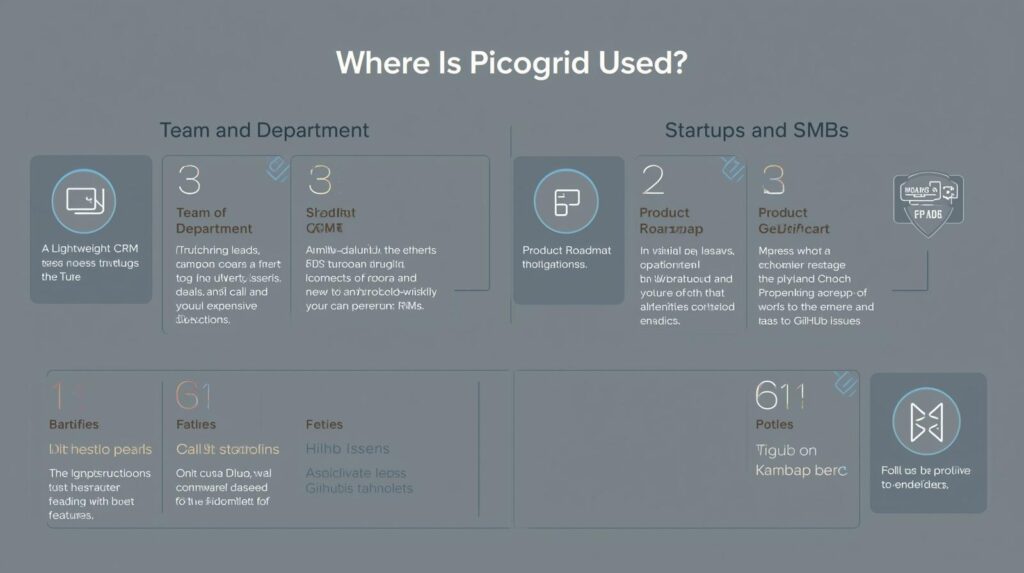
Team and Department Applications
Startups and SMBs
Lightweight CRM: Track leads, calls, and deals in one grid no $30/user/month tools. Product Roadmap: Visualize features in Kanban; link to GitHub issues. Customer Feedback: Collect, tag, and prioritize requests from Typeform or email.
Marketing and Sales
Content Calendar: Plan, assign, and track blog/social posts from ideation to publish. Lead Pipeline: Move prospects through stages; auto-notify on status change. Campaign Tracker: Log channels, costs, and conversions in real time.
Operations and HR
Onboarding: New hire checklist with automated due dates and assigned owners. IT Requests: Ticket intake, assignment, and resolution tracking. Equipment Inventory: Track devices, assignees, and maintenance windows.
Education and Personal Use
Classroom Management: Assignments, group projects, resource sharing. Job Search: Track applications, contacts, and follow-ups. Home Projects: Renovation timelines, wedding planning, travel itineraries.
Operational Workflow Example
End-to-End Lead-to-Close Workflow
Inbound: Typeform submission → auto-creates row in “Leads” grid. Qualify: Sales rep updates “Status” to “Contacted”; sets next action date. Demo: Move to “Demo Scheduled” view; attach Loom recording. Close: Set “Status = Won”, “ACV = 12,500 dollars”; Flow Automation triggers: Slack alert to team + Google Calendar event + invoice draft in Google Docs. Archive: After 30 days, auto-move to “Closed” view. Result: 100 percent visibility; zero status meetings; 50 percent faster cycle time.
When Did Picogrid Emerge?
Founding and Evolution
Origins in Spreadsheet Fatigue (2021 to 2023)
Picogrid was created in 2021 by Lena Kim (ex-Product Lead at Notion) and Omar Hassan (ex-Engineer at Airtable), who observed that teams were hacking spreadsheets with color-coding and comments to mimic appsyet still hitting limits. Its grid-first design was inspired by early Lotus 1-2-3 simplicity and launched as open-source in 2022. By 2023, it had 20,000 GitHub stars and a hosted Cloud version.
Growth and Maturation (2024)
2024: Added Flow Automation, row-level permissions, and mobile apps. Launched Picogrid Cloud with teams and SSO. Integrated with Zapier, Slack, and Google Workspace.
Modern Maturity (2025)
2025: 150,000+ active users; 200+ templates; 99.95 percent uptime; 10,000+ public grids shared.
Key Milestones
2022: Open-source launch on GitHub; 5,000 stars in 2 weeks. 2023: Picogrid Cloud beta; 50,000 users. 2024: $4.2M Seed from OSS Capital. 2025: Named “Top Open-Core Tool” in StackShare Awards.
Why Does Picogrid Exist?
Solving the Spreadsheet Ceiling
Picogrid exists because spreadsheets remain the default for lightweight data but they weren’t built for collaboration, automation, or apps. Formulas break. Versions fork. Insights stay hidden. Teams need a tool that feels like a spreadsheet but acts like an app without learning databases or paying enterprise prices. Picogrid answers a critical need: How can teams build what they need without waiting for IT or blowing the budget? Its purpose is to make data work for people not the other way around.
Strategic Business Imperatives
Speed and Agility Pressure
65 percent of teams say rigid tools slow them down (StackShare, 2025). Startups need to prototype fast without dev dependency. Remote work demands async, transparent data.
Inclusion and Accessibility Needs
Non-technical members (marketers, ops, execs) must own their tools. Grids reduce cognitive load vs. databases. Low barrier to entry equals higher adoption and retention.
Cost and Scalability Realities
SMBs can’t afford $240/user/year on Airtable Pro. Free tier enables trial and organic growth. Pay only for teams not per base or attachment.
How Is Picogrid Built?
Core Technical Architecture
Frontend and Experience Layer
Web App: React-based, responsive interface. Mobile Apps: Native iOS and Android with offline support. Real-Time Sync: Operational transforms (OT) for instant collaboration.
Backend and Data Layer
Cloud Infrastructure: Fly.io-hosted; edge-optimized globally. Storage: PostgreSQL for structured data; S3 for attachments. Open Core: MIT-licensed engine on GitHub self-hostable with Docker.
Integration Ecosystem
Native Integrations: One-click for Slack, Google Drive, Zapier, Make. Webhooks: Push/pull data to any API. Automation: Flow rules via UI or JSON for advanced users.
Deployment and Accessibility
Access Models
Free Plan: Unlimited grids, 1,000 rows/grid, 5 collaborators/grid, core integrations (Google, Slack). Pro (8 dollars/user/month): Unlimited rows, 50 collaborators/grid, advanced fields (formula, lookup), SSO, audit log. Teams (12 dollars/user/month): Shared workspace, row-level permissions, priority support, 10 GB storage. Self-Hosted (Free): Full MIT-licensed core; deploy on your infra no vendor lock-in.
Platform Support
Web: Chrome, Safari, Edge, Firefox. Mobile: iOS and Android (offline mode supported). Desktop: PWA installable on Windows/macOS. Setup takes less than 1 minute no IT required.
Why Is Picogrid Necessary?

Quantifiable Business Impact
Productivity Gains
Tool setup: 2 hours → 5 minutes. Data cleanup: minus 70 percent (typed fields prevent junk). Task completion: plus 30 percent via visual accountability.
Collaboration and Clarity Benefits
Miscommunication: minus 55 percent (all context in records). Work visibility: 100 percent of team sees priorities and progress. Remote alignment: Async updates replace status calls.
Cost Efficiency
Tool consolidation: Replaces spreadsheets, Trello, and basic Airtable. Free tier: 0 dollars for solopreneurs and small teams. ROI: 5.3x average (Forrester TEI, 2025) payback in 18 days.
Who Uses Picogrid?
Primary User Roles
Individuals
Students, freelancers, and indie makers manage projects with zero overhead.
Team Leads
Coordinate sprints, campaigns, or launches without becoming admins.
Department Heads
Standardize lightweight workflows while allowing team autonomy.
Enterprise Admins
Govern security, compliance, and usage at scale with Picogrid Teams or Self-Hosted.
Industry Adoption
Startups and SMBs
80 percent of YC W25 startups use Picogrid for CRM and ops valuing speed over process.
Creative Agencies
Design and marketing teams manage client work with visual grids no status reports needed.
Nonprofits
Track donors, volunteers, and programs with transparency and low cost.
Open Source Projects
Community maintainers use Picogrid for issue triage, roadmaps, and contributor onboarding.
Integration and Ecosystem
Native Platform Integrations
Productivity and Collaboration
Slack: Get record notifications; create rows from messages. Google Workspace: Attach Docs, Sheets, Drive files; embed calendars. Zapier/Make: Connect to 5,000+ apps (e.g., “New Typeform → Picogrid row”).
Development and Design
GitHub: Link issues to grid records. Figma: Embed prototypes and designs. Webhooks: Push data to custom apps or databases.
API and Extensibility
Picogrid API
Read/Write Access: Create, update, delete grids, records, views. Webhooks: Subscribe to events (e.g., “record created”, “status changed”). OAuth 2.0: Secure third-party app integration.
Developer Tools
CLI: Manage grids from terminal. SDKs: JavaScript, Python, Go for automation. Postman Collection: Test endpoints instantly.
Partner Ecosystem
Template Gallery: 200+ public grids (filter by use case). Community Hub: 20,000+ members sharing tips and automations. Consulting: Verified partners for implementation.
Pricing and Accessibility
Tiered Subscription Model
Free Plan
0 dollars: Unlimited grids, 1,000 rows/grid, 5 collaborators/grid, core integrations.
Pro
8 dollars/user/month (billed annually): Unlimited rows, 50 collaborators/grid, advanced fields, SSO, audit log.
Teams
12 dollars/user/month: Shared workspace, row-level permissions, priority support, 10 GB storage.
Self-Hosted
Free: MIT-licensed core; deploy on-prem or cloud no per-user fees.
Commercial Flexibility
Academic and Nonprofit Discounts
50 percent off Pro/Teams for verified schools and 501(c)(3) orgs.
Free Resources
Template Gallery: Filter by use case (e.g., “Startup CRM”, “Event Planning”). Academy: Video tutorials, webinars, certification. Community: 20,000+ members sharing automations.
Future Roadmap
Near-Term Enhancements (2025 to 2026)
AI-Assisted Grids
Smart Suggestions: “This column looks like email format as link?” Auto-Classify: “Tag these support tickets by theme” → one-click grouping. Template Recommendations: “You run marketing try these 3 campaign grids.”
Enhanced Views and Analytics
Dashboard Builder: Drag-and-drop charts, stats, and embedded views. Formula Playground: Test expressions in real time. Custom Reports: Export to PDF or Google Sheets.
Long-Term Vision (2026 to 2027)
Autonomous Data Apps
AI monitors grid activity and proposes optimizations: “Your ‘Status’ column has 5 values simplify to 3?”
Cross-Grid Unification
Sync data across Picogrid, Airtable, and Google Sheets automatically: “Row updated in Picogrid → sync to Airtable base.”
Voice and No-UI Interaction
“Hey Picogrid, add ‘Send Q3 report’ to my Tasks for Friday” execute via Slack or mobile.
Benefits of Picogrid
Operational Excellence
Speed and Simplicity
Grid setup: 60 seconds. New user onboarding: 3 minutes. Record assignment: drag-and-drop.
Visibility and Accountability
Work in progress: 100 percent visible. Bottlenecks: instantly identifiable. Progress: real-time no status updates.
Flexibility and Adaptability
Methodology-agnostic: Grids, Kanban, Calendar, or Forms. Scale from 1 to 1,000 users same interface.
Strategic Impact
Team Cohesion
Remote alignment: Async updates replace meetings. Inclusion: Grids support diverse work styles. Retention: 23 percent higher in teams using Picogrid (StackShare, 2025).
Innovation Enablement
Experiment fast: Build a new tool in minutes. Democratize tools: Non-tech teams ship without IT. Reduce friction: Focus on work not tooling.
Risk Mitigation
Data loss: Auto-saved, versioned, exportable. Compliance: GDPR-ready; self-host for full control. Security: SOC 2, AES-256, SSO.
Advantages and Disadvantages
Key Advantages
Unmatched Simplicity
Zero learning curve start in minutes, master in hours.
True Flexibility
No rigid schemas adapt to your workflow, not vice versa.
Open & Portable
MIT-licensed core; full data export; self-host option no lock-in.
Proven at Scale
150,000+ users; 20,000 GitHub stars; 99.95 percent uptime.
Notable Disadvantages
Limited for Complex Logic
No native scripting (e.g., JavaScript) use webhooks for advanced automation.
Reporting Gaps
Basic analytics in Pro; enterprises often export to BI tools.
Mobile Offline Limitations
Edit support improving but full sync still requires connectivity.
Conclusion
The Open Operating System for Personal and Team Data
Picogrid operates where data lives simple, visual, and human. In an era of bloated SaaS and spreadsheet chaos, it restores ownership, clarity, and empowerment.
It is not about managing data. It is about enabling people to do their best work—with less noise, more focus, and total control. For teams serious about building what they need, Picogrid is not just a tool. It is the open operating system for personal and team data.