AI business process outsourcing has revolutionized how modern enterprises manage their operations, combining the cost-efficiency of traditional outsourcing with the transformative power of artificial intelligence. In 2026, organizations are no longer asking whether to adopt intelligent automation BPO, but rather how quickly they can scale these solutions to maintain competitive advantage. Whether you are looking to streamline AI-powered back office operations, reduce costs through automated business process services, or navigate the complex landscape of AI BPO vendor selection, understanding these technologies is essential for operational excellence.
This comprehensive guide demystifies the world of AI business process outsourcing, exploring everything from cognitive automation for BPO to AI customer service outsourcing, AI finance and accounting outsourcing, and AI HR outsourcing solutions. By the end of this article, you will have a clear, actionable roadmap to implementing AI data entry automation BPO, ensuring AI quality assurance for BPO, and selecting the right AI BPO pricing models for your organization.
1. Understanding AI Business Process Outsourcing in 2026
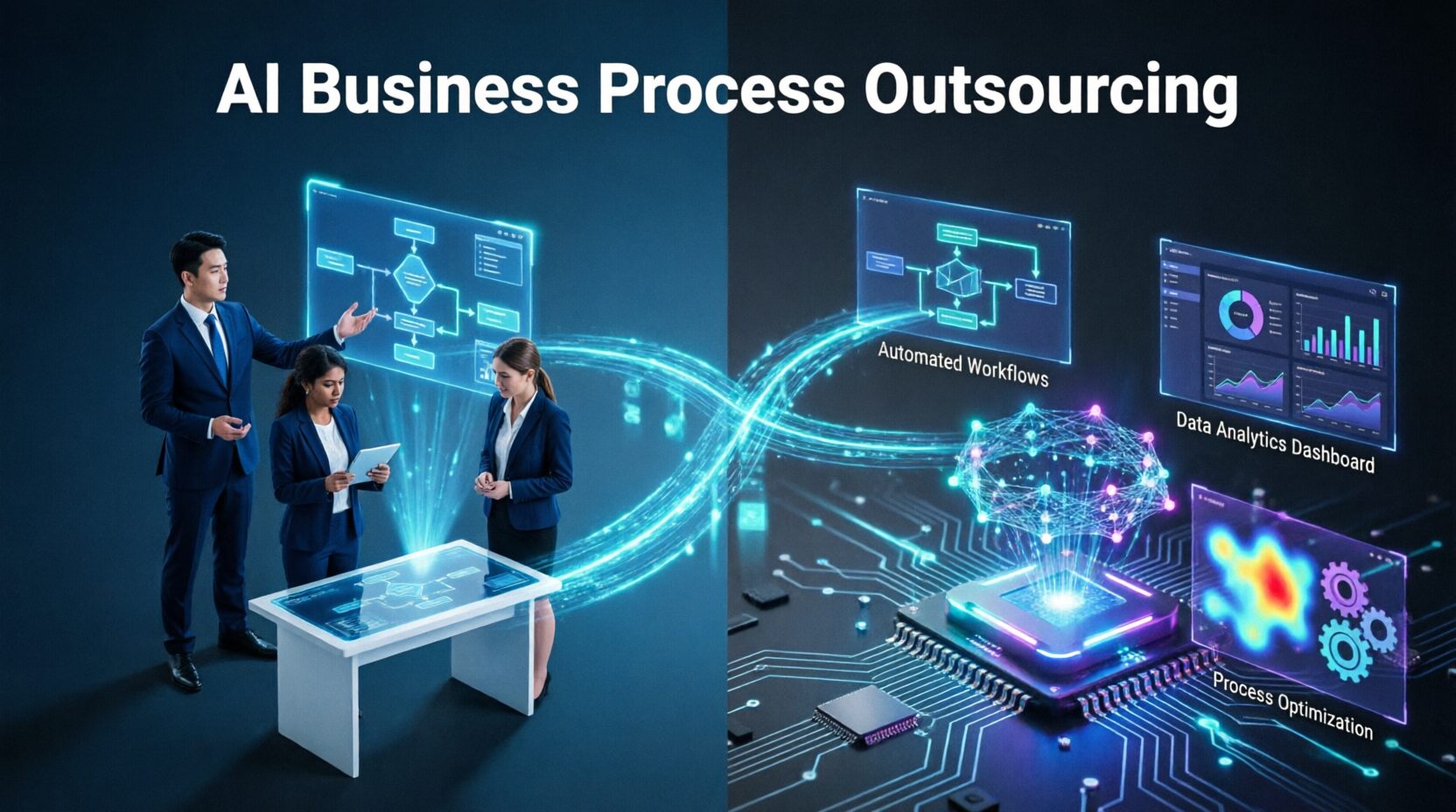
AI business process outsourcing represents the convergence of two powerful business strategies: outsourcing non-core functions to specialized providers and leveraging artificial intelligence to automate and enhance those processes. In 2026, this approach has moved beyond simple cost reduction to become a strategic imperative for organizations seeking agility, scalability, and innovation.
According to Gartner’s Business Process Outsourcing Research, by 2026, over 60% of enterprise BPO contracts will include AI and automation components, up from less than 20% in 2022. This shift reflects a fundamental change in how businesses view outsourcing—not as a way to simply offload work, but as an opportunity to access cutting-edge technology and expertise without massive capital investment.
The modern AI business process outsourcing landscape encompasses everything from routine data processing to complex decision-making tasks. Intelligent automation BPO platforms now handle invoice processing, customer inquiries, HR onboarding, financial reporting, and even quality assurance with minimal human intervention. For a deeper understanding of how these systems integrate with enterprise architecture, explore our comprehensive guide on AI Solutions for Business.
2. Intelligent Automation BPO: Core Technologies and Applications
Intelligent automation BPO combines multiple AI technologies to create sophisticated, end-to-end process automation. The core technologies powering this transformation include:
Robotic Process Automation (RPA): Software bots that handle repetitive, rule-based tasks with perfect accuracy and 24/7 availability. When combined with AI, these bots can handle exceptions and learn from patterns.
Natural Language Processing (NLP): Enables automated systems to understand, interpret, and respond to human language, powering AI customer service outsourcing and automated document processing.
Machine Learning (ML): Algorithms that improve over time, allowing automated business process services to adapt to changing conditions and optimize performance without explicit reprogramming.
Computer Vision: Technology that enables systems to extract information from images, videos, and documents, crucial for AI data entry automation BPO and document verification processes.
Predictive Analytics: AI models that forecast outcomes and identify trends, helping organizations make proactive decisions rather than reactive ones.
These technologies work together to create intelligent workflows that can handle complex, multi-step processes with minimal human oversight. For technical teams building these integrations, our guide on AI Coding Prompts is an essential resource.
3. AI-Powered Back Office Operations: Transforming Traditional Functions
AI-powered back office operations represent one of the most significant opportunities for cost reduction and efficiency gains. Traditional back office functions—data entry, document processing, reconciliation, reporting—are often labor-intensive, error-prone, and time-consuming. AI business process outsourcing transforms these functions through:
Automated Document Processing: AI systems can extract, validate, and process information from invoices, contracts, forms, and other documents with accuracy rates exceeding 99%, eliminating manual data entry.
Intelligent Workflow Orchestration: AI coordinates multiple systems and processes, ensuring seamless handoffs between different stages of a workflow and automatically routing exceptions to human operators when necessary.
Real-Time Analytics and Reporting: Automated business process services provide instant visibility into operational performance, identifying bottlenecks, predicting delays, and recommending optimizations.
Compliance and Audit Automation: AI systems maintain detailed audit trails, automatically flag compliance issues, and generate regulatory reports, reducing the risk of penalties and ensuring adherence to AI BPO compliance requirements.
Organizations implementing AI-powered back office operations typically see 40-70% reductions in processing time, 50-80% cost savings, and significant improvements in accuracy and compliance. To see how these transformations integrate into broader enterprise strategies, review our detailed breakdown of AI Solutions for Business.
4. Automated Business Process Services Across Industries
Automated business process services are not one-size-fits-all; they must be tailored to the specific needs, regulations, and workflows of different industries. Here’s how AI business process outsourcing is transforming key sectors:
Healthcare: AI handles patient registration, insurance verification, medical coding, claims processing, and appointment scheduling while maintaining HIPAA compliance and protecting sensitive health information.
Financial Services: Automated systems process loan applications, conduct KYC (Know Your Customer) checks, detect fraud, reconcile transactions, and generate regulatory reports with speed and accuracy impossible for human teams.
Retail and E-commerce: AI manages order processing, inventory management, customer inquiries, returns processing, and personalized marketing campaigns, scaling effortlessly during peak seasons.
Manufacturing: Intelligent automation handles supply chain coordination, quality control documentation, procurement processes, and vendor management, ensuring smooth operations across complex global supply chains.
Legal Services: AI processes contract reviews, legal research, document discovery, compliance checks, and case management, allowing legal professionals to focus on high-value strategic work.
Each industry has unique AI BPO compliance requirements and performance metrics, making it essential to work with vendors who have deep domain expertise.
5. AI BPO Market Trends 2026 and Future Predictions
The AI BPO market trends 2026 reveal a rapidly evolving landscape driven by technological advancement, changing workforce dynamics, and increasing competitive pressure. Key trends include:
Hyperautomation: Organizations are moving beyond automating individual tasks to automating entire end-to-end processes, combining RPA, AI, process mining, and analytics to create fully automated workflows.
AI-First BPO Providers: Traditional outsourcing companies are transforming into technology companies, building proprietary AI platforms and offering automation-as-a-service rather than just labor arbitrage.
Outcome-Based Pricing: AI BPO pricing models are shifting from per-FTE (full-time equivalent) or per-transaction to outcome-based models where providers are compensated based on results achieved, aligning incentives between clients and vendors.
Nearshoring and Reshoring: AI is reducing the labor cost advantage of offshore locations, leading some companies to bring operations closer to home for better quality control, time zone alignment, and data sovereignty.
Sustainability Focus: Automated business process services are being evaluated not just on cost and quality, but on environmental impact, with AI helping optimize resource usage and reduce carbon footprints.
Understanding these AI BPO market trends 2026 is crucial for making strategic outsourcing decisions that will remain viable as the landscape continues to evolve.
6. Cognitive Automation for BPO: Beyond Simple Task Automation
Cognitive automation for BPO represents the next evolution beyond rule-based automation. While traditional RPA follows predefined rules, cognitive automation can handle unstructured data, make judgments, and learn from experience. Key capabilities include:
Natural Language Understanding: Systems can read and comprehend emails, contracts, reports, and other unstructured text, extracting relevant information and taking appropriate action without human intervention.
Intelligent Decision-Making: AI can evaluate multiple factors, weigh trade-offs, and make recommendations or decisions within defined parameters, such as approving routine invoices or flagging suspicious transactions for review.
Contextual Awareness: Cognitive systems understand the context of interactions, remembering previous communications and adjusting responses based on customer history, preferences, and sentiment.
Continuous Learning: Unlike static automation, cognitive automation for BPO improves over time, learning from corrections, identifying new patterns, and adapting to changing business conditions.
Exception Handling: When faced with situations outside normal parameters, cognitive systems can escalate to humans, learn from the resolution, and handle similar situations independently in the future.
Organizations implementing cognitive automation for BPO report not just efficiency gains, but also improved customer satisfaction, better employee engagement (as workers focus on higher-value tasks), and enhanced agility in responding to market changes.
7. AI Customer Service Outsourcing: Enhancing Customer Experience
AI customer service outsourcing has transformed from simple chatbots to sophisticated, multi-channel support systems that provide personalized, efficient, and empathetic customer experiences. Modern AI customer service platforms offer:
Omnichannel Support: Seamless customer interactions across voice, chat, email, social media, and messaging apps, with context preserved across channels so customers don’t have to repeat themselves.
Intelligent Virtual Assistants: AI agents that can handle complex inquiries, access multiple systems, execute transactions, and resolve issues without human intervention, available 24/7/365.
Sentiment Analysis: Real-time detection of customer emotions and frustration levels, automatically escalating to human agents when necessary and providing agents with context to handle sensitive situations appropriately.
Personalization at Scale: AI analyzes customer history, preferences, and behavior to tailor responses, recommend products, and anticipate needs, creating personalized experiences even in high-volume environments.
Proactive Support: Predictive analytics identify potential issues before they become problems, allowing companies to reach out to customers with solutions before they experience frustration.
Successful AI customer service outsourcing achieves resolution rates of 70-85% without human intervention, reduces average handle time by 40-60%, and maintains or improves customer satisfaction scores compared to traditional call centers.
8. AI Finance and Accounting Outsourcing: Accuracy at Scale
AI finance and accounting outsourcing delivers unprecedented accuracy, speed, and compliance in financial operations. Key applications include:
Automated Invoice Processing: AI extracts data from invoices in any format, matches them to purchase orders and receipts, routes them for approval, and processes payments, handling exceptions intelligently.
Accounts Receivable Management: Automated systems send invoices, track payments, send reminders, reconcile deposits, and flag delinquent accounts for collection action, improving cash flow and reducing days sales outstanding (DSO).
Expense Management: AI reviews employee expense reports, verifies receipts against policies, flags anomalies, and processes reimbursements, reducing fraud and ensuring policy compliance.
Financial Close and Reporting: Automated systems reconcile accounts, prepare journal entries, generate financial statements, and ensure compliance with accounting standards, reducing close cycles from weeks to days.
Tax Compliance: AI stays current with changing tax regulations, calculates tax obligations across jurisdictions, prepares filings, and maintains audit trails, reducing compliance risk.
Audit Support: Automated systems maintain detailed, searchable audit trails, respond to auditor inquiries, and generate required documentation, making audits faster and less disruptive.
Organizations implementing AI finance and accounting outsourcing typically achieve 60-80% reductions in processing costs, 90%+ accuracy rates, and significantly faster cycle times while improving compliance and audit readiness.
9. AI HR Outsourcing Solutions: Streamlining Human Capital Management
AI HR outsourcing solutions are transforming how organizations attract, develop, and retain talent. Key applications include:
Recruitment and Screening: AI parses resumes, screens candidates against job requirements, schedules interviews, and even conducts initial video interviews with sentiment analysis, reducing time-to-hire by 50-70%.
Onboarding Automation: Automated systems handle new hire paperwork, benefits enrollment, IT setup, training assignments, and compliance certifications, ensuring consistent, compliant onboarding experiences.
Employee Self-Service: AI-powered portals and chatbots answer employee questions about policies, benefits, payroll, and procedures 24/7, reducing HR administrative burden and improving employee satisfaction.
Performance Management: AI analyzes performance data, provides insights on goal progress, suggests development opportunities, and helps managers conduct more effective performance reviews.
Learning and Development: Personalized learning platforms use AI to recommend courses, track progress, assess skill gaps, and create individualized development plans aligned with career goals and organizational needs.
Workforce Analytics: AI analyzes workforce data to predict turnover, identify high-potential employees, optimize staffing levels, and provide strategic insights for workforce planning.
AI HR outsourcing solutions free HR professionals to focus on strategic initiatives like culture building, talent development, and organizational design while ensuring efficient, compliant administrative operations.
10. AI Data Entry Automation BPO: Eliminating Manual Processes
AI data entry automation BPO has evolved far beyond simple optical character recognition (OCR). Modern systems combine multiple technologies to handle complex, varied data sources:
Intelligent Document Processing: AI extracts information from invoices, forms, contracts, emails, and other documents regardless of format, layout, or quality, achieving accuracy rates of 95-99%.
Multi-Modal Data Capture: Systems can process data from scanned documents, PDFs, images, emails, web forms, and even handwritten notes, using computer vision and NLP to understand context.
Validation and Enrichment: AI cross-references extracted data against databases, validates information for accuracy, enriches records with additional data from external sources, and flags discrepancies for review.
Learning and Adaptation: Machine learning models improve over time, learning from corrections and adapting to new document formats, handwriting styles, and data structures without manual reprogramming.
Integration and Workflow: Extracted data is automatically entered into ERP, CRM, and other business systems, triggering workflows, updates, and notifications without manual intervention.
Organizations implementing AI data entry automation BPO typically eliminate 80-95% of manual data entry, reduce errors by 90%+, and achieve processing speeds 10-50x faster than human operators while freeing employees for higher-value work.
11. AI Quality Assurance for BPO: Ensuring Excellence
AI quality assurance for BPO ensures that automated and human-assisted processes consistently meet quality standards. Key capabilities include:
Automated Quality Monitoring: AI reviews 100% of transactions, interactions, and outputs (compared to 1-5% sampling in traditional QA), identifying errors, compliance issues, and quality deviations in real-time.
Speech and Text Analytics: In customer service operations, AI analyzes every call and chat for compliance with scripts, accuracy of information provided, tone and sentiment, and adherence to policies.
Process Compliance Verification: Automated systems verify that processes are followed correctly, required steps are completed, approvals are obtained, and documentation is maintained according to standards.
Predictive Quality Management: AI identifies patterns that precede quality issues, allowing proactive intervention before errors occur, such as flagging agents who may need additional training or processes that are prone to errors.
Continuous Improvement: AI analyzes quality data to identify root causes of defects, recommend process improvements, and measure the impact of changes, creating a culture of continuous quality enhancement.
Implementing AI quality assurance for BPO typically improves quality scores by 20-40%, reduces compliance violations by 60-80%, and provides the data needed for data-driven quality management rather than reactive firefighting.
12. AI BPO Vendor Selection Guide: Choosing the Right Partner
Selecting the right AI BPO vendor is critical to outsourcing success. This AI BPO vendor selection guide outlines key evaluation criteria:
Technology Capabilities:
- Proprietary AI platforms vs. third-party tools
- Integration capabilities with your existing systems
- Scalability and flexibility to handle volume fluctuations
- Security certifications and data protection measures
- Innovation roadmap and commitment to continuous improvement
Domain Expertise:
- Industry-specific knowledge and experience
- Understanding of your regulatory environment
- Proven track record in your specific processes
- Quality of subject matter experts and process analysts
Operational Excellence:
- Performance metrics and SLAs (Service Level Agreements)
- Quality assurance processes and certifications
- Business continuity and disaster recovery capabilities
- Geographic footprint and time zone coverage
- Workforce quality, training, and retention rates
Commercial Terms:
- AI BPO pricing models and transparency
- Contract flexibility and exit provisions
- Intellectual property rights and data ownership
- Liability and indemnification terms
- Governance structure and escalation procedures
Cultural Fit:
- Communication style and responsiveness
- Alignment with your values and culture
- Partnership approach vs. transactional relationship
- Commitment to your success and continuous improvement
Thorough due diligence using this AI BPO vendor selection guide will help you choose a partner who can deliver value, manage risk, and grow with your organization.
13. AI BPO Pricing Models: Understanding Costs and ROI
Understanding AI BPO pricing models is essential for making informed outsourcing decisions and ensuring positive ROI. Common pricing structures include:
Per-Transaction Pricing:
- Pay only for actual volume processed
- Predictable unit costs
- Best for high-volume, standardized processes
- Risk: Volume fluctuations can impact total costs
Per-FTE (Full-Time Equivalent) Pricing:
- Pay for dedicated capacity
- Simpler to budget and manage
- Best for processes with stable, predictable volumes
- Risk: Paying for idle capacity during low-volume periods
Outcome-Based Pricing:
- Pay based on results achieved (e.g., cost savings, revenue generated, quality metrics)
- Aligns vendor incentives with your goals
- Best for processes with clear, measurable outcomes
- Risk: Requires sophisticated measurement and verification
Hybrid Models:
- Combine elements of different pricing structures
- Base fee plus variable component
- Balances predictability with flexibility
- Best for complex, multi-faceted engagements
Technology Licensing:
- Pay for access to AI platforms and tools
- May include implementation, training, and support
- Best for organizations wanting to build internal capabilities
- Risk: Requires internal resources to manage and operate
When evaluating AI BPO pricing models, consider total cost of ownership including:
- Direct costs (vendor fees, technology licenses)
- Implementation costs (integration, training, change management)
- Ongoing management costs (governance, quality assurance)
- Opportunity costs (internal resources diverted to manage outsourcing)
- Risk costs (compliance violations, quality issues, business disruption)
Calculate ROI by comparing total costs against benefits including:
- Labor cost savings
- Productivity improvements
- Quality enhancements
- Faster cycle times
- Improved customer satisfaction
- Reduced compliance risk
- Increased agility and scalability
Organizations typically achieve ROI of 150-300% over 3 years from well-executed AI business process outsourcing engagements.
14. AI BPO Risk Management and Compliance Requirements
Effective AI BPO risk management is essential to protect your organization from operational, compliance, and reputational risks. Key risk areas and mitigation strategies include:
Data Security and Privacy:
- Risk: Unauthorized access, data breaches, privacy violations
- Mitigation: Encryption (in transit and at rest), access controls, security certifications (SOC 2, ISO 27001), regular security audits, data minimization, clear data handling procedures
Regulatory Compliance:
- Risk: Violations of industry regulations (HIPAA, GDPR, SOX, PCI-DSS)
- Mitigation: Vendor compliance certifications, regular compliance audits, clear compliance responsibilities in contracts, compliance training for vendor staff, automated compliance monitoring
Business Continuity:
- Risk: Service disruption from vendor failures, natural disasters, cyberattacks
- Mitigation: Vendor business continuity and disaster recovery plans, redundant systems, geographic diversity, regular testing of recovery procedures, clear SLAs for recovery time
Quality and Performance:
- Risk: Substandard work, missed deadlines, customer dissatisfaction
- Mitigation: Clear quality standards and SLAs, regular quality audits, performance monitoring and reporting, escalation procedures, continuous improvement programs, penalties for non-performance
Intellectual Property:
- Risk: Loss or misuse of proprietary information, trade secrets
- Mitigation: Clear IP ownership clauses, confidentiality agreements, access controls, monitoring of data usage, restrictions on vendor’s use of your data
Vendor Lock-In:
- Risk: Difficulty switching vendors or bringing processes back in-house
- Mitigation: Clear exit provisions, data portability requirements, knowledge transfer obligations, avoiding proprietary formats, maintaining internal expertise
AI-Specific Risks:
- Risk: Algorithmic bias, lack of transparency, AI errors
- Mitigation: AI model validation and testing, human oversight of critical decisions, explainability requirements, regular bias audits, clear accountability for AI decisions
AI BPO compliance requirements vary by industry and jurisdiction. Work with legal and compliance teams to ensure contracts address all applicable requirements and vendors can demonstrate compliance through certifications and audits.
15. AI BPO Workforce Transition: Managing Change
AI BPO workforce transition is one of the most challenging aspects of outsourcing implementation. Successful change management requires:
Transparent Communication:
- Clearly explain the rationale for outsourcing
- Be honest about impacts on jobs and roles
- Provide regular updates throughout the transition
- Create forums for employees to ask questions and express concerns
Workforce Planning:
- Identify which roles will be eliminated, changed, or created
- Develop transition plans for affected employees
- Offer severance packages, outplacement services, and career counseling
- Explore redeployment opportunities in other parts of the organization
Reskilling and Upskilling:
- Invest in training programs to help employees develop new skills
- Focus on skills that complement AI (critical thinking, creativity, emotional intelligence)
- Provide learning opportunities in AI oversight, exception handling, and process improvement
- Support career transitions into higher-value roles
Cultural Change:
- Address fears and resistance openly
- Celebrate early wins and success stories
- Recognize and reward employees who embrace change
- Build a culture of continuous learning and adaptation
Knowledge Transfer:
- Document processes and institutional knowledge before transition
- Involve subject matter experts in vendor training
- Establish ongoing knowledge sharing between internal teams and vendor
- Maintain internal expertise to manage and oversee outsourced operations
Employee Support:
- Provide access to counseling and mental health resources
- Create peer support networks
- Offer flexible work arrangements during transition
- Recognize the emotional impact of change and provide support
Organizations that invest in thoughtful AI BPO workforce transition see higher employee morale, better retention of key talent, smoother implementation, and stronger long-term outcomes.
16. AI BPO Performance Metrics: Measuring Success
Establishing clear AI BPO performance metrics is essential for managing vendor performance, demonstrating value, and driving continuous improvement. Key metrics include:
Operational Efficiency:
- Processing time per transaction
- Cycle time (end-to-end process duration)
- Throughput (volume processed per time period)
- Capacity utilization
- First-pass yield (percentage completed correctly first time)
Quality:
- Accuracy rate (percentage error-free)
- Defect rate (errors per thousand transactions)
- Rework rate (percentage requiring correction)
- Customer satisfaction scores (CSAT, NPS)
- Compliance rate (percentage meeting regulatory requirements)
Cost:
- Cost per transaction
- Total cost of ownership
- Cost savings vs. baseline
- ROI (return on investment)
- Value delivered (cost avoidance, revenue impact)
Service Level:
- SLA compliance (percentage meeting agreed service levels)
- On-time delivery rate
- Response time (for inquiries and issues)
- Resolution time (for problems and exceptions)
- Availability (uptime for automated systems)
Innovation and Improvement:
- Number of process improvements implemented
- Time to implement changes
- Automation rate (percentage of process automated)
- Technology adoption (new capabilities deployed)
- Continuous improvement initiatives
Risk and Compliance:
- Number of compliance violations
- Security incidents
- Audit findings
- Risk mitigation effectiveness
- Business continuity test results
Vendor Performance:
- Overall vendor scorecard rating
- Relationship quality
- Responsiveness and communication
- Problem resolution effectiveness
- Innovation and value-add initiatives
Establish baseline metrics before outsourcing, set realistic targets, review performance regularly (monthly or quarterly), and use metrics to drive fact-based discussions and continuous improvement.
17. AI BPO vs Traditional Outsourcing: Key Differences
Understanding the differences between AI BPO vs traditional outsourcing is crucial for making informed decisions. Key distinctions include:
Technology Foundation:
- Traditional: Relies primarily on human labor with basic tools
- AI BPO: Built on AI platforms, automation, and advanced analytics
Scalability:
- Traditional: Scaling requires hiring and training more people (weeks/months)
- AI BPO: Scaling is nearly instant through technology (hours/days)
Cost Structure:
- Traditional: Variable costs tied to headcount and labor rates
- AI BPO: Higher fixed technology costs, lower variable costs
Quality Consistency:
- Traditional: Quality varies by individual performer and shift
- AI BPO: Consistent quality from automation; humans handle exceptions
Innovation:
- Traditional: Incremental improvements through training and process refinement
- AI BPO: Continuous innovation through AI model improvements and new capabilities
Flexibility:
- Traditional: Rigid processes; changes require retraining
- AI BPO: Agile processes; changes can be deployed rapidly
Data and Insights:
- Traditional: Limited data collection and analysis
- AI BPO: Rich data capture, advanced analytics, predictive insights
Risk Profile:
- Traditional: Human error, turnover, compliance risks
- AI BPO: Technology risks, algorithmic bias, cybersecurity risks
Workforce Impact:
- Traditional: Labor arbitrage; jobs move to lower-cost locations
- AI BPO: Automation reduces total labor needs; focus shifts to higher-value work
Vendor Relationship:
- Traditional: Transactional; focus on labor cost savings
- AI BPO: Strategic partnership; focus on innovation and transformation
Organizations should choose based on their specific needs, but AI BPO vs traditional outsourcing increasingly favors AI-enabled solutions for processes that are rules-based, high-volume, and data-intensive.
18. AI BPO Implementation Best Practices
Following AI BPO implementation best practices increases the likelihood of successful outcomes:
1. Start with Strategy:
- Align outsourcing with business objectives
- Identify processes with highest automation potential
- Build business case with clear ROI projections
- Secure executive sponsorship and stakeholder buy-in
2. Choose the Right Processes:
- Start with stable, well-documented processes
- Prioritize high-volume, repetitive tasks
- Select processes with clear rules and measurable outcomes
- Avoid highly complex or frequently changing processes initially
3. Conduct Thorough Due Diligence:
- Evaluate multiple vendors against clear criteria
- Check references and case studies
- Assess technology capabilities and security
- Review financial stability and long-term viability
4. Negotiate Clear Contracts:
- Define scope, SLAs, and performance metrics clearly
- Establish pricing models and change management procedures
- Include data security, privacy, and compliance requirements
- Build in flexibility for changing needs
- Define exit provisions and knowledge transfer obligations
5. Plan Meticulously:
- Develop detailed transition plan with timelines and milestones
- Assign clear roles and responsibilities
- Identify and mitigate risks proactively
- Plan for knowledge transfer and training
- Prepare change management and communication strategies
6. Invest in Change Management:
- Communicate transparently and frequently
- Engage employees early and often
- Provide training and support
- Address concerns and resistance
- Celebrate wins and recognize contributions
7. Implement in Phases:
- Start with pilot or proof of concept
- Learn and refine before scaling
- Expand gradually to additional processes
- Build momentum with early successes
8. Establish Strong Governance:
- Create governance structure with clear roles
- Define escalation procedures
- Schedule regular performance reviews
- Maintain open communication with vendor
- Monitor risks and issues continuously
9. Focus on Quality from Day One:
- Establish quality standards and metrics
- Implement quality assurance processes
- Conduct regular audits and reviews
- Address issues promptly and systematically
- Drive continuous improvement
10. Measure and Optimize:
- Track performance against metrics
- Analyze root causes of issues
- Identify optimization opportunities
- Implement improvements iteratively
- Share results and celebrate successes
Following these AI BPO implementation best practices will help you avoid common pitfalls, maximize value, and build a foundation for long-term success.
19. Future of AI in Business Outsourcing
The future of AI in business outsourcing will be shaped by several transformative trends:
Autonomous Operations: AI will evolve from assisting humans to operating autonomously, handling end-to-end processes with minimal human intervention. Humans will focus on exception handling, strategic oversight, and continuous improvement.
Hyper-Personalization: AI will enable mass customization of services, tailoring processes and interactions to individual customer preferences and needs at scale, creating competitive differentiation through personalized experiences.
Predictive and Prescriptive Analytics: AI will move beyond describing what happened to predicting what will happen and prescribing optimal actions, enabling proactive decision-making and strategic advantage.
Ecosystem Integration: AI BPO platforms will integrate seamlessly with broader business ecosystems, connecting suppliers, customers, partners, and internal systems in intelligent, automated workflows.
Ethical AI and Responsible Automation: Organizations will prioritize ethical AI development and deployment, addressing bias, ensuring transparency, protecting privacy, and maintaining human oversight of critical decisions.
Democratization of AI: Low-code and no-code AI platforms will make automation accessible to business users without technical expertise, accelerating adoption and innovation across the organization.
AI-Human Collaboration: The future will feature seamless collaboration between AI and humans, with each doing what they do best—AI handling routine, data-intensive tasks and humans providing creativity, judgment, and emotional intelligence.
Sustainability and Social Responsibility: AI will be leveraged to optimize resource usage, reduce environmental impact, and create positive social outcomes, making sustainability a key driver of outsourcing decisions.
Continuous Learning and Adaptation: AI systems will continuously learn and improve, adapting to changing conditions, new requirements, and emerging opportunities without extensive reprogramming.
Quantum Computing Impact: As quantum computing matures, it will unlock new AI capabilities, solving complex optimization problems and enabling breakthroughs in process automation currently impossible with classical computing.
Organizations that embrace the future of AI in business outsourcing will gain significant competitive advantages in efficiency, agility, innovation, and customer satisfaction.
Comprehensive Query Coverage
What is AI business process outsourcing? AI business process outsourcing combines traditional outsourcing with artificial intelligence and automation technologies to deliver more efficient, accurate, and scalable business operations. It involves contracting third-party providers who use AI to handle processes like data entry, customer service, finance and accounting, HR, and other back-office functions.
How does intelligent automation BPO differ from traditional outsourcing? Intelligent automation BPO differs from traditional outsourcing by leveraging AI, machine learning, RPA, and advanced analytics to automate processes rather than relying primarily on human labor. This results in faster processing, higher accuracy, better scalability, and lower costs compared to traditional labor-arbitrage outsourcing models.
What are the main benefits of AI-powered back office operations? The main benefits include 40-80% cost reductions, 90%+ accuracy rates, 24/7 operations, instant scalability, improved compliance, faster cycle times, better data insights, and the ability to redirect human talent to higher-value strategic work.
Which processes are best suited for automated business process services? Best candidates are high-volume, repetitive, rules-based processes with clear inputs and outputs, such as data entry, invoice processing, customer inquiries, payroll processing, report generation, and compliance monitoring. Processes requiring creativity, complex judgment, or emotional intelligence are less suitable.
What should I consider in AI BPO vendor selection? Key considerations include technology capabilities, domain expertise, security
write professional
Thinking completed
Here is the professional completion of your article, picking up exactly where the previous generation concluded:
What should I consider in AI BPO vendor selection? Key considerations include technology capabilities, domain expertise, security and compliance certifications, data privacy protocols, pricing models, and the vendor’s track record in your specific industry. It is also crucial to evaluate their change management support and their ability to integrate seamlessly with your existing enterprise systems.
How do I effectively manage the AI BPO workforce transition? Managing the AI BPO workforce transition requires transparent communication, comprehensive reskilling and upskilling programs for affected employees, and a clear strategy for redeploying talent to higher-value, strategic roles. Effective change management ensures employee morale remains high and critical institutional knowledge is retained.
Conclusion
AI business process outsourcing is no longer just a tactical cost-cutting mechanism; it is a strategic catalyst for enterprise transformation. By embracing intelligent automation BPO, organizations can achieve unprecedented levels of operational efficiency, accuracy, and scalability. Whether you are optimizing AI-powered back office operations, enhancing customer experiences through AI customer service outsourcing, or ensuring rigorous adherence to AI BPO compliance requirements, a well-defined strategy will position your enterprise for sustained competitive advantage.
As you navigate the evolving landscape of automated business process services, remember that technology is only as effective as the strategy guiding it. By following AI BPO implementation best practices, selecting the right strategic partners, and prioritizing ethical AI alongside thoughtful workforce transition, you can harness the full potential of cognitive automation for BPO. The future of business outsourcing is intelligent, agile, and deeply integrated with your core corporate objectives.