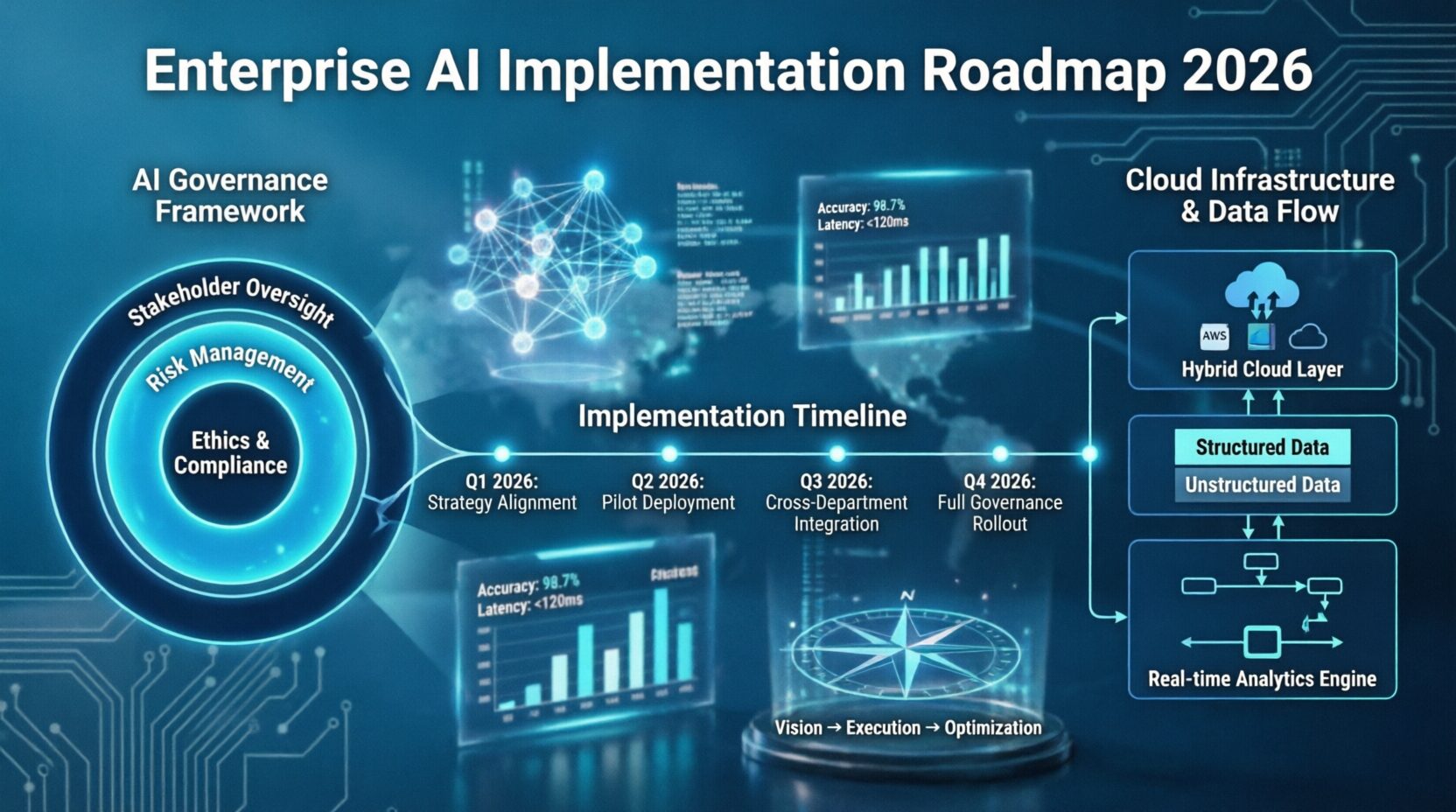
Enterprise AI implementation has transitioned from a futuristic ambition to a critical business imperative in 2026. As generative AI, machine learning, and autonomous agents mature, organizations that successfully navigate large-scale AI deployment gain unprecedented competitive advantages in efficiency, innovation, and customer experience. However, moving beyond isolated pilot projects to a cohesive, organization-wide strategy remains a formidable challenge. If you are an executive, IT leader, or digital transformation officer wondering how to build a resilient AI transformation strategy enterprise, you are in the right place. Understanding the nuances of an enterprise AI adoption framework, establishing a robust enterprise AI governance model, and accurately forecasting enterprise AI ROI measurement are the definitive keys to unlocking sustainable value from artificial intelligence.
This comprehensive, step-by-step guide demystifies the complex journey of enterprise AI implementation. By exploring AI maturity assessment enterprise methodologies, defining clear AI infrastructure requirements enterprise, and mastering AI change management enterprise, this article provides a definitive large-scale AI deployment guide. By the end of this roadmap, you will have a clear, actionable blueprint to avoid enterprise AI failure prevention pitfalls, establish an AI center of excellence enterprise, and leverage proven AI implementation success stories enterprise to drive your organization into the future.
1. Understanding the Enterprise AI Implementation Landscape in 2026
To truly master enterprise AI implementation, we must first recognize the current technological and business landscape. In 2026, AI is no longer just a tool for IT departments; it is a core driver of business strategy. According to McKinsey’s State of AI Report, organizations that have fully integrated AI into their core operations report significantly higher revenue growth and cost reductions compared to those still experimenting with isolated use cases.
Successful enterprise AI implementation requires a shift from ad-hoc experimentation to structured, scalable execution. This means moving beyond the hype and focusing on tangible business outcomes. It requires aligning AI initiatives with overarching corporate goals, ensuring that every algorithm deployed serves a clear strategic purpose. For a deeper understanding of how to align AI initiatives with broader corporate objectives, explore our comprehensive guide on AI Solutions for Business.
2. Developing a Robust AI Transformation Strategy Enterprise
A successful AI transformation strategy enterprise begins with a clear vision. It is not enough to simply adopt new technology; leaders must redefine how the organization operates, makes decisions, and delivers value.
Key components of a winning strategy include:
- Vision Alignment: Ensuring AI goals directly support overarching business objectives, such as revenue growth, cost reduction, or customer satisfaction.
- AI Maturity Assessment Enterprise: Conducting a thorough evaluation of your organization’s current data readiness, technical infrastructure, and cultural openness to AI. This baseline assessment dictates the pace and scope of your implementation.
- AI Use Case Prioritization Enterprise: Not all AI projects are created equal. Prioritize use cases based on potential business value, feasibility, and data availability. Start with high-impact, low-complexity projects to build momentum and secure early wins.
By establishing a clear AI transformation strategy enterprise, you create a north star that guides all subsequent implementation efforts, ensuring resources are allocated to initiatives that truly move the needle.
3. The Enterprise AI Adoption Framework: From Concept to Reality
Translating strategy into action requires a structured enterprise AI adoption framework. This framework serves as the blueprint for moving from ideation to production, minimizing risk and maximizing efficiency.
A standard framework includes the following phases:
- Ideation and Discovery: Brainstorming potential AI applications across different business units.
- Feasibility Analysis: Evaluating the technical, financial, and operational viability of each proposed use case.
- AI Proof of Concept Enterprise: Developing a small-scale, controlled experiment to validate the technology and demonstrate initial value before committing significant resources.
- Pilot Deployment: Rolling out the solution to a limited user group to gather feedback, refine the model, and identify potential roadblocks.
- Production and Scaling: Transitioning the validated solution into full-scale production, supported by robust monitoring and maintenance protocols.
Following a disciplined enterprise AI adoption framework ensures that AI initiatives are systematically evaluated, tested, and scaled, reducing the likelihood of costly failures.
4. Building a Scalable Enterprise AI Governance Model
As AI systems become more pervasive, the need for a robust enterprise AI governance model becomes paramount. Governance ensures that AI is used ethically, securely, and in compliance with evolving regulatory landscapes.
A comprehensive governance model addresses:
- Enterprise AI Security Compliance: Implementing strict controls to protect sensitive data, prevent model poisoning, and ensure compliance with regulations like GDPR, CCPA, and emerging AI-specific legislation.
- Ethical AI Guidelines: Establishing principles to mitigate algorithmic bias, ensure transparency, and maintain human oversight in critical decision-making processes.
- AI Center of Excellence Enterprise: Creating a centralized team of experts responsible for defining standards, sharing best practices, and overseeing the ethical deployment of AI across the organization.
By prioritizing a strong enterprise AI governance model, organizations can innovate confidently, knowing they are protected against reputational, legal, and operational risks.
5. Navigating AI Infrastructure Requirements Enterprise and Data Strategy
The foundation of any successful AI initiative is robust infrastructure and high-quality data. Ignoring AI infrastructure requirements enterprise is a primary cause of project failure.
Critical infrastructure considerations include:
- Compute Power: Ensuring access to sufficient processing power, whether through on-premise GPU clusters or scalable cloud-based solutions, to train and run complex models.
- AI Data Strategy for Enterprises: AI is only as good as the data it consumes. Organizations must break down data silos, establish rigorous data quality standards, and implement robust data lineage tracking to ensure models are trained on accurate, representative datasets.
- Integration Capabilities: Ensuring that new AI tools can seamlessly integrate with existing legacy systems, ERPs, and CRMs to deliver value within existing workflows.
Investing in a solid AI data strategy for enterprises and the necessary infrastructure is not an optional expense; it is the bedrock upon which all enterprise AI implementation is built.
6. Enterprise AI Vendor Selection Criteria and Proof of Concept
Building AI capabilities in-house is not always feasible or desirable. Partnering with the right technology providers is often critical. Developing clear enterprise AI vendor selection criteria is essential to avoid vendor lock-in and ensure long-term success.
When evaluating vendors, consider:
- Scalability and Performance: Can the solution handle your organization’s current and future data volumes and user loads?
- Security and Compliance: Does the vendor offer enterprise-grade security, data encryption, and compliance certifications?
- Total Cost of Ownership: Look beyond the initial license fee to consider implementation, training, maintenance, and scaling costs.
- AI Proof of Concept Enterprise Support: Does the vendor offer robust support and resources to help you successfully execute a proof of concept and validate the technology in your specific environment?
A rigorous evaluation based on these enterprise AI vendor selection criteria will help you choose partners who are truly aligned with your long-term strategic goals.
7. Driving Success: AI Change Management Enterprise and Talent Development
Technology is only half the equation; the human element is equally critical. AI change management enterprise is the process of preparing, supporting, and helping individuals, teams, and organizations in making organizational change.
Key strategies include:
- Transparent Communication: Clearly articulating the “why” behind AI adoption, addressing fears of job displacement, and highlighting how AI will augment rather than replace human workers.
- Enterprise AI Talent Development: Investing in upskilling and reskilling programs to equip your existing workforce with the necessary AI literacy and technical skills. This includes training for both technical staff (data scientists, ML engineers) and business users who will interact with AI tools daily.
- Champion Networks: Identifying and empowering early adopters within different business units to advocate for AI, share success stories, and provide peer-to-peer support.
Effective AI change management enterprise ensures that your workforce is not just compliant with new technologies, but actively engaged and empowered to leverage them for maximum impact.
8. Measuring Success: Enterprise AI ROI Measurement and Scaling Strategies
To secure ongoing investment and demonstrate value, organizations must master enterprise AI ROI measurement. Moving beyond vanity metrics to track tangible business outcomes is essential.
Effective measurement involves:
- Defining Clear KPIs: Establishing specific, measurable, achievable, relevant, and time-bound (SMART) key performance indicators before the project begins. This could include metrics like reduction in processing time, increase in sales conversion rates, or decrease in operational costs.
- Continuous Monitoring: Implementing dashboards and monitoring tools to track model performance, data drift, and business impact in real-time.
- Enterprise AI Scaling Strategies: Once a use case has proven its ROI, developing a clear plan to scale it across other departments, regions, or product lines. This requires standardizing processes, automating deployment pipelines (MLOps), and ensuring the underlying infrastructure can handle the increased load.
By focusing on rigorous enterprise AI ROI measurement and deploying effective enterprise AI scaling strategies, organizations can transform isolated AI wins into enterprise-wide transformation.
9. Enterprise AI Failure Prevention and Implementation Success Stories
Learning from the mistakes of others is one of the most effective ways to ensure your own success. Enterprise AI failure prevention requires proactive risk management.
Common pitfalls to avoid include:
- Lack of Executive Sponsorship: AI initiatives without strong, visible support from the C-suite often struggle to secure necessary resources and overcome organizational resistance.
- Poor Data Quality: Attempting to build advanced AI models on top of messy, incomplete, or biased data will inevitably lead to inaccurate and unreliable results.
- Ignoring the Human Element: Failing to invest in AI change management enterprise and enterprise AI talent development will result in low adoption rates and wasted investment.
Conversely, studying AI implementation success stories enterprise provides valuable blueprints for success. Organizations that have successfully navigated this journey typically share common traits: strong leadership, a clear strategic vision, a focus on data quality, and a commitment to continuous learning and adaptation. For technical teams building these large-scale systems, our guide on AI Coding Prompts is an essential resource.
10. Comprehensive Query Coverage
What is the first step in enterprise AI implementation? The first step in enterprise AI implementation is conducting an AI maturity assessment enterprise. This involves evaluating your current data infrastructure, technical capabilities, and organizational readiness to establish a realistic baseline and inform your AI transformation strategy enterprise.
How do you measure the success of an AI project? Success is measured through rigorous enterprise AI ROI measurement. This involves tracking predefined KPIs such as cost savings, revenue growth, process efficiency gains, and customer satisfaction improvements, rather than just technical metrics like model accuracy.
What are the main challenges in large-scale AI deployment? The main challenges include ensuring enterprise AI security compliance, managing AI change management enterprise to overcome employee resistance, securing high-quality data through a robust AI data strategy for enterprises, and aligning AI initiatives with actual business needs through effective AI use case prioritization enterprise.
How can organizations prevent AI project failures? Enterprise AI failure prevention starts with strong executive sponsorship, clear AI use case prioritization enterprise, and a phased approach starting with an AI proof of concept enterprise. Additionally, investing in an AI center of excellence enterprise ensures consistent governance and best practices.
What is the role of an AI Center of Excellence? An AI center of excellence enterprise acts as the central hub for AI strategy, governance, and best practices. It standardizes tools, provides training for enterprise AI talent development, and ensures that all AI initiatives align with the broader enterprise AI adoption framework.
Where can I find more resources on enterprise AI strategy? Beyond this guide, explore the Allesora AI Directory for curated lists of enterprise AI platforms, and check out our guides on AI Solutions for Business and AI Tools Importance for maximizing your organization’s technology stack.
Conclusion
Mastering enterprise AI implementation is no longer a luxury; it is a fundamental requirement for organizational survival and growth in 2026. By developing a clear AI transformation strategy enterprise, adhering to a structured enterprise AI adoption framework, and establishing a robust enterprise AI governance model, leaders can navigate the complexities of large-scale AI deployment with confidence.
Success requires more than just technology; it demands a holistic approach that includes rigorous AI maturity assessment enterprise, strategic enterprise AI budget planning, and a relentless focus on enterprise AI talent development. By prioritizing enterprise AI security compliance, leveraging proven enterprise AI vendor selection criteria, and learning from AI implementation success stories enterprise, organizations can avoid common pitfalls and unlock the true potential of artificial intelligence.
As you embark on this transformative journey, remember that enterprise AI implementation is not a one-time project, but an ongoing evolution. Continuously refine your AI data strategy for enterprises, adapt your enterprise AI scaling strategies, and foster a culture of innovation to ensure your organization remains at the forefront of the AI revolution.