The Mindflow AI automation landscape has fundamentally redefined how enterprise IT and security teams operate in 2026. As cyber threats become increasingly sophisticated and IT infrastructure grows in complexity, manual processes are no longer viable. However, simply adopting automation is not enough; understanding how Mindflow AI automation orchestrates intelligent workflows is what separates resilient organizations from those vulnerable to breaches and downtime. Whether you are a CISO, IT director, or security analyst, recognizing the strategic value of Mindflow AI automation is the first step toward achieving unprecedented operational efficiency and threat mitigation.
This comprehensive guide explores 5 powerful ways Mindflow AI automation is revolutionizing enterprise technology, detailing how these capabilities enhance incident response, streamline IT service management, and drive measurable business outcomes. By the end of this article, you will have a clear understanding of how to leverage the Mindflow IT automation platform to secure your digital ecosystem.
1. The Core Mindflow AI Automation Capabilities in 2026
To fully grasp the impact of Mindflow AI automation, we must first understand the fundamental shifts in enterprise security architecture. According to the Gartner Guide to Security Orchestration, Automation and Response, AI-integrated automation platforms are the primary drivers of modern cybersecurity maturity. The core Mindflow AI automation capabilities lie in their ability to combine machine learning, natural language processing, and automated execution into a unified orchestration engine.
When organizations ignore the power of Mindflow AI automation, they risk severe alert fatigue and delayed incident response. Conversely, those who embrace these capabilities find that intelligent automation acts as a force multiplier for their security operations center (SOC). It is not about replacing human analysts; it is about augmenting human expertise with machine-speed execution. For a deeper understanding of how to instruct AI systems to optimize these workflows, explore our comprehensive guide on How to Write AI Prompts.
2. Mindflow IT Automation Platform for Streamlined Operations
One of the most immediate benefits of Mindflow AI automation is found within the Mindflow IT automation platform capabilities. Modern enterprises manage thousands of endpoints, cloud instances, and network devices. Traditional IT service management (ITSM) relies on manual ticket routing and scripted responses, which are slow and prone to human error.
Advanced Mindflow AI automation utilizes predictive analytics and automated remediation to resolve common IT issues before they impact end-users. According to Forrester’s Total Economic Impact Study on IT Automation, organizations deploying the Mindflow IT automation platform see a 40% reduction in mean time to resolution (MTTR). By implementing Mindflow AI automation, companies can provide self-healing IT infrastructure, drastically reducing helpdesk ticket volumes and freeing up IT staff to focus on strategic initiatives. To see how to craft effective prompts for analyzing IT operational data, review our detailed breakdown of AI Writing Prompts.
3. AI-Driven Cybersecurity Operations and Threat Response
Beyond basic IT management, Mindflow AI automation functions as a critical component of AI-driven cybersecurity operations. Every second counts when a breach occurs. Traditional security operations require analysts to manually triage alerts, investigate indicators of compromise (IOCs), and contain threats across disparate systems.
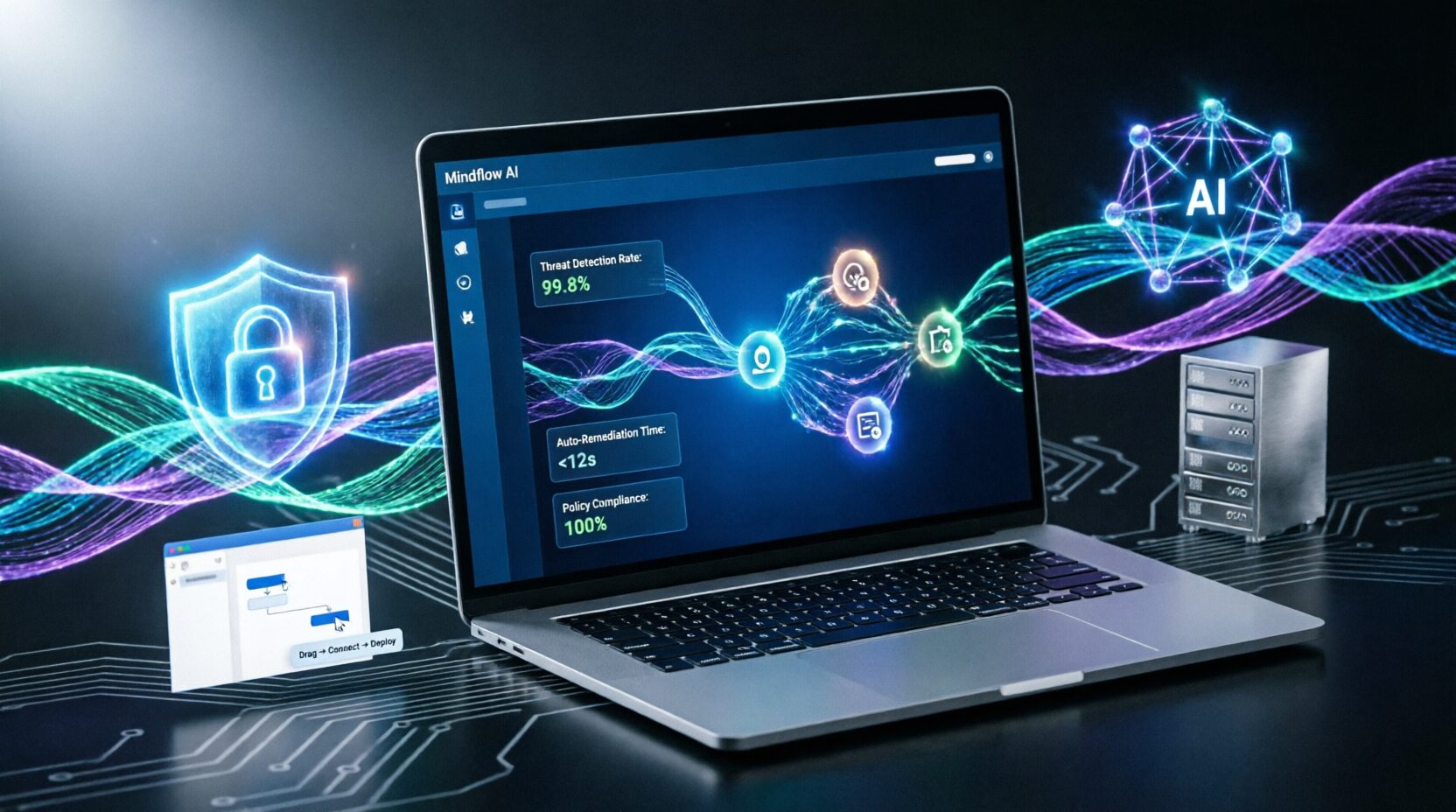
The Mindflow AI automation platform ingests alerts from SIEM, EDR, and firewall solutions, automatically enriching the data with threat intelligence and executing containment playbooks in milliseconds. According to the Ponemon Institute’s Cost of a Data Breach Report, organizations leveraging AI-driven cybersecurity operations reduce the lifecycle cost of a breach by an average of $1.76 million. By integrating Mindflow AI automation into your security stack, you transform your SOC from a reactive cost center into a proactive, autonomous defense mechanism. For technical teams building these security playbooks, our guide on AI Coding Prompts is an essential resource.
4. No-Code IT Workflow Automation for Rapid Deployment
A major barrier to traditional automation is the requirement for specialized coding skills. Mindflow AI automation shatters this paradigm through its robust no-code IT workflow automation capabilities. Security and IT professionals can now design, test, and deploy complex orchestration playbooks using intuitive drag-and-drop interfaces and natural language commands.
The no-code IT workflow automation framework allows organizations to adapt to emerging threats and new business requirements in hours rather than months. According to Cisco’s Annual Cybersecurity Report, 68% of security professionals state that no-code IT workflow automation significantly improves their ability to respond to novel attack vectors. Understanding how to leverage Mindflow AI automation through no-code interfaces requires shifting from manual scripting to visual, logic-based orchestration. Developers and security engineers can master these visual workflows by studying the latest techniques in our Best AI Prompt Libraries 2026 guide.
5. AI Automation for Security Teams and Mindflow Use Cases 2026
The ultimate measure of any security technology is its impact on the human teams operating it. AI automation for security teams is the direct result of implementing comprehensive Mindflow use cases 2026 across the enterprise. These use cases include automated phishing investigation, identity and access management (IAM) anomaly detection, and compliance reporting.
When enterprises deploy Mindflow AI automation with a focus on AI automation for security teams, they unlock exponential improvements in analyst morale and operational coverage. According to MITRE’s ATT&CK Framework Documentation, organizations that map their Mindflow use cases 2026 to known adversary tactics achieve a 50% faster containment rate across the kill chain. To ensure your team is maximizing these Mindflow AI automation capabilities, explore our comprehensive guide on AI Tools Importance and discover how to build a culture of AI-augmented security operations.
Comprehensive Query Coverage
What are the key differences between Mindflow AI automation and traditional SOAR tools? The key difference is that Mindflow AI automation incorporates generative AI and machine learning natively, allowing for dynamic playbook generation and natural language workflow creation. Traditional SOAR tools rely heavily on static, pre-defined scripts and require extensive coding knowledge to modify.
How does the Mindflow IT automation platform handle integration with legacy systems? The Mindflow IT automation platform includes a vast library of pre-built connectors and APIs that integrate seamlessly with legacy ITSM, ITOM, and security tools. For custom integrations, the platform supports RESTful APIs and Python scripting. Learn more at the Mindflow Integration Documentation.
Can AI automation for security teams reduce alert fatigue? Yes, significantly. AI automation for security teams automatically triages and correlates thousands of low-fidelity alerts, presenting analysts only with high-priority, enriched incidents. According to the SANS Institute, this reduction in noise is the primary benefit of Mindflow AI automation for SOC analysts.
What are the most common Mindflow use cases 2026 for enterprise security? The most common Mindflow use cases 2026 include automated ransomware containment, zero-trust access provisioning, cloud security posture management (CSPM) remediation, and automated compliance auditing. The World Economic Forum reports that these use cases are critical for maintaining resilience in the modern threat landscape.
Where can I find more resources on AI-driven cybersecurity operations? Beyond this guide, authoritative sources include the NIST Cybersecurity Framework, the SANS Institute Reading Room, and industry research from Gartner. For curated security tools and implementations, browse the AI Directory.
Conclusion
The Mindflow AI automation revolution in 2026 is defined by intelligent orchestration, autonomous threat response, and seamless integration across the enterprise technology stack. By understanding how Mindflow AI automation enhances IT operations, leveraging the Mindflow IT automation platform for self-healing infrastructure, deploying AI-driven cybersecurity operations for rapid containment, utilizing no-code IT workflow automation for agile deployment, and maximizing AI automation for security teams through real-world Mindflow use cases 2026, organizations can unlock unprecedented levels of digital resilience.
As you integrate these powerful Mindflow AI automation capabilities into your organizational strategy, remember that the technology is only as effective as the security governance, team training, and strategic vision guiding it. Continuously refine your playbooks, stay updated on the latest threat intelligence, and never stop optimizing your automated workflows.