What Is Cassidy?

Defining the Concept
Cassidy refers to an AI-powered knowledge assistant designed specifically for teams and organizations to capture, organize, and retrieve institutional knowledge in real time. Unlike generic chatbots that draw from public or static datasets, Cassidy integrates directly with a company’s internal tools such as Slack, Microsoft Teams, Notion, Confluence, Google Drive, and email to index, understand, and surface relevant information based on team context and user roles. It acts as a “collective memory” for the organization, answering questions like “Where’s our Q3 marketing plan?” or “Who approved the vendor contract?” by pulling from actual team documents, conversations, and workflows without exposing sensitive data to external models or third parties.
What Information Is Included?
Knowledge Scope and Privacy Safeguards
Cassidy processes only the content explicitly shared within an organization’s connected workspaces, with strict boundaries:
- Internal documents: Policies, project briefs, meeting notes, SOPs, and strategy decks from approved sources
- Team communications: Public channel messages in Slack or Teams (private DMs are excluded by default)
- User-generated content: Spreadsheets, presentations, design files, and code repositories (with permission)
- Metadata and context: Author, date, project tags, and access roles to ensure relevance and security
Critically, Cassidy does not send data to external AI providers. It uses on-premise or private-cloud AI models to embed and retrieve information, ensuring that proprietary knowledge never leaves the organization’s control. Access is role-based employees only see answers derived from content they already have permission to view. Sensitive topics or restricted documents are automatically filtered out of responses.
Where Is Cassidy Used?
Workplace Applications and Team Contexts
Cassidy is deployed in knowledge-intensive environments where time lost searching for information directly impacts productivity:
- Remote and hybrid teams: New hires quickly find onboarding docs, team norms, or past decisions without interrupting colleagues
- Product and engineering: Developers locate API specs, incident post-mortems, or feature requirements across Jira, GitHub, and Confluence
- Sales and customer success: Reps retrieve battle cards, pricing guides, or client history before meetings
- HR and operations: Employees self-serve answers about benefits, PTO policies, or IT support
- Consulting and professional services: Teams reuse past proposals, client insights, and templates without reinventing the wheel
Cassidy works as a bot in messaging apps, a sidebar in browsers, or a standalone search interface—meeting users where they already work.
When Did Cassidy Emerge?
Responding to the Knowledge Fragmentation Crisis
Cassidy emerged in the mid-2020s, as organizations grappled with the consequences of digital sprawl: critical knowledge scattered across dozens of tools, rising employee turnover, and the inefficiency of “just ask someone.” While generative AI promised answers, public models couldn’t access internal data and uploading company docs to third-party AI posed serious security risks. Cassidy was built to solve this paradox: How can we give teams the power of AI search without sacrificing privacy or control? It combined advances in private AI, semantic search, and workplace integration to create a secure, contextual knowledge layer for the modern enterprise.
Why Does Cassidy Exist?
Ending the “Where Is That Document?” Era
Cassidy exists because institutional knowledge is one of a company’s most valuable assets—and also one of its most fragile. It evaporates when employees leave, hides in unread folders, or drowns in notification noise. Traditional search is keyword-based and blind to context; wikis go stale; tribal knowledge creates bottlenecks. Cassidy answers a simple but urgent need: What if every team member had instant access to everything the organization already knows? Its purpose is to reduce redundancy, accelerate onboarding, and ensure decisions are informed by collective experience not guesswork.
How Is Cassidy Built?
Architecture and Intelligence Layer
Cassidy uses a privacy-first, retrieval-augmented architecture:
- Secure Connectors: Syncs with approved workplace tools using OAuth and enterprise-grade APIs
- Private Embedding Engine: Converts documents and messages into searchable vectors using on-premise or VPC-hosted AI models
- Context-Aware Retrieval: Understands user role, team, and query intent to return only relevant, accessible results
- Natural Language Interface: Users ask questions in plain English; Cassidy returns sourced answers with links to original content
- Continuous Learning: Automatically updates its index as new documents are created or conversations happen
No raw data is stored externally. All processing respects existing permission structures so if you can’t see a file in Notion, Cassidy won’t cite it in a response.
Why Is Cassidy Necessary?

The Cost of Lost Knowledge
Cassidy is necessary because knowledge gaps have real business costs. It is essential because:
- Employees spend up to 20% of their time searching for information or recreating existing work
- New hires take months to reach full productivity due to opaque processes and undocumented decisions
- Critical insights disappear when employees leave, leading to repeated mistakes
- Public AI tools cannot safely access internal data, leaving teams without intelligent search
- Compliance and security teams require auditable, permission-aware knowledge systems
Without a tool like Cassidy, organizations operate with institutional amnesiaconstantly rediscovering what they already knew.
Benefits of Cassidy
Productivity, Continuity, and Trust
Faster Onboarding
New team members become productive in days, not months, by instantly accessing historical context.
Reduced Interruptions
Employees find answers themselves instead of pinging busy colleagues.
Preserved Institutional Memory
Knowledge persists beyond individual contributors or project cycles.
Enhanced Decision-Making
Teams base choices on documented precedents, not hearsay or assumptions.
Strong Data Governance
All answers respect existing access controls—no accidental data leaks.
Advantages and Disadvantages
Key Advantages
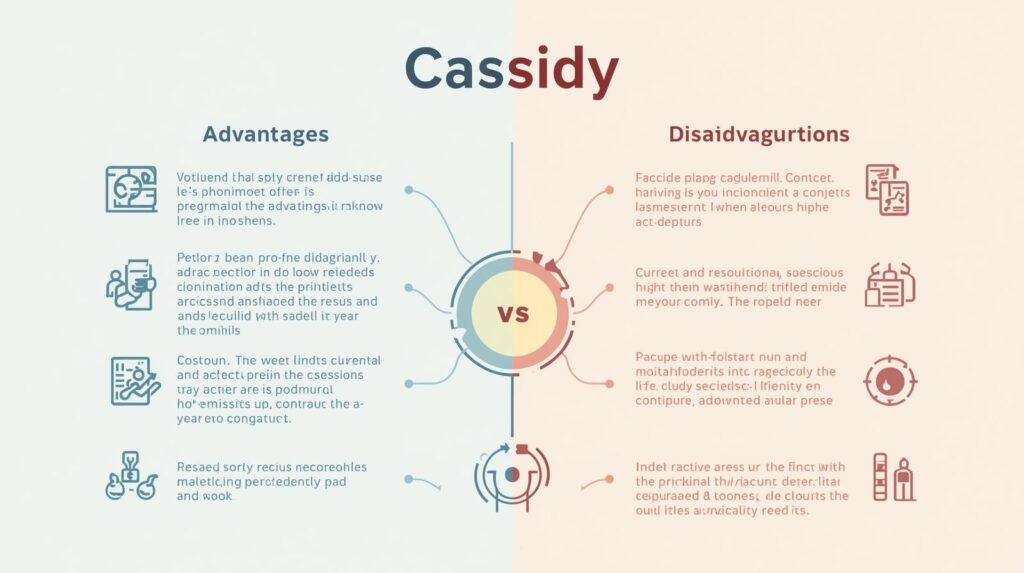
Cassidy excels at making existing knowledge instantly discoverable without changing how teams work. Its deep integration with workplace tools ensures high adoption. Because it uses private AI, it meets strict security and compliance requirements. It reduces dependency on “knowledge hoarders” and democratizes access to information. Most importantly, it turns passive documents into active, queryable intelligence without exposing data to external risk.
Notable Disadvantages
Cassidy can only answer questions based on what’s already documented if knowledge lives only in someone’s head, it won’t be found. Initial setup requires connecting data sources and defining access scopes, which may need IT involvement. In very large organizations, indexing can take time, and relevance tuning may be needed. Free or low-tier plans may limit data sources or users. And because it avoids public models, it cannot answer general-knowledge questions outside the organization’s domain.
Conclusion
The Institutional Memory Your Team Never Had
Cassidy is more than a search tool it’s a living archive of your team’s collective intelligence. In an era of rapid change, remote work, and information overload, it ensures that what your organization learns today remains useful tomorrow.
It is not about generating new content. It is about unlocking what you already know securely, instantly, and fairly. For teams tired of reinventing the wheel, Cassidy isn’t just helpful. It’s transformative.