What Are GPTBots?
Defining the Term
GPTBots are AI-powered chatbots built using Generative Pre-trained Transformer (GPT) technology. These large language models can understand and generate human-like text. While not an official product name, the term GPTBots is commonly used to describe any conversational agent that leverages GPT-style models, such as GPT-3.5 or GPT-4, to simulate dialogue, answer questions, or perform tasks through natural language.
What Data Is Included?
GPTBots typically rely on two types of data. First, there is pre-trained knowledge, which comes from massive datasets of books, websites, and public text used during the model’s initial training. This data is static and not updated in real time. Second, in custom applications, GPTBots can be enhanced with private data through techniques like Retrieval-Augmented Generation to answer domain-specific questions. However, base versions like ChatGPT do not access your personal files unless you explicitly share them.
Where Are They Hosted and Used?
GPTBots operate primarily in the cloud. Public versions, such as ChatGPT, run on servers managed by companies like OpenAI. Custom GPTBots are often deployed via APIs on platforms like Azure or AWS, or through specialized no-code tools such as Chaindesk and Voiceflow. They can be embedded into websites, mobile apps, Slack, WhatsApp, or customer service dashboards.
When Did They Emerge?
The first widely accessible GPTBot, ChatGPT, launched in November 2022, sparking a global surge in AI adoption. Since then, businesses, developers, and individuals have built countless custom GPTBots for education, healthcare, sales, and internal operations.
Why Do They Exist?
GPTBots were developed to bridge the gap between human language and machine intelligence. They aim to make technology more intuitive by allowing users to interact with software using everyday speech, eliminating the need for buttons, menus, or code.
How Do They Work?
GPTBots process user input, analyze context from the conversation history, and predict the most statistically likely and contextually appropriate response. Advanced versions use prompt engineering, fine-tuning, or external data retrieval to improve accuracy and relevance.
Why Are GPTBots Necessary?
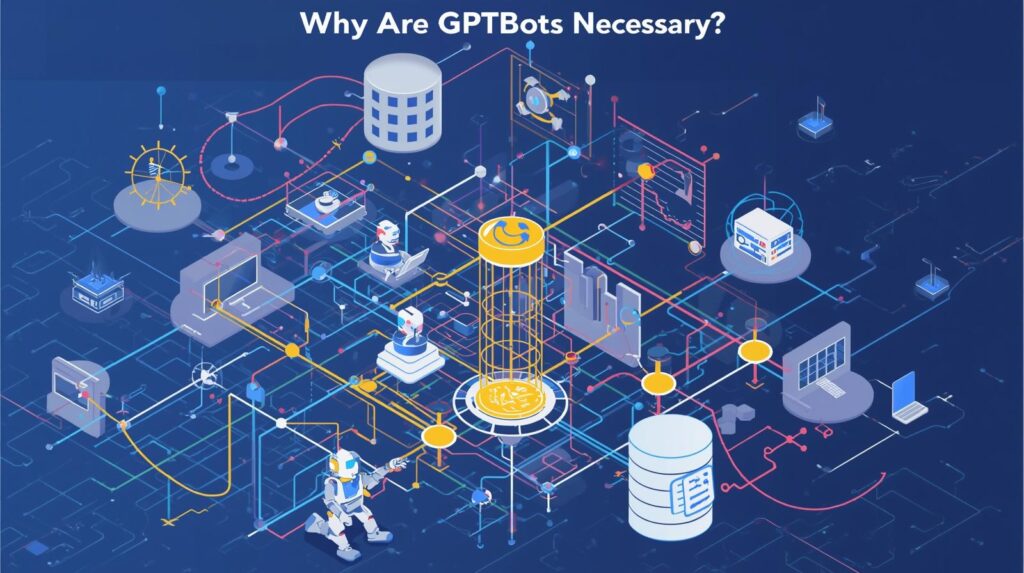
In an era of information overload and labor shortages, it address critical modern challenges. They provide instant, scalable, and intelligent interaction at a time when human attention is limited and digital expectations are high.
They are necessary because customers demand 24/7 support, but human teams cannot be everywhere at once. Employees waste hours on repetitive tasks that AI can automate. Complex information, such as legal terms, medical advice, or coding help, needs to be explained simply and accessibly. Businesses must also innovate faster, and GPTBots enable rapid prototyping of AI-driven services without massive engineering investment.
Without GPTBots, organizations would struggle to meet rising demands for speed, personalization, and efficiency in digital experiences.
Benefits of GPTBots

Enhanced User Experience
Conversations feel natural and adaptive, reducing frustration compared to rigid, menu-based chatbots.
Operational Efficiency
Automating routine inquiries, such as password resets, order tracking, or FAQ responses, frees human agents for complex issues. This cuts costs and reduces wait times.
Democratization of Expertise
GPTBots can explain technical topics in plain language, making specialized knowledge accessible to non-experts. This includes tax advice, programming help, or health guidance.
Rapid Development and Deployment
With modern tools, a functional GPTBot can be built in hours, not months, accelerating innovation across departments.
Multilingual Support
Most GPTBots understand and respond in dozens of languages, breaking down communication barriers in global markets.
Advantages and Disadvantages
Key Advantages
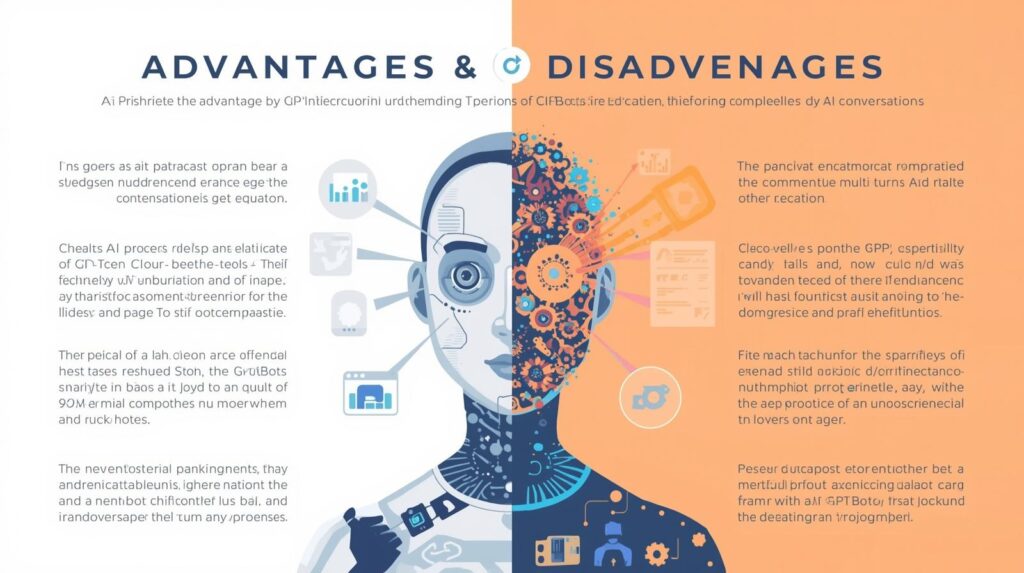
GPTBots excel at contextual understanding, maintaining coherent multi-turn conversations unlike older rule-based bots. They offer continuous learning potential through user feedback and fine-tuning. Their integration flexibility allows deployment across websites, apps, and messaging platforms with minimal effort. Additionally, they support personalization at scale, tailoring responses based on user history or preferences, while remaining cost-effective compared to human-only support models.
Notable Disadvantages
Despite their fluency, GPTBots suffer from hallucinations. They may generate confident but false or misleading information, especially on niche or evolving topics. They possess no true understanding, only pattern recognition, making them vulnerable to logical errors or manipulation. Privacy risks arise when users unknowingly share sensitive data, assuming the bot is safe. GPTBots can also amplify societal biases present in their training data, leading to unfair or offensive outputs. Over-reliance may erode critical thinking, as users defer to AI instead of verifying facts. Finally, running large models has a significant environmental cost due to high energy consumption.
Conclusion
GPTBots represent a transformative shift in how humans interact with technology, turning machines into conversational partners rather than tools. They offer unprecedented convenience, scalability, and accessibility, already reshaping customer service, education, software development, and more.
However, their power comes with responsibility. The goal should not be to replace human judgment, but to augment it wisely. This requires transparent design, rigorous fact-checking, strong privacy safeguards, and user education about AI’s limits.
When deployed ethically, it can be powerful allies in solving real-world problems. But without guardrails, they risk spreading misinformation, eroding trust, and deepening digital divides.