
What Is Jestor?

Defining the Concept
Jestor refers to a no-code internal operations platform that enables non-technical teams to build custom business applications such as CRMs, project trackers, inventory systems, vendor portals, and approval workflows without writing code or relying on engineering resources. Unlike rigid off-the-shelf software that forces teams to adapt to predefined structures, or fragile spreadsheets that break at scale, Jestor provides a flexible, relational database-driven environment where users can model custom data structures, design intuitive interfaces, automate multi-step workflows, and integrate with external tools like Slack, Google Workspace, and Stripe. Built for startups, e-commerce brands, agencies, and SMBs, Jestor turns internal operations from a bottleneck into a strategic advantage by empowering teams to create tailored, scalable solutions that evolve with their business—reducing reliance on manual processes, disjointed tools, and costly custom development.
What Information Is Included?
Data Scope and Application Capabilities
Jestor handles structured operational data across a wide range of internal use cases, including:
- Custom records and relationships: Entities like leads, deals, support tickets, inventory SKUs, employee requests, or partner contracts, with one-to-many or many-to-many links (e.g., “Customer → Orders → Products”)
- Rich field types: Text, number, date, status (dropdown), checkbox, formula, rollup, attachment, and rich text fields with version history
- Automation rules: Conditional triggers that execute actions like sending Slack messages, updating fields, creating new records, or emailing stakeholders (e.g., “When status = ‘Approved,’ notify finance and generate PO”)
- Files and media: Secure storage of documents, images, and videos with access controls and audit trails
- Activity logs: Timestamped history of record changes, comments, and approvals for compliance and transparency
- Integrations: Native connections to Google Sheets, Slack, Gmail, Stripe, Zapier, and webhooks for custom API integrations
All data is encrypted in transit (TLS 1.3 plus) and at rest (AES-256). Jestor is SOC 2 Type II compliant and supports GDPR-ready data handling, including right-to-erasure requests and data export in CSV or JSON format. Customers retain full ownership of their data, and enterprise plans offer SSO, audit logs, and data residency options in U.S. or EU regions.
Where Is Jestor Used?
Internal Operations Across Growing Organizations
Jestor is deployed wherever teams need custom, agile, and integrated internal tools but lack developer bandwidth or budget for enterprise software:
- Startups and scale-ups: Build lightweight CRMs before investing in Salesforce; manage investor pipelines, cap table requests, or board meeting prep in a single workspace
- E-commerce brands: Track custom order statuses, returns, vendor onboarding, or influencer gifting workflows with automated notifications and SLA timers
- Marketing and creative agencies: Manage client projects, content calendars, budget approvals, and invoice tracking with real-time collaboration
- HR and operations teams: Create internal request systems for IT access, facilities, equipment, or onboarding with multi-step approvals and handoffs
- SaaS companies: Operate customer success playbooks, feature request boards, partner directories, or beta tester management with segmentation and tagging
- Finance teams: Handle expense approvals, invoice tracking, budget requests, and payment reconciliations with audit-ready trails
Jestor supports both department-specific tools (e.g., an HR onboarding hub) and company-wide operational centers (e.g., a unified ops dashboard), enabling everything from simple task lists to complex multi-phase workflows with human-in-the-loop approvals.
When Did Jestor Emerge?
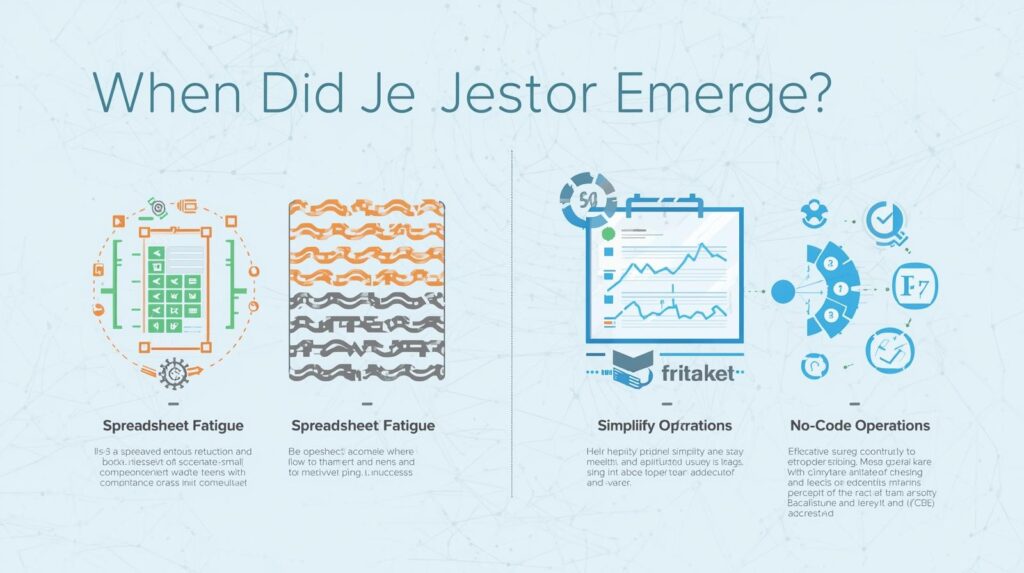
From Spreadsheet Fatigue to No-Code Operations OS
Jestor was founded in 2020 by former startup operators and product managers who experienced firsthand the pain of managing hypergrowth with spreadsheets, email, and disconnected tools. The platform launched in 2021 with a focus on simplicity and speed, targeting teams tired of waiting months for engineering resources to build internal tools. Early adopters included DTC brands, SaaS startups, and digital agencies managing operations across remote teams. By 2022 to 2023, Jestor added advanced features like relational databases, conditional automations, and native integrations. In 2024 to 2025, it evolved into a full internal operations suite—positioning itself as the “operating system for startups”—with a growing user base across North America, Europe, and Latin America, and integrations spanning 50 plus tools.
Why Does Jestor Exist?
Solving the Internal Tooling Gap
Jestor exists because most companies outgrow spreadsheets and email before they can afford enterprise software—and engineering teams are too busy building customer-facing products to support internal needs. Operations, sales, and HR teams resort to fragile, error-prone workarounds that don’t scale, leading to version conflicts, manual errors, and compliance risks. Jestor answers a critical need: How can non-technical teams build reliable, integrated, and maintainable internal tools—fast and affordably? Its purpose is to democratize app development for operations, so every team can work the way they need to—without code, without IT tickets, and without compromise.
How Is Jestor Built?
Architecture and Core Components
Jestor’s platform is built on a modern, cloud-native stack with four key layers:
- Data Engine: A relational database where users define custom tables, fields, and relationships through a visual schema builder no SQL required
- UI Builder: Drag-and-drop interface designer for creating forms, tables, kanban boards, calendars, and dashboards mobile-responsive by default
- Automation Studio: Visual workflow editor to set triggers (e.g., “When record is created”) and actions (e.g., “Send Slack message to #ops, assign to manager”)
- Integration Hub: Pre-built connectors to Google Sheets, Slack, Gmail, Stripe, Typeform, and webhooks for custom API integrations
All components run on secure AWS infrastructure with automatic daily backups, role-based permissions, and audit logging. The platform is fully web-based—no installation required and updates are delivered seamlessly without downtime. Jestor’s API allows developers to extend functionality for advanced use cases.
Why Is Jestor Necessary?
The Hidden Cost of Operational Chaos
Jestor is necessary because disconnected internal processes directly impact productivity, accuracy, and scalability. It is essential because:
- Spreadsheets lead to version conflicts, data loss, and manual errors—costing teams 5 to 10 hours per week in reconciliation
- Off-the-shelf tools force teams to adapt to rigid workflows, not the other way around
- Engineering dependency slows down operational innovation and creates backlogs
- Lack of audit trails creates compliance and accountability risks (e.g., unlogged approvals, missing documentation)
- Manual handoffs between tools (e.g., Slack to email to spreadsheet) waste time and cause dropped requests
Jestor ensures that internal operations are as efficient, reliable, and scalable as customer-facing products—so teams can focus on outcomes, not overhead.
Who Uses Jestor?
Target Users and Team Roles
Jestor serves a range of professionals across growing organizations:
- Founders and COOs: Build and oversee company-wide operational hubs without developer dependency
- Operations Managers: Design and iterate workflows for scalability and compliance
- Sales and Customer Success Leads: Create lightweight CRMs and onboarding trackers tailored to their motion
- HR and People Ops: Standardize people processes to improve employee experience and reduce time-to-hire
- Finance Analysts: Automate approvals, reconciliations, and reporting without spreadsheet errors
- Marketing and Project Managers: Coordinate campaigns, content, and vendors in a single, transparent workspace
The platform’s intuitive interface requires minimal training—most users build their first app in under an hour.
Integration and Ecosystem
Connecting Jestor to Existing Toolchains
Jestor enhances—not replaces—existing workflows through seamless integrations:
- Communication Tools: Notify assignees via Slack or email when tasks are due or records change
- Productivity Suites: Embed Google Sheets for advanced calculations; attach Docs or Drive files directly to records
- CRM and Sales Tools: Sync lead data to or from HubSpot or Salesforce via Zapier
- Payment and E-commerce: Trigger actions in Stripe (e.g., “When invoice status = ‘Paid,’ update Jestor record”)
- Form Builders: Ingest Typeform or Google Form submissions as new records
- Analytics: Export data to Google Looker Studio or Airtable for reporting
These integrations ensure Jestor becomes the operational layer that connects people, data, and tools.
Pricing and Accessibility
Plans for Startups and SMBs
Jestor offers transparent, growth-friendly pricing:
- Free Plan: Unlimited users, 1,000 records, basic automations, and core integrations—ideal for solopreneurs or early validation
- Starter Plan: 15 dollars per user per month (billed annually) includes 10,000 records, advanced automations, and priority support
- Growth Plan: 29 dollars per user per month adds unlimited records, audit logs, SSO, and API access
- Enterprise Plan: Custom pricing with dedicated onboarding, SLAs, data residency, and white-glove support
All plans include mobile apps, unlimited views, and 50-plus integrations. Nonprofits and early-stage startups qualify for discounted or free premium access.
Future Roadmap
What’s Next for Jestor
Jestor is expanding its platform to deepen intelligence and collaboration:
- AI-Powered Field Enrichment: Auto-fill descriptions, tags, or summaries from raw notes using generative AI
- Predictive Workflow Suggestions: Recommend automations based on usage patterns (e.g., “You often notify Slack after approval—automate it?”)
- Mobile-First Field Operations: Offline form submission and photo-based verification for remote teams
- Enhanced Collaboration: @mentions, threaded comments, and version history for record-level discussions
- Template Marketplace: Community-driven library of pre-built apps for common use cases (e.g., “Startup CRM,” “E-commerce Returns”)
These innovations aim to make Jestor not just a tool builder, but an active partner in operational excellence.
Benefits of Jestor
Strategic and Operational Impact
Accelerated Tool Delivery
Build custom internal apps in hours or days, not weeks or months—enabling rapid iteration as the business evolves.
Reduced Operational Risk
Eliminate spreadsheet errors and version chaos with a single source of truth and audit-ready trails.
Improved Team Autonomy
Empower non-technical teams to solve their own problems without engineering tickets or IT dependency.
Stronger Compliance
Ensure GDPR, SOC 2, and internal policy adherence with encryption, access controls, and data export.
Cost Efficiency
Replace multiple point solutions (e.g., Trello + Google Sheets + Zapier) and avoid costly custom development.
Scalable Operations
Grow from 10 to 1,000 employees without rebuilding core processes from scratch.
Advantages and Disadvantages

Key Advantages
Jestor offers one of the most intuitive, startup-friendly, and relational no-code platforms for internal operations. Its data model goes beyond simple lists to support complex use cases (e.g., nested relationships, rollup calculations) without complexity. The UI is clean, fast, and mobile-optimized, with zero learning curve for spreadsheet users. Pricing is transparent and affordable for SMBs, and the platform evolves rapidly based on customer feedback. Most importantly, it turns operational teams from passive tool users into active solution builders—accelerating growth without technical debt.
Notable Disadvantages
Jestor is optimized for SMBs and startups, not large enterprises with complex compliance or legacy system needs. Advanced custom logic (e.g., complex formulas, third-party API calls) may require workarounds or webhooks. While it integrates with major tools, it lacks native connectors for niche enterprise software (e.g., SAP, Oracle). Data export is supported, but full migration to another platform requires manual effort. And because it’s a centralized SaaS product, organizations must trust Jestor with their operational data—making security and uptime critical.
Conclusion
The Operating System for Modern Teams
Jestor may not face customers, but its impact is felt in every streamlined process, every accurate report, every empowered team. In an era where agility defines competitive advantage, it provides the foundation for internal operations that move as fast as the business itself.
It is not about replacing spreadsheets. It is about replacing chaos with clarity—so teams can build, adapt, and scale without waiting. For startups and SMBs serious about operational excellence, Jestor is not just a tool. It is the engine of self-reliant, efficient, and scalable growth.