
What Is OpenCall.ai?
Defining the Concept
OpenCall.ai refers to an AI-driven sales engagement platform that uses conversational AI agents to conduct human-like outbound phone calls at scale handling prospecting, lead qualification, appointment setting, and follow-ups without human intervention. Unlike traditional robocalls or basic IVR systems that play static messages, OpenCall.ai deploys dynamic, voice-enabled AI agents trained on real sales conversations to engage live prospects in natural, two-way dialogue. These agents understand speech in real time, respond contextually, handle objections, and book meetings directly into calendars mimicking the cadence, tone, and adaptability of top-performing sales reps. Built for revenue teams in SaaS, staffing, real estate, and local services, OpenCall.ai turns cold calling from a manual, low-conversion chore into an automated, high-throughput revenue channel.
What Information Is Included?
Conversation Scope and Data Handling
OpenCall.ai processes live voice interactions and structured sales data to drive intelligent outreach, including:
- Call audio and transcripts: Full recordings and real-time speech-to-text of prospect conversations, with speaker diarization to distinguish agent and prospect
- Intent and sentiment signals: Detection of interest, hesitation, objections, or disengagement using acoustic and linguistic cues
- Lead qualification data: Responses to qualifying questions (e.g., budget, timeline, authority, need) captured as structured fields
- Calendar and CRM sync: Meeting bookings, contact updates, and activity logs pushed directly to Google Calendar, Salesforce, HubSpot, or Outreach
- Performance analytics: Call volume, connect rates, conversation duration, objection frequency, and conversion rates by agent, script, or campaign
All voice and text data is encrypted in transit (TLS 1.3 plus) and at rest (AES-256). OpenCall.ai does not store raw audio beyond what is necessary for compliance and quality assurance typically 30 to 90 days and customers can request immediate deletion. The platform is SOC 2 Type II compliant, supports GDPR and CCPA data rights, and offers data residency in U.S. regions (AWS us-east-1). Prospects are clearly informed they are speaking with an AI agent at the start of every call, ensuring transparency and regulatory alignment (TCPA, FCC, FTC guidelines).
Where Is OpenCall.ai Used?
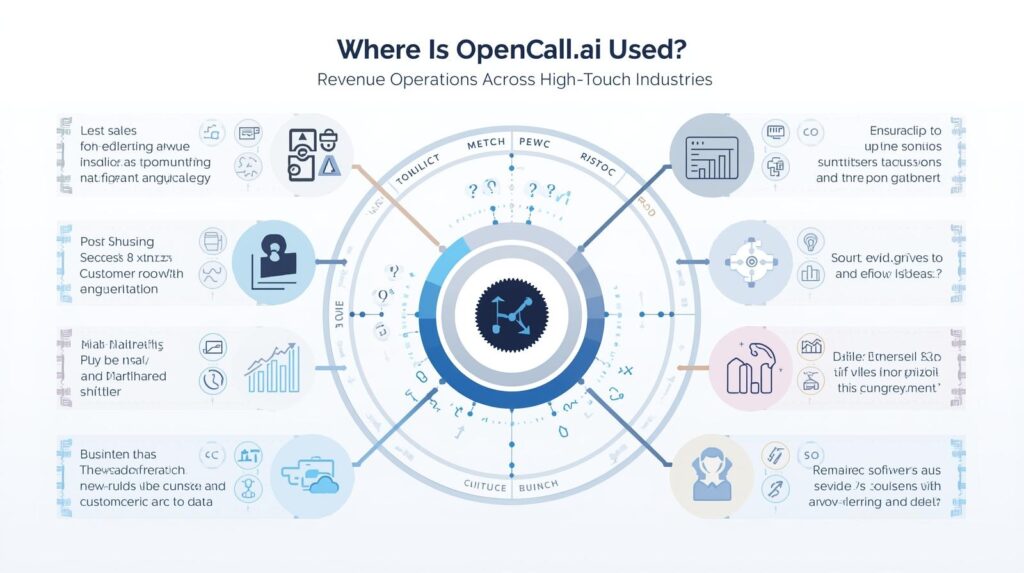
Revenue Operations Across High-Touch Industries
OpenCall.ai is deployed wherever scalable, human-like outbound calling drives pipeline and revenue:
- SaaS companies: Qualifying inbound leads 24/7, booking demos for high-intent sign-ups, and re-engaging trial users before churn
- Staffing and recruiting firms: Screening candidates for availability, experience, and interest; scheduling interviews at scale
- Real estate agencies: Following up on listing inquiries, qualifying buyer budgets, and booking property tours within minutes of form submission
- Local services (HVAC, roofing, legal, dental): Converting web leads into booked appointments within 5 minutes—critical for high-intent local search
- Market research firms: Conducting short surveys or preference checks via voice with higher completion rates than email or SMS
- B2B sales teams: Executing multi-touch cadences that blend email, SMS, and AI calls for maximum response (e.g., “Call after 2 emails and 1 SMS”)
OpenCall.ai supports both high-volume lead follow-up and targeted account-based outreach ensuring no lead goes cold due to human bandwidth limits.
When Did OpenCall.ai Emerge?
From AI Voice Experiments to Revenue Automation
OpenCall.ai was founded in 2022 by AI and sales technology veterans who recognized that while email and chat automation had matured, voice the highest-converting channel remained stubbornly manual. The platform launched in 2023 with a focus on appointment setting for local businesses, using proprietary voice synthesis and natural language understanding models fine-tuned on thousands of sales calls. By 2024, it expanded to enterprise SaaS and staffing verticals, added CRM-native integrations, and introduced multi-turn objection handling (e.g., “I’m not interested” → “Totally understand is now just a bad time, or should I follow up next quarter?”). In 2025, OpenCall.ai added real-time sentiment adaptation, multilingual support (English, Spanish, French), and SOC 2 compliance establishing itself as a leader in ethical, high-performance AI calling.
Why Does OpenCall.ai Exist?

Solving the Lead Response and Scale Gap
OpenCall.ai exists because 80 percent of sales leads go uncontacted or are followed up too slowly, and human reps can only make 30 to 50 calls per day. Meanwhile, speed-to-lead is the number one predictor of conversion calls within 5 minutes are 9 times more likely to connect and 39 times more likely to qualify (InsideSales, 2024). Traditional solutions like call centers are expensive; robocalls are ineffective and often illegal. OpenCall.ai answers a critical need: How can companies engage every lead instantly, at scale, with a human-like experience without hiring armies of reps? Its purpose is to make outbound calling reliable, scalable, and revenue-generating so sales teams focus on closing, not dialing.
How Is OpenCall.ai Built?
Architecture and Core Components
OpenCall.ai’s platform combines generative AI, telephony, and sales workflow automation in a unified system:
- AI Voice Agent Engine: Proprietary large language and speech models trained on thousands of sales calls to generate natural, responsive dialogue with realistic intonation, pacing, and emotional prosody
- Real-Time Speech Processing: Low-latency automatic speech recognition (ASR) and text-to-speech (TTS) that adapts to accents, background noise, and interruptions—ensuring <1 second response time
- Sales Logic Layer: Configurable call flows with branching logic for objections, qualifying questions, and dynamic script adaptation (e.g., “If budget = ‘under $10K,’ pivot to Starter plan”)
- Integration Framework: Native sync with Google Calendar, Salesforce, HubSpot, Outreach, and Zapier to push bookings and update lead status automatically
- Compliance Safeguards: Built-in TCPA, Do Not Call list, and STIR/SHAKEN validation; mandatory AI disclosure at call start
All calls are placed via compliant telephony partners (Twilio, Bandwidth) with 99.95 percent uptime SLA. The system runs on secure cloud infrastructure with daily model retraining and human-in-the-loop quality assurance.
Why Is OpenCall.ai Necessary?
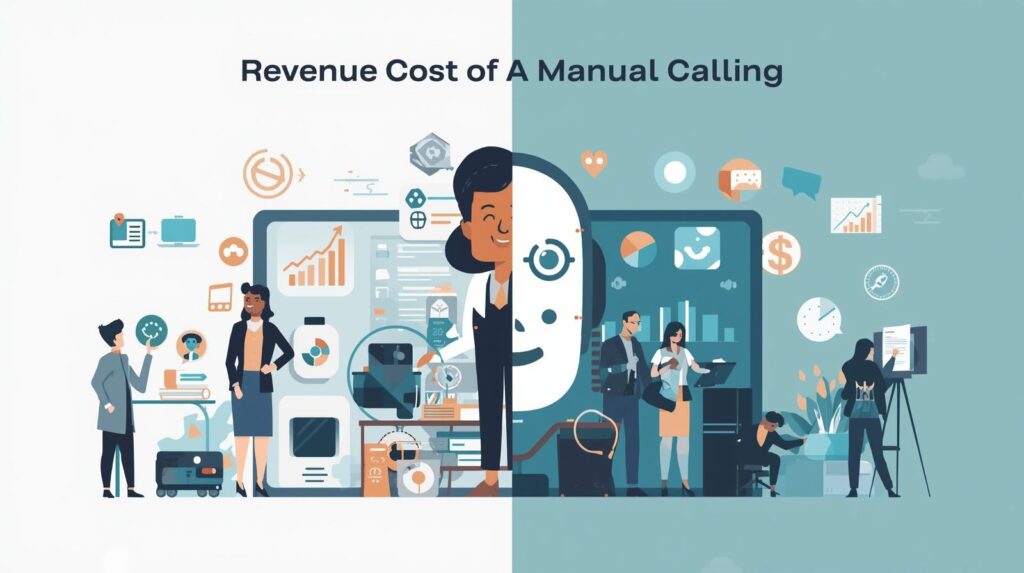
The Revenue Cost of Manual Calling
OpenCall.ai is necessary because slow or inconsistent lead follow-up directly leaks revenue. It is essential because:
- Leads go cold within minutes, not hours—response time is the top conversion driver
- Human reps waste 60 percent of dialing time on disconnected numbers, voicemails, and unqualified leads
- Scaling outbound requires hiring, training, and managing large call centers costing $40 to $60 per hour per rep
- Compliance risks (e.g., TCPA violations) plague manual and robotic dialers, leading to six-figure fines
- Top reps spend too much time dialing and not enough time selling or strategizing
OpenCall.ai ensures every lead is contacted instantly, qualified accurately, and booked efficiently so pipeline never slips through the cracks.
Who Uses OpenCall.ai?
Target Users and Team Roles
OpenCall.ai serves revenue professionals across demand generation and sales:
- Sales Development Representatives (SDRs): Offload cold calling to AI, freeing time for high-value follow-ups and demos
- Recruiters and Sourcers: Scale candidate screening and interview scheduling without hiring coordinators
- Local Business Owners: Convert web leads into appointments 24/7 without staffing a call center
- Marketing Operations: Close the loop between campaign clicks and booked meetings with automated outreach
- Revenue Leaders: Achieve predictable pipeline generation with measurable, scalable ROI
The platform requires no technical setup—users configure campaigns via web dashboard in under 15 minutes.
Integration and Ecosystem
Connecting OpenCall.ai to Existing Revenue Tech
OpenCall.ai enhances—not replaces—existing sales stacks:
- CRM Sync: Push lead status, call notes, and booked meetings to Salesforce, HubSpot, or Outreach in real time
- Calendar Integration: Auto-book meetings into Google Calendar or Outlook with buffer time and time zone detection
- Lead Sources: Pull leads from web forms (Typeform, Jotform), landing pages (Unbounce, Instapage), or chatbots (Drift, Intercom)
- Analytics Platforms: Export call metrics to Tableau or Google Looker Studio for attribution modeling
- Dialer and Engagement Platforms: Complement human dialers (e.g., Salesloft, Outreach) by handling after-hours or overflow leads
These integrations ensure AI calling fits seamlessly into modern revenue operations.
Pricing and Accessibility
Performance-Based Plans for ROI Alignment
OpenCall.ai offers transparent, outcome-focused pricing:
- Starter Plan: 299 dollars per month includes 500 minutes of AI calling, basic integrations, and email support
- Growth Plan: 799 dollars per month includes 2,000 minutes, CRM sync, objection handling, and priority support
- Enterprise Plan: Custom pricing includes unlimited minutes, multilingual agents, dedicated success manager, and SOC 2 compliance
All plans include free onboarding, script optimization, and A/B testing. Pricing is often structured as cost per booked meeting (e.g., $15 to $25 per qualified appointment), aligning cost directly with results.
Future Roadmap
What’s Next for OpenCall.ai
OpenCall.ai is expanding its capabilities to deepen sales impact:
- AI Deal Coaching: Analyze call transcripts to provide reps with personalized feedback on objection handling and pitch effectiveness
- Voice Cloning (Opt-In): Allow reps to use their own voice for AI calls (with explicit consent and compliance safeguards)
- Multilingual Expansion: Add German, Portuguese, and Japanese support for global outreach
- Predictive Dialing: Integrate with human SDRs to route warm leads (e.g., “Prospect said ‘maybe’ transfer to rep”)
- Sentiment-Driven Scripting: Dynamically adjust tone and messaging based on real-time emotional cues (e.g., more empathetic for frustrated prospects)
These innovations aim to make OpenCall.ai not just a calling tool, but an intelligent revenue co-pilot.
Benefits of OpenCall.ai
Strategic and Operational Impact
Faster Lead Response
Contact leads within seconds of form submission boosting connect rates by 3 to 5 times and qualification rates by 2 times.
Higher Conversion at Scale
Book 20 to 50 plus qualified meetings per day per campaign without additional headcount—scaling pipeline linearly with budget.
Reduced CAC
Lower cost per acquisition by automating top-of-funnel outreach typical payback in under 30 days.
24/7 Availability
Engage leads across time zones without staffing night shifts or weekend coverage.
Full Compliance
Built-in TCPA, GDPR, and Do Not Call list adherence with clear AI disclosure—reducing legal risk.
Improved Rep Productivity
Free SDRs from dialing to focus on high-value conversations and relationship building.
Advantages and Disadvantages
Key Advantages

OpenCall.ai delivers one of the most human-like, compliant, and conversion-optimized AI calling experiences available. Its voice agents handle real-time dialogue not pre-recorded scripts making interactions feel authentic and adaptive. The platform is purpose-built for sales, with deep CRM integrations and objection-handling logic that generic voice AI lacks. Pricing is performance-based, aligning cost with results. Most importantly, it turns voice from a bottleneck into a scalable growth lever without sacrificing ethics or effectiveness.
Notable Disadvantages
OpenCall.ai is designed for structured, goal-oriented calls (e.g., qualification, booking)—not open-ended discovery or complex negotiations. While voice quality is high, some prospects may still prefer human interaction, requiring seamless handoff protocols. Regulatory landscapes for AI calling vary by region (e.g., stricter rules in the EU under GDPR), limiting global use. Setup requires crafting effective call scripts and training the AI on brand-specific language—though OpenCall provides templates and consulting. And because it relies on telephony, call quality can be affected by carrier issues or poor prospect audio.
Conclusion
The Always-On Sales Rep
OpenCall.ai operates tirelessly but its impact is measured in booked demos, closed deals, and recovered revenue. In an era where speed and scale define sales success, it provides the missing layer between lead capture and human engagement.
It is not about replacing salespeople. It is about ensuring no opportunity is lost to delay or distraction. For revenue teams serious about pipeline velocity, conversion, and efficiency, OpenCall.ai is not just a calling tool. It is the always-on front line of modern sales.