What Is Bizagi?
Defining the Concept
Bizagi refers to a low-code business process automation and workflow management platform that enables organizations to model, automate, execute, and optimize end-to-end business processes with minimal coding. Unlike generic automation tools that focus on task-level scripting, Bizagi centers on process intelligence allowing business analysts, operations teams, and IT professionals to visually design, simulate, and deploy complex workflows that span people, systems, and data. By combining process modeling (BPMN 2.0), case management, rules engines, and integration capabilities, Bizagi turns abstract process diagrams into live, executable applications that drive efficiency, compliance, and continuous improvement across the enterprise.
What Information Is Included?
Process, Data, and Governance Scope
Bizagi manages three core types of information:
- Process models: Visual workflows built using BPMN (Business Process Model and Notation) that define tasks, decisions, roles, and system interactions
- Operational data: Case details, forms, documents, and user inputs generated during process execution (e.g., loan applications, service requests, onboarding records)
- Analytics and KPIs: Metrics like cycle time, bottlenecks, error rates, and user performance tracked in real time
All data resides within the organization’s infrastructure—on-premise, private cloud, or secure public cloud and is governed by role-based access controls. it does not store or use customer process data for its own AI training or external purposes. Sensitive information (e.g., PII, financial data) can be encrypted, masked, or redacted based on compliance policies, and audit logs capture every action for traceability.
Where Is Bizagi Used?
Industry Applications and Operational Contexts
Bizagi is deployed in organizations where structured, auditable, and scalable processes are critical:
- Banking and financial services: Automating loan origination, KYC/AML checks, fraud investigations, and account opening
- Insurance: Managing claims processing, policy administration, and underwriting workflows
- Healthcare: Coordinating patient intake, referral management, and regulatory compliance (e.g., HIPAA-aligned processes)
- Government and public sector: Streamlining citizen services, permit approvals, and internal HR or procurement workflows
- Manufacturing and logistics: Handling quality inspections, supplier onboarding, and maintenance requests
- Retail and telecom: Managing customer onboarding, service provisioning, and complaint resolution
It integrates with ERP (SAP, Oracle), CRM (Salesforce), databases, email, and legacy systems via APIs, web services, or connectors ensuring processes bridge both digital and human touchpoints.
When Did Bizagi Emerge?
From Process Modeling to Intelligent Automation
Founded in 2000, Bizagi began as a BPM (Business Process Management) modeling tool for analysts. It evolved through the 2010s into a full low-code automation platform, and by the early-to-mid 2020s, it integrated AI-driven process mining, predictive analytics, and adaptive case management. This transformation reflected a broader shift: from documenting processes to executing and optimizing them in real time. Bizagi’s cloud-native offering, it Studio and Automation Platform, now supports agile, citizen-led development while maintaining enterprise-grade governance.
Why Does Bizagi Exist?
Bridging the Gap Between Business and IT
Bizagi exists because most business processes are too complex for spreadsheets or basic forms, yet too dynamic for rigid custom software. Traditional IT development is slow and expensive, while business teams lack tools to build robust applications themselves. Bizagi answers a fundamental need: How can business experts design and own their own digital workflows without waiting months for IT? Its mission is to democratize process automation by putting powerful, visual, and compliant tools directly in the hands of those who understand the work best.
How Is Bizagi Built?
Architecture and Core Components
Bizagi’s platform is built around three integrated layers:
- Bizagi Modeler: A desktop tool for designing BPMN-compliant process diagrams with forms, rules, and data models
- Bizagi Studio: A web-based environment to refine, test, and publish processes as live applications
- Bizagi Automation: The runtime engine that executes workflows, manages user tasks, enforces business rules, and logs performance
Key capabilities include drag-and-drop form builders, decision tables, role-based task routing, real-time dashboards, and REST/SOAP integration. Recent versions add AI-powered process recommendations (e.g., “This step causes 70% of delays”) and simulation modes to test changes before deployment—all within a governed, version-controlled environment.
Why Is Bizagi Necessary?
The Need for Process-Centric Digital Transformation
Bizagi is necessary because digital transformation fails when it ignores how work actually flows. It is essential because:
- Siloed systems and manual handoffs create friction, errors, and poor customer experiences
- Regulatory compliance requires documented, consistent, and auditable processes
- Business agility depends on the ability to quickly adapt workflows to market changes
- IT backlogs prevent timely process improvements without low-code empowerment
- Data trapped in unstructured workflows cannot fuel analytics or AI
Bizagi ensures that automation is not just about technology but about how work gets done.
Benefits of Bizagi
Operational, Strategic, and Cultural Advantages
Faster Process Deployment
Business teams can build and launch applications in days or weeks, not months.
Improved Compliance and Consistency
Standardized workflows reduce deviation and ensure regulatory adherence.
Enhanced Visibility
Real-time dashboards show bottlenecks, SLA breaches, and team performance.
Strong Business-IT Collaboration
Business owns the logic; IT provides governance, security, and integration support.
Continuous Optimization
Process mining and analytics enable data-driven refinement over time.
Advantages and Disadvantages
Key Advantages
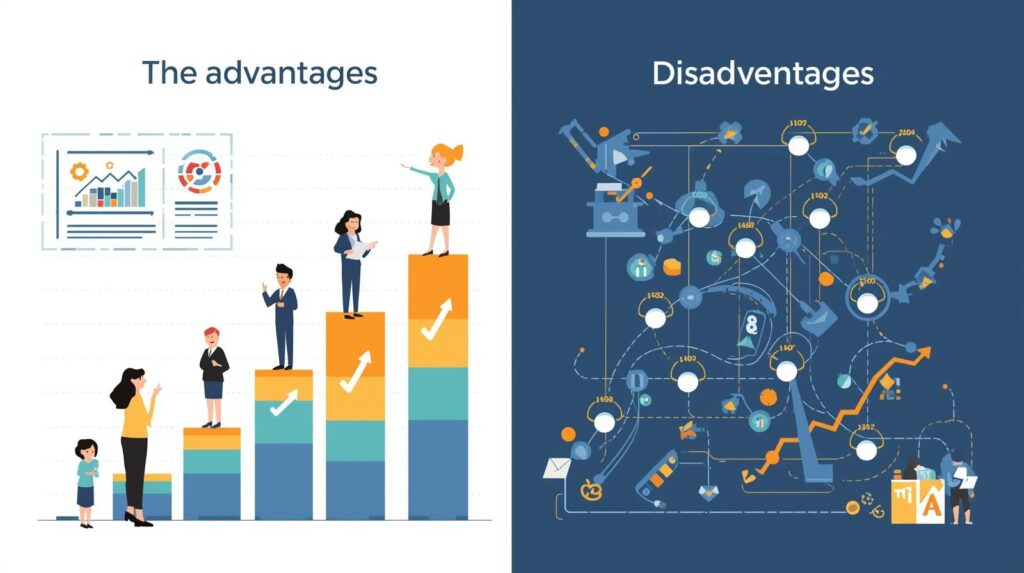
Bizagi excels at modeling and automating human-centric, rule-based processes that involve approvals, reviews, and multi-system coordination. Its BPMN foundation ensures clarity and industry alignment. The low-code approach accelerates time-to-value while maintaining structure. Strong auditability and compliance features make it ideal for regulated industries. Most importantly, it fosters a culture where business units become active participants in digital innovation.
Notable Disadvantages
Bizagi is less suited for high-volume, transactional automation (e.g., data ingestion at scale) where RPA or ETL tools may be better. Complex integrations with niche legacy systems can require custom development. The learning curve for advanced features (e.g., expressions, event handling) may challenge non-technical users. Licensing costs can be significant for large deployments. And while it supports mobile access, the primary design experience remains desktop-focused.
Conclusion
The Engine of Process-Led Enterprise Agility
Bizagi represents a mature, disciplined approach to automation—one rooted not in AI hype, but in the timeless need to understand, execute, and improve how work flows. In a world racing toward agentic AI and autonomous systems, it reminds us that many of the most impactful automations still involve people, decisions, and structured collaboration.
It is not about replacing humans with robots. It is about giving humans the right digital scaffolding to work smarter, faster, and more consistently. For organizations serious about operational excellence, Bizagi isn’t just a platform. It’s a philosophy of process-first transformation.